
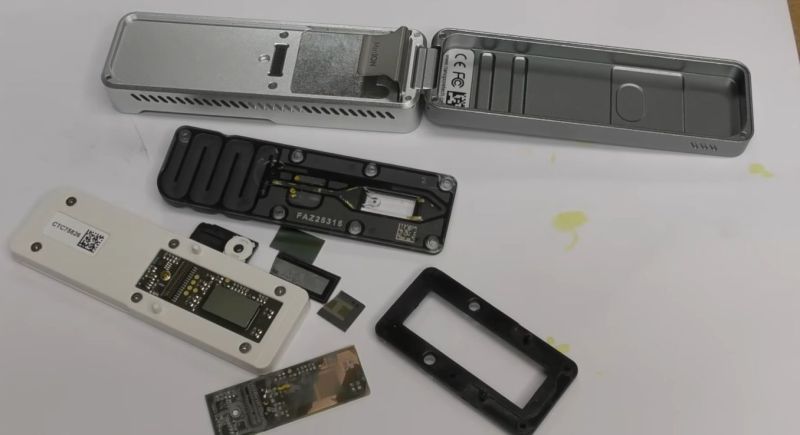
For most people the term ‘DNA sequencing’ probably brings to mind large, expensive laboratory equipment in sterile rooms, but over the past decades technological progress really has had its way with it, to the point where it’s now just another small portable device. Something like the Oxford Nanopore MinION unit that [Mike] recently took to bits to ogle at the intricate insides.
This device was trialed in 2014 in a limited release before its commercial release in 2015, with this paper by [Miten Jain] et al. in Genome Biology detailing the workings of this nanopore sequencer. At a mere $2,000 it’s rather remarkable how affordable it is, though this comes with the caveat of the consumables, which are also shown in the video. These come in at a cool £690 per unit, can sequence either RNA or DNA and can be used at most a few times before they need to be replaced.
The main unit is fairly simple, featuring a Xilinx Spartan 6 FPGA and a rather nice slim fan-based cooling solution. For the nanopore unit you get the typical microfluidics system, to guide the deposited fluid containing the genetic material to sequence over the nanopore system. In here we see the actual magic as well, in the form of the high-density pitch ICs on both sides of the PCB inside the consumable sequencer unit.
Although this particular unit got discontinued already, the consumables are still available for it if you are feeling the sequencing itch. Of course, we’re likely to see the costs for DNA and RNA sequencing to keep plummeting, as what were once complex chips get overtaken once again by the progress of technology.












DNA sequencing can be quite cool or it can be devastating.
I recently got it done on insistence of a parent (who’s a doctor). It revealed a lot of things, like how I’m my vitamin B12 deficiency is genetic from something called “methylation” (or lack thereof, I have no idea, the geneticist interpreted the report for us). Another thing that was revealed was my sensitivity to caffeine, I had lower ability to metabolise caffeine so it would affect me more and for longer (I had known this for years after being unable to sleep from a few sips of coffee that my univ roommate drank before going to bed!). Also salt sensitivity, even a modest amount makes my BP shoot up.
In the end I had to settle for low salt food, B12 supplements, and mushroom coffee. It was a lousy trade but I took it for the sake of health.
I recommend you to get it done too if you can afford it, and get the report interpreted by a geneticist. It provides great insights.
If you can stomach sharing your genetic material with a company. I’m not very comfortable with the fact, but I did it, and personally for me, it was worth it I feel.
That’s the issue – I’d do it quite happily if I knew that only I would have access to the information and maybe the company would store it but in a secure way and with no possibility of it ever being shared or sold.
But careful about the respective company and local data regulation. You don’t want your DNA data in the hands of some data broker.
It is an information so secret that you literally spread it on anything you touch. Good luck preventing a collect.
MTHFR Genotyping doesn’t require sequencing. In many respects, SNP panels give a better picture of a genetic variation since it is a much more reliable test method compared to [relatively] error prone rapid sequencing. It does however require knowledge of what genes are important and which genes are not, then designing molecular diagnostic assays that target single nucleotide polymorphisms for each of those genes and can support rapid diagnostic chemistries. Both roads lead to Gattaca-esque dystopian insurance practices and potential genetic discrimination if it is not used with extreme ethical standards.
” no possibility of it ever being shared or sold.”
If it is a US company, you can bet it will be sold. :(
That is really intriguing, and the consumable actually looks like something the crazy home fab folks might be able to do – unless i missed something it seems like the features are actually relatively large.
the issue is organic micropores are extremely hard to produce and not destroy. not impossible, but the chips essentially have to stay wet or the pores die off. that leads to all sorts of challenges afterwards. not to mention the micro impedance they are measuring to determine which atc or g is coming through. really cool tech for insanely low price. the larger versions have been able to sequence an entire genome in 4 hours! I love how the future is finally here.
Fantastically cool. I’m always looking for ways to incorporate this in my actual work, but they have the downside of high per-base error rates (so you need a ton of depth to compensate). This downside is offset by the huge read lengths it can generate, some as long as whole genomes, depending on the organism.
In terms of re-using these, the flow-cells are where to cost is, and those take a protein complex to work. I would be so excited to see someone home brewing that.
Here is an example of the use of MinION in home settings “How I sequenced my genome at home – home-seq” https://iwantosequencemygenomeathome.com/