
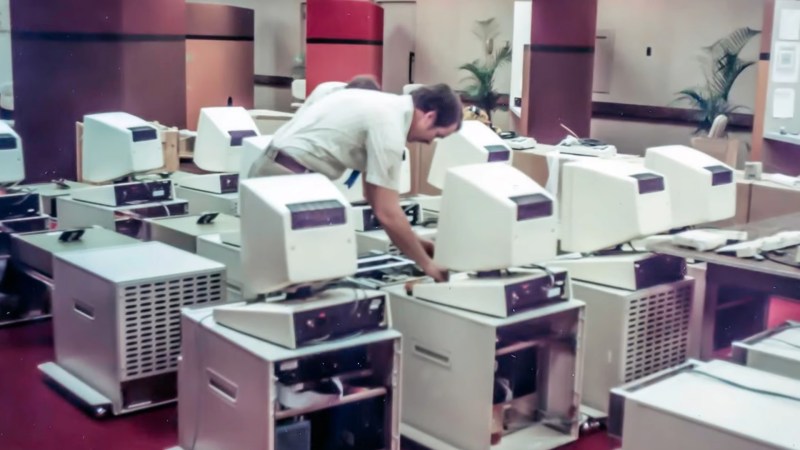
You’ve almost certainly heard of the Xerox Alto, the machine that pioneered the desktop-mouse-keyboard interface and inspired Steve Jobs to produce the Apple Lisa and Macintosh computers. It wasn’t just having a desktop, though– so much of our modern computing paradigm was invented on these machines. Given that, why aren’t we all using Xerox clones instead of Apples or PCs descended from the IBM compatibles? [Ctrl+Alt+Fail] has a video that answers the question: whatever happened to the computer of tomorrow, anyway?
It goes through the whole story of the Alto, from its introduction at Xerox PARC in the 1970s to its demise. At the introduction, the engineers showed of the What You See Is What You Get word processor, networked the machines together to show off e-mail and that anyone could use the office laser printer. It all seems very familiar now, but at the time, it was a revolution. An expensive one. The monitor sitting on the desk wasn’t the computer, after all: that was a large filing-cabinet sized desk sitting underneath. Only about 2000 were ever built, so what happened?
It wasn’t just that the first units cost twelve grand USD to build in 1973 money– about 90 large today by CPI, or for the gold bugs that’s 96 oz or 2.7 kg. It wasn’t worth its weight in gold, but it was close. Still, that wasn’t the problem: later models would be cheaper. The problem was that Xerox refused to sell the thing in the 70s. They saw the potential of a paperless office, and it scared them. Sure, they could sell a computer, once. They wouldn’t get a monthly service fee, nor the cost of the toner, drums and other consumables the Alto wouldn’t need. So they sat on it, and let others like Steve Jobs who didn’t have an existing business empire to lose take their ideas and run with them.
It seems shortsighted, but Xerox had already lost millions on big iron computing around the same time the Alto came along, and every business decision after that was carefully weighed on its projected revenue. Compared to a copier that printed money for Xerox as surely as it printed paper, the Alto just didn’t look like it could pay for itself. It looked likely to lose them a lot of money, which, in fact the adoption of the personal computer ultimately did. Hindsight is 20/20 and it’s easy to play Monday Morning Quarterback and say these developments were inevitable and Xerox should have run out in front, but [Ctrl+Alt+Fail] does a good job of explaining the logic from the Xerox boards’ point of view, which makes the video very much worth a watch.
If you can’t get enough Alto, we can also point you to what it takes to restore one, what almost killed one, and why you shouldn’t mine bitcoin with one.












Reminds me “The Mouse?” episode of Pirates of Silicon Valley
https://www.youtube.com/watch?v=R0j7zdVJnus
It is always insane how short sighted businesses people like this are. Surely even if it will make your current business obsolete, you must realise that you have stolen a march on your competitors who will no doubt develop the technology once it becomes obvious it is possible?
You say all that with the reinforcement of foresight. Back then they didn’t have that.
Reinforcement of hindsight?
This was just an implementation of the Dynabook concept of 1968. But quite bad, because it did not fit in the pocket as promised.
Still, considering we went from primitive dit-dat of an RTTY in 1920s to Quake 3 Arena in 1990s it’s pretty impressive growth and I doubt it will happen again for a long time.
Renewables have been on a pretty fast curve – nowhere near Moore’s law but the price per kWh for solar / wind / battery has plummeted in the last decade and is still going, and growth is going up on a similar trend too.
Part of that is driven by predatory business tactics and crony capitalism, so predicting growth and estimating true cost is a little uncertain. Both sides of the supply/demand equation are hiding the true cost from the market by subsidizing: the Chinese in order to capture and monopolize the market to themselves, and the western nations to pay political favors to the renewables industry.
While this is technically beneficial in the environmental sense, more renewable energy is good, the situation is not exactly economically sustainable and may result in a market crash.
It’s not as simple as it sounds.
At the time, Xerox was in trouble. On the one hand they were being investigated by the US government over concerns that they were abusing their market power in photocopiers while at the same time companies out of Japan were starting to release competing photocopiers. They were too busy trying to find a way to stop the Japanese while convincing the US government that the Japanese competition was in fact good and the reason why they were not in fact abusing their market power which meant they had no spare resources to focus on anything else.
They were also worried that moving further into computers could lead to allegations that they were abusing their market power in photocopying to gain an advantage in the computer market. And at the time, there was no real market for what Xerox had. What businesses wanted (and were buying) at the time were dedicated “word processors” that were basically an evolution of the typewriter.
Another example of the irreparable harm that antitrust laws do.
… that antitrust laws DID.
Right now I can spot no less than two dozens of cartels that need to be broken up. Cartels, because they are no longer properly regulated, and certainly NOT harmed in any noticeable way by the few regulations that are still in place. I can name one, Conagra, but there are other similar kinds, out of sight, out of mind, but still there.
That’s a narrow take – looking around the corporate landscape right now would suggest we need stronger anti-trust / anti-monopoly laws not weaker.
As opposed to the much worse harm done by monopolies and the abuse of the customer and markets caused by the monopolies.
Competition is good and needed. Monopolies kill markets and innovation and raise costs for the customers.
Antitrust laws are needed to prevent the corporations from abusing the markets and the customers.
There seems to be a parallel here with Kodak and the invention of the digital camera.
Kodak Photo CD standard! 😃 It was being supported by Philips CD-i players, too!
They also worked on the infamous Hotel Mario game…
Kodak’s invention of the digital camera wasn’t a reference to Photo CDs. It was invented in 1975 using the first CCD chips and stored its 100×100 pixel image onto cassette tape. PhotoCDs appeared 20 years later (ish).
https://www.bbc.co.uk/future/article/20251205-how-the-handheld-digital-camera-was-born
Interesting. Here in W-Germany, monochrome tube cameras were still “normal” by ca. late 80s/early 90s.
They had been used in security/surveilance, for example.
The high resolution of up to 800 or 1000 lines was great.
Then, by early 90s, these cute little CCD camera modules with analog AV out became publicly known.
Picture quality was still inferior to Vidicon or Orthicon, of course.
These CCD models had been used in model railroad hobby, for example.
Color models existed, too, but their picture quality was still fuzzy.
The b/w models were quite lower in price, also.
Then webcams such as Connectix Quickcam or that SGI camera appeared, too.
I went to a presentation by some Kodak guy at a Palo Alto camera store who was trying to pitch machines whose sole purpose was to read and display their new photos CDs. They wanted to perpetuate the slide projector. I told him that nobody wanted that — they wanted a reader that could import the digital images into their computers. He was not pleased to get my feedback.
In this context don’t forget the more successful Three Rivers PERQ (in the UK sold by ICL) in the late 70s, early 80s. Quite popular in universities in science and engineering. After playing with one I saw the future and was so blown away I saved up and bought an Apple Lisa !
Having worked on both the alto and the perq, the perq was setup for more mass market.
Intran was selling them to insurance companies by the dozens.
DigiBarn Stories: The Intran Story (as told by those who were there) https://share.google/lim5czFcCvDOgqm8h
I still have my ICL microcode manual on my shelf!
Had Xerox kept the pirates at bay, and used the proceeds to get into aerospace as Elon later did…. perhaps we would be closer to the 2001: Space Odyssey model, with no Tech-bro antics.
Xerox might have been better stewards…they and Kodak working together might have improved lithography will less interruptions and perhaps gave us 3D printing earlier.
I am all about support for the MAKE movement, but both GE and GM at their height were about systems… stability.
A place for everything–and everything in its place.
This was the second example where well meaning government oversight actually made things worse in terms of products.
Progressives went after the “electric cab trust” that held the internal combustion engine patent…with it considered only for the Otto, EVs took a hit.
Same here.
Hate tech-bros? Thank the busy-bodies that went after Xerox.
It’s been insinuated that the tech Xerox developed was “stolen”. No. They made a product that they couldn’t sell. So they sold the rights to the tech to recover their investment and narrowed their focus on office copiers. This is not unusual in such business.
Plus, they already had the eye of the feds on them for their dominance of the office copier market, going far beyond protecting their patents. The divestiture of PC/terminal tech was a good move from a legal standpoint. It’s a supreme irony that IBM, of all companies, picked up the mantle in that market, considering IBM’s own market dominance strategies. “Exception that proves the rule”, I guess.
At the time, the feds were on the rampage with the Sherman and Clayton Acts for companies like Bell/AT&T monopolizing their tech. You literally couldn’t purchase a telephone unless it was made by them. The feds were even diving deep, like looking into the auto industry’s trolling smaller companies in court about using transistors in windshield wiper intermittent delay circuits. Xerox didn’t want to be another Ma Bell.
Actually, I think this was “normal”:
Wise companies used to have a team of free-thinking tinkerers in the cellar that would develop various things they thought would be interesting.
The commercial aspect wasn’t in focus, it was about collecting ideas and solutions.
There is a functioning Xerox Alto at the System Source Computer Museum in Hunt Valley, Maryland. The museum is well worth a visit if you are in the area.
Obvious AI-slop voice is obvious. Pretty hard not to notice, when the voice says “I E E E” where any knowledgeable human would say what everyone else does, “I triple-E”. There are also various other stilted pronunciations. Shame on you for promoting an AI-slop YouTube channel, Tyler.
The YouTube channel Ctrl+Alt+Fail is an AI slop-fest. Every single one of their videos begins with “On {$date} {$name} walked into a room at {$place}…” We’re then treated to an AI-slop narration that repeats a grab bag of random information over and over while showing a slide show of photos, some of them having nothing at all to do with the topic. The videos never seem to get to any point or build any sort of story or argument.
Your slop is another man’s dinner. If people want to get creative, why are you against?
It is a rather complicated story and on the Apple side it coincides with the period where Steve Jobs and Jef Raskin were inseparable and brainstorming on long walks all the time. Raskin’s employee number was somewhere in the 30’s I think. 31 maybe. I know his personal assistant was number 49 and the late Bill Atkinson was number 51. Raskin had been studying human interface problems since the 1960’s and had seen the Engelbart demonstrations of the mouse and menus in 1968. His Macintosh project began with his vision of a more text based interface (Canon Cat). He took his small crew to visit PARC at one point and on the way back Atkinson said they are doing menus and graphics all wrong. Jef had also remarked on the menus. They had missed the mark on what he called “infinite depth” targeting. Obvious today, it meant menus across the top of the screen (or anywhere on the edges) and you can just slam the mouse in the general direction as opposed to hover and click on something. We all use it today without thinking. I think for the graphics remark that Atkinson meant that PARC was using the center of a pixel as the origin (Like Windows did IIRC) instead of the intersections between pixels, which makes the math so much cleaner.
At Boeing in the late 70’s the 7N7 project was underway with a VAX11/780 in each of 4 or 5 sites with one for each major group – Structures, Aerodynamics, Propulsion, Avionics, etc. I recall there was an Alto in at least one of the sites along with a Tek storage display terminal that did graphics and a monochrome and a color Vector General high resolution terminals. Nobody used the Alto except to fiddle with the draw program.
Infinite depth targeting has largely lost its purpose nowadays. Even novice computer users can aim well because the pointing devices are fast and accurate. The screens are so large that moving the cursor all the way to the top of the screen is more trouble than just aiming a bit more accurately at the menu bar of the current window.
Seeing how OS with Desktop GUI is now pretty much in every OS regardless makes me think that, perhaps, average corporate office never needed things that are way too advanced.
However, and after thinking this for awhile, I came to the conclusion that maybe we already have everything average office needs. Home Office – even more so, we now have fully integrated Everything, Communications (email, voice calls, virtual meetings), Documents (Word processing, unlimited storage size, easy copying – Xerox no longer needed, average printer is the New Xerox), Rolodex, etc etc.
Point being, the last remaining piece, complete suit of communications, wasn’t present yet, only emails and slow speed dial-ups to distant servers, but now it is, real-life virtual document sharing, virtual face-to-face meetings, etc. Compared to 1970s, when telephone had its own dedicated network, printed documents still needed snail mail or pony express to deliver, forums most of the times were actual physical meetings you had to attend in person, etc.
Now, for the unclear (to me) part, some of things like Solid Works emerged elsewhere for reasons unrelated (dedicated industrial grade engineering/blueprinting), and back then (1970s) you’d need dedicated hardware to go with it to work properly.
I would say the particular industrial use probably was always something else, not exactly average office worker level. If I am to project this into 100 year old framework, while average office worker had telephone, rolodex, typewriter and office cabinet, it was not enough to operate large textile factory or build a ship (or operate a seaport – this was before airports were properly established, seaports WERE the airports of the past, in a sense). So while Xerox was trying the waters, it was in the business of, say, uprooting Cray, but more like generic direction, and if I would be the Board of Directors answering to investors that would probably be the same “which market segment are you targeting?”. Furthermore, I’d probably hold my chips betting with smaller-scale projects taking better hold, and Xerox investors probably won’t be thrilled with, say, investing in Amiga computers.
Though, hindsighting is easy, of course, I am sure the realities of something else (oil crisis, one example) were anything but convincing to continue with revolutionary concepts of unclear merit (at the time).
(on the topic of Oil Crisis – it showed just how incapable and largely uninventive average US corporations were).
Which oil crisis? The one in the early 1970s was due to Nixon’s price controls, aggravated by the Yom Kippur War. The 1979-1980 crisis was due to the Iranian Revolution. Both spurred introduction and production of more efficient cars, and more petroleum production. It takes time to create new cars (about 3 years) and government regulations don’t help.
Government regulations such as not bursting into flames when you open the door? Not crushing the occupants when you hit a pothole? Not poisoning the environment too much?
Luckily your new government is getting rid of all of that (including the antitrust laws you mentioned earlier), whilst simultaneously preventing you from buying cheap, clean, efficient EVs from overseas.
Have a nice day.
Funny, you trying to simplify the regulations to make them sound “obviously good” directly illustrates the problem. There’s not a single “non-combustion-on-door-open” line, there are paragraphs and paragraphs, and forms and inspections and then compliance audits. It’s very non-engineer to think regulations don’t involve tradeoffs, why should the lawyers get to break the iron triangle when we can’t?
You mention “cheap clean EVs from overseas” and “cars not bursting into flames when you open the door”. If you’re talking about Chinese EVs you obviously haven’t looked at all the videos of BYDs bursting into flames for no reason that manage to escape the CCPs censorship. And airbags that fail to deploy. When one of their cars goes up in flames the first thing the responders do is pry off all the car’s badges so you can’t tell what brand it is, then put up screens to keep people from recording. Then they look for survivors and try to put out the fire.
Do you have a link for that? I’m having trouble finding it myself.
I’d say both crisises.
True, corporations were forced to design and build more efficient cars – but those were already present, just not very popular, the likes of AMC (which absorbed Nash and Hudson), etc. I am kind of unclear how the need for more efficient cars didn’t result in something modern and better overall, but delivered mixed results, and while it was busy delivering mixed results, japanese car makers improved quality of their cars (not to mention japanese electronics – a separate topic of its own) and US car makers couldn’t keep up.
Regulations are easy to blame, and corporate propaganda likes to twist facts. I’ll point out one I’ve been personally witnessing for the last 30+ years, the number of dumb decisions made is about equal, for-profit corporations or government agencies (or non-profits). There are quite dumb people making careers working in both, and I would abstain from making for-profit corporations into suffering saints they actually not, most are doing handsomely well absorbing my taxes with nothing to show in return. GM alone received 1981 bailout moneys and returned not a lot overall, really, they couldn’t beat japanese car makers in their home turf.
Regulations-wise corporate propaganda (I call it “Red Propaganda” because it reminds me of one, straight from the 1970s) keeps forgetting successful regulations – I usually cite airplane tickets of the 1950 and 1960 that forced fledgling airlines into making things affordable to all – spurring pretty darn good industry growth that only tapered off around late 1990s (which kind of coincided with the long tail of the de-regulation, airplane tickets pricing was let loose something like decade earlier). Not only airlines, all the many sub-industries that grew with it, too, food preservation, navigation, infrastructure, which means construction machinery and civil engineering, etc etc. In very real sense it powered sizable chunks of the US economy for very, very long while, and we now actually need something comparable.
Back to the topic at hand, niches market exist, of course, they always did, say, educational institutions, but they are not really the economy drivers, just like sales of luxury yachts are, or political favors (oh, that’s HUGE market, barter economy, too), they may benefit certain investors’ pockets, but for the rest of us results are largely none.
I remain a home turf solipsist until I see what I’ve been asking for, a $15k EV car that last ~50 years, etc etc. Corporations delivering profits to their investors are good and all, but what do I have out of that deal? Where’s my product I need sold for the price I can afford? ‘Till then it is as good as looking at the Moon craters in the telescopes – they are decidedly there, but of no real use to me here, on Earth : ]
You should consider that Japan and Europe had a clean slate after WWII with new infrastructure and new machinery, and a lot of help from US treasure. The US had old old machinery and systems. Sure they product truly vast amounts of everything in the 3.5 years they were in the war from portable bridges to aircraft carriers. And England got screwed. Japan had newly designed cars and manufacturing because they could not make the old ones.
The question worth looking at is why did China not achieve the kinds of things Japan did? Or North Korea? Or India, which after the Raj was left packed with German And English heavy machinery – the stuff you see today in the videos from Pakistan and Northern India. What happened? What was the difference? Plus the US needed a different kind of car that reliably went 200,000 miles and would run the entire Route 66 and back (5,000 miles) without more than checking the oil. Or going to see Grandma the other side of Texas (700 miles). Or driving your sales route through the Midwest with all your samples and literature. And yes, government regulations were fierce and stupid. And they changed at a pace that far outstrips the rate at which new tooling can be produced and tested. The 1970’s and 80’s produced a lot of US cars that were just plain stupid. They were compromises made of the worst of design + the worst of regulation.
Someone knows, how many Altos went to Europe?
It has been said that Xerox “couldn’t market a cure for death”.
I saw this adage somewhere years ago:
“Never hesitate to undermine your existing product line,
because your competitors definitely won’t.”
This sounds like AI narration with unnatural phrase breaks etc. and I was sufficiently close to the early history of things like this that the poor presentation outweighs the likelihood that I’ll learn anything.