
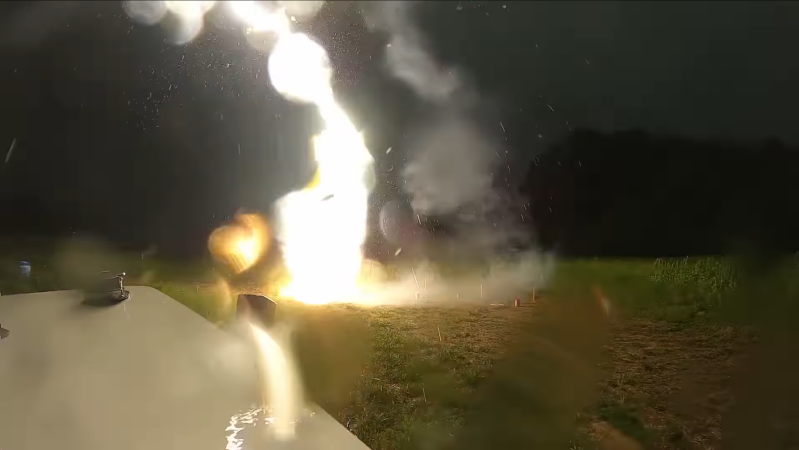
Lightning, despite being a common and readily-detected phenomenon, is nevertheless difficult to study. One reason is the difficulty of predicting when and where lightning will strike; tall structures do attract more lightning strikes, but it’s hard to move them into a storm’s path. Instead, researchers often use small rockets carrying a fine wire to trigger strikes, an approach [Electron Impressions] recently replicated (more details).
The science of this is less than straightforward: even in calm weather, there’s a surprisingly strong atmospheric electric field, about 100 volts per meter off the ground. During a thunderstorm, though, this can build up to kilovolts per meter, and may reverse polarity. When an updraft carries supercooled water, ice crystals, and graupel (ice particles formed by supercooled water freezing on a snowflake) upwards, the heavier graupel falls relative to the other components. As it collides with ice crystals, it builds up a negative charge and the crystals accumulate a positive charge; across a storm, this leads to positive charge building up near the top of clouds and negative charge near the bottom. Lightning equalizes this imbalance. In the relatively few cloud-to-ground strikes, a dielectric breakdown begins from both sides of the stroke, with leaders rising from the ground and descending from the cloud. The wire trailed by a rocket creates an artificial leader, ideally triggering a controlled strike.
To consistently get a strike, the rocket needs to be launched under a strongly-negatively-charged region of the cloud. An electric field mill measures the local field strength; these are usually quite expensive, but [Electron Impressions] managed to build his own. The rocket itself was 3D printed and designed to fly well under stormy conditions. It carried a strand of thin copper wire wound onto a plastic spool meant to minimize friction and prevent broken wires. The rocket’s igniter was waterproofed for storm conditions and remotely triggered using a walkie-talkie for safety.
After many attempts, [Electron Impressions] finally managed to trigger a strike and video the results. The first stroke created a plasma channel, along which several more strokes followed. This indicated that the cloud had probably been negatively charged, which was in agreement with the field mill’s measurements. The wind blew the plasma channel slightly to the side, where it caused a second rocket to explode on the ground. Both ignition systems were destroyed, and the remains of the rocket were never found. Sadly, the strike doesn’t seem to have formed a fulgurite, but it did fracture the ground as water flash-boiled.
For a more reusable solution, some researchers have also experimented with using drones to trigger lightning. There’s good reason for more study; the theory of lightning formation still has some major open questions.












I learned some stuff I didn’t know I needed to know there, thank you!
Doc could have used this to help Marty McFly back to the future
Not much that’s new in the world any more, is there?…
Martin Uman, the world’s acknowledged, leading expert on lightning, published his seminal work, Lightning, in 1984.
He has been triggering lightning strikes with rockets since…forever.
Uman is the chair of the Department of Electrical and Computer Engineering at the University of Florida and also leads the International Center for Lightning Research and Testing. He is the author of numerous books; Lightning (1984),
All About Lightning (1987), and The Lightning Discharge (1987), among them.
Some excerpts from interviews with Martin Uman:
“…The problem right after the Apollo event was for NASA to explain how they didn’t know that the rocket was going to get struck by lightning. But it took several years for people to figure out that it wasn’t struck by lightning—it made the lightning. And that when big objects like airplanes and space vehicles get into a cloud, they distort the situation so that lightning is produced even if that cloud was not going to produce lightning by itself. And it turned out that if you triggered lightning and made it come down a wire, you could study its properties…”
(Interviewer)”…Who, or what entity, had the idea to trigger lightning using rockets and wire to trigger lightning?”
(Uman) “It’s generally attributed to a guy named Morris Newman, who shot small rockets trailing wires off of a ship that he operated with an Air Force contract. He didn’t make any scientific measurements, not significant ones anyway, it was a demonstration for the military. And then after that, a group in France took it up…”
And now it’s available to citizen science.
I have no doubt that the mix of fear and excitement you feel when you summon a lightening bolt never gets old.
I was expecting the project being called “Thor”, since it is summoning Mjölnir no less : ]
Wouldnt it be called Mjölner (the name of Thors hammer), because when Thor uses it, it causes thunder and lightning?
Yes, Mjölner is good name for the rocket : – ]
Back in the 80s, NOVA on PBS did a series on lighting, and using rockets to trigger it. Never could find the episode later.
I think this is it
https://archive.org/details/WGBHLightning
Would be cool if the rocket left the launch-site, then at some point below the cloud it separated into two smaller rockets, one continuing up into the cloud carrying one end of the wire and the second, with the other end of the wire, returning to the ground next to someone you didn’t like.
That sounds like something Churchill’s toyshop would have tried.
Worth reading a few of the declassified materials floating around.
Wile E Coyote got something like that from Acme – it could never backfire in the turbulence of a thunderstorm, amirite?
Looks like a good way to execute treasonous North Korean generals.
I think I read some stuff a couple years ago about Raytheon making uv lasers that could ionize the air and be followed by zapping someone at a distance with a tazer-like weapon. I was wondering at the time if you could do this to trigger lightning, probably by using a reflecting mirror so your nice expensive uv laser didn’t get cooked. (Although air is opaque enough to UV that this may not have the range required.)
“If you point this laser on that cloud, you will see something very few people ever saw…”
South Dakota School of Mines meteorology department has a launch site for their lightning research program.
Why mines? Turns out underground explosives can be set off by surface lightning. Boom!
If the rocket is big enough, the ionized air from the engine can trigger lightning, as demonstrated by Apollo 12
Anyone remembers that kreosan video? https://www.youtube.com/watch?v=LKvE5CXlcaI
Redneck edition
https://m.youtube.com/shorts/sNb9MMzYbHI
6:37 – excellent view of the beads forming from twisted (z-pinched) plasma streams; if I remember right, those are proto-ball-lightnings, and with enough initial energy within they may sustain for some while until the reserve is exhausted and they disperse. (or they find a ground channel and collapse).
There is very good/thorough book with a dedicated/detailed chapter on the subject (ionized gas channel laminar flow breaking into beads), but I forgot the name. It is out of print, but can be found on them ebays.
I wonder if you could use a drone without destroying the drone, I mean maybe a very long non-conductive wire to pull a conductive one.
For if there is no wind for your kite.
Will the risk just be a strike or also the EMP you think?
I remember watching a video on exactly this topic way back in the early 2000s on Discovery Channel. I think then they used a rubber pipe with compressed air to fire the rockets in a way safe for the operators.
It would be nice if the power from the lightning could be used for something. Maybe capture it in a capacitor or use it to shrink coins.