The Physics Of Keeping Thermal Power Stations Cool

Recently thermal power stations have been in the news quite a bit, mostly in the context of them being throttled back or shut down due to the river water used to cool them either getting too warm or said river having dropped to a level where it can no longer provide cooling water. Obviously this is a problem, but it helps to understand how we got to this point and what can be done to fix it.

Thermal power stations – also called power plants – come in a wide variety of shapes and sizes, ranging from old-school coal- and gas-fueled power stations to modern nuclear power plants. Something like a concentrated solar power (CSP) station is also a thermal power station, as all of them have a heat source that’s used to generate electricity from, whether that’s a boiler, nuclear reactor core or a big vat of sodium heated up by the Sun via massive mirrors or oil-filled tubes in parabolic throughs.

Except for open-cycle gas turbines (OCGTs) – which are basically jet engines connected to a generator – this thermal energy is then used to generate steam that drives a steam turbine. Once most energy in the steam has been depleted, it has to be condensed back into e.g. water, so that it can be led back to the steam generator. How this condensing step is performed is the question here, with a number of methods available.

Continue reading “The Physics Of Keeping Thermal Power Stations Cool”
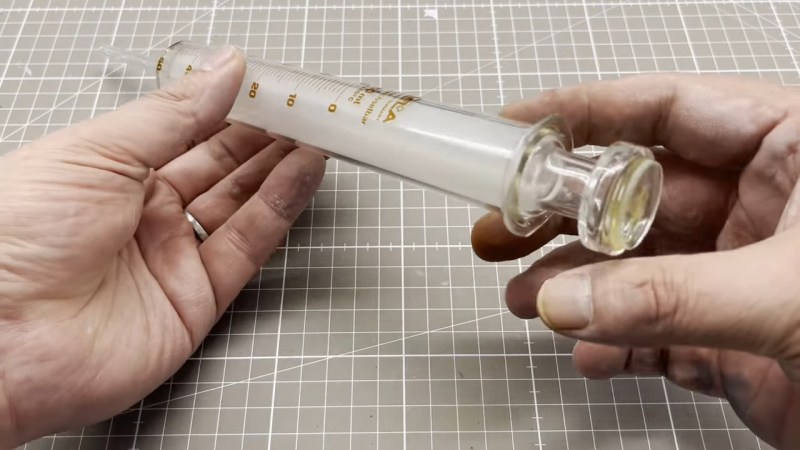
An Absolute Zero Of A Project

How would you go about determining absolute zero? Intuitively, it seems like you’d need some complicated physics setup with lasers and maybe some liquid helium. But as it turns out, all you need is some simple lab glassware and a heat gun. And a laser, of course.

To be clear, the method that [Markus Bindhammer] describes in the video below is only an estimation of absolute zero via Charles’s Law, which describes how gases expand when heated. To gather the needed data, [Marb] used a 50-ml glass syringe mounted horizontally on a stand and fitted with a thermocouple. Across from the plunger of the syringe he placed a VL6180 laser time-of-flight sensor, to measure the displacement of the plunger as the air within it expands.

Data from the TOF sensor and the thermocouple were recorded by a microcontroller as the air inside the syringe was gently heated. Plotting the volume of the gas versus the temperature results shows a nicely linear relationship, and the linear regression can be used to calculate the temperature at which the volume of the gas would be zero. The result: -268.82°C, or only about four degrees off from the accepted value of -273.15°. Not too shabby.

[Marb] has been on a tear lately with science projects like these; check out his open-source blood glucose measurement method or his all-in-one electrochemistry lab.

Continue reading “An Absolute Zero Of A Project”

Copper Bling Keeps Camera Chill

Every action camera these days seems prone to overheating and sudden shutdowns after mere minutes of continuous operation. It can be a real pain, especially when the only heat problem a photographer might face back in the day was fogged film from storing a camera in a hot car. Then again, the things a digital camera can do while it’s not overheated are pretty amazing compared to analog cameras. Win some, lose some, right?

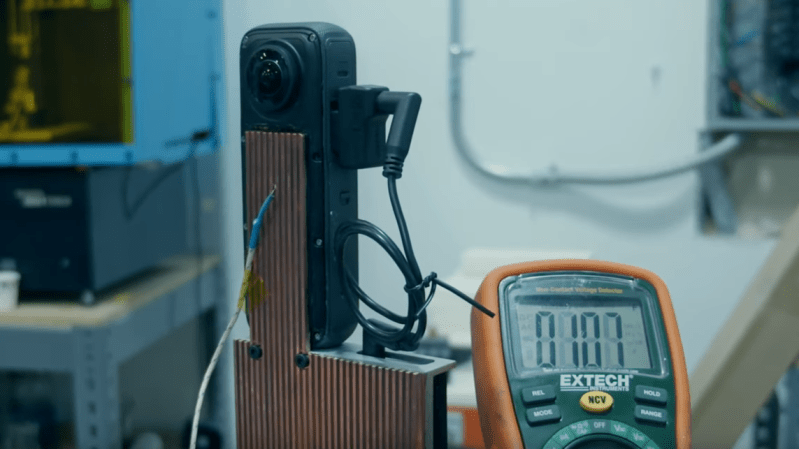
Maybe not. [Zachary Tong], having recently acquired an Insta360 digital camera, went to extremes to solve its overheating problem with this slick external heat sink project. The camera sports two image sensor assemblies back-to-back with fisheye lenses, allowing it to capture 360° images, but at the cost of rapidly overheating. [Zach]’s teardown revealed a pretty sophisticated thermal design that at least attempts to deal with the excess heat, including an aluminum heat spreader built into the case, which would be the target of the mod.

He attached a custom copper heatsink to a section of the heat spreader, which had been carefully milled flat to provide the best thermal contact. [Zach] used a fancy boron nitride heat transfer paste and attached the heat sink to the spreader with epoxy. A separate aluminum enclosure was bonded to the copper heat sink, giving [Zach] a place to mount his audio sync and timecode recorder and providing extra thermal mass.

Does it help? It sure seems to; where [Zach] was previously getting about twenty minutes before thermal shutdown with both cameras running, the heatsink-adorned rig was able to run about six times longer, with the battery giving out first. True, the heatsink takes away from the original sleek lines of the camera and might make it tough to use while snowboarding or surfing, but it’s still more portable than some external camera heatsinks we’ve seen. And besides, the copper is pretty gorgeous. Continue reading “Copper Bling Keeps Camera Chill”

A 1971 Thermos compliments this mid-century corner of my office.

The Incredible Tech Of The Vacuum-Seal Flask

I recently started using a 50-year-old vacuum-seal flask that belonged to my Grandpa so that I don’t have to leave the dungeon as often to procure more caffeine. Besides looking totally awesome on my side desk, this thing still works like new, at least as far as I can tell — it’s older than I am.

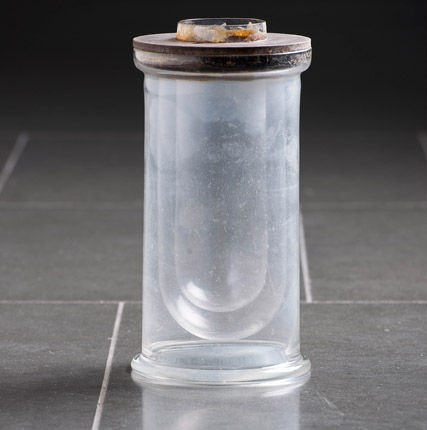
Sir James Dewar's original vacuum-seal flask.
Sir James Dewar’s original vacuum-seal flask. Image via the Royal Institute

Of course this got me to wondering how exactly vacuum-seal flasks, better known in household circles as Thermoses work, and how they were invented. The vacuum-seal flask is surprisingly old technology. It was first invented by Scottish chemist Sir James Dewar and presented to the Royal Institute in 1892. Six years later, he would be the first person to liquefy hydrogen and is considered a founding father of cryogenics. Continue reading “The Incredible Tech Of The Vacuum-Seal Flask”

Mechanical Engineering Hack Chat

Join us on Wednesday, September 30 at noon Pacific for the Mechanical Engineering Hack Chat with Adam Zeloof!

Almost every non-trivial project involves some level of cross-discipline work. If you build a robot, for instance, you need to worry not just about the electronics but also the mechanical design. You need to make sure that the parts you use will be strong enough to deal with the forces that it’ll face, you have to know how much power it’ll take to move your bot, and you have to deal with a thousand details, from heat flow to frictional losses to keeping things moving with bearing and seals.

Unfortunately for many of us, the mechanical engineering aspects of a project are foreign territory. We lack the skills to properly design mechanical systems, and so resort to seat-of-the-pants decisions on materials and fasteners, or over-engineering in the extreme — the bigger the bolt, the better. Right?

Some of us, though, like Adam Zeloof, actually know a thing or two about proper mechanical engineering. Strength of materials, finite element analysis, thermodynamics — all that stuff that most of us just wing are Adam’s stock in trade. Adam brings a trained mechanical engineer’s skillset to his multi-discipline projects, like the Rotomill or his reverse-engineered ride-share scooter. And many of you will have been lucky enough to see Adam’s excellent 2019 Superconference talk on thermal design for PCBs.

Adam joins us on the Hack Chat to talk about anything and everything to do with mechanical engineering. Join us with your burning — sometimes literally — questions on how to make your designs survive the real world, where things break and air resistance can’t be ignored.

join-hack-chatOur Hack Chats are live community events in the Hackaday.io Hack Chat group messaging. This week we’ll be sitting down on Wednesday, September 30 at 12:00 PM Pacific time. If time zones baffle you as much as us, we have a handy time zone converter.

Click that speech bubble to the right, and you’ll be taken directly to the Hack Chat group on Hackaday.io. You don’t have to wait until Wednesday; join whenever you want and you can see what the community is talking about.

Continue reading “Mechanical Engineering Hack Chat”

A Crash Course In Thermodynamics For Electrical Engineers

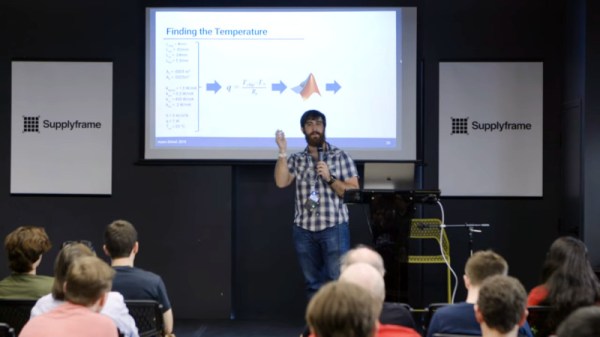
It’s a simple fact that, in this universe at least, energy is always conserved. For the typical electronic system, this means that the energy put into the system must eventually leave the system. Typically, much of this energy will leave a system as heat, and managing this properly is key to building devices that don’t melt under load. It can be a daunting subject for the uninitiated, but never fear — Adam Zeloof delivered a talk at Supercon 2019 that’s a perfect crash course for beginners in thermodynamics.

Adam’s talk begins by driving home that central rule, that energy in equals energy out. It’s good to keep in the back of one’s mind at all times when designing circuits to avoid nasty, burning surprises. But it’s only the first lesson in a series of many, which serve to give the budding engineer an intuitive understanding of the principles of heat transfer. The aim of the talk is to avoid getting deep into the heavy underlying math, and instead provide simple tools for doing quick, useful approximations.

Continue reading “A Crash Course In Thermodynamics For Electrical Engineers”

DIY Ram Pump Obeys The Laws Of Physics

Despite the claims of “free energy” on the title of the video below, this is not yet another wacky perpetual motion story. We here at Hackaday fully support the laws of thermodynamics, and we think you should too. But you have to admit that a pump that works without any apparent energy inputs looks kind of shady at first glance.

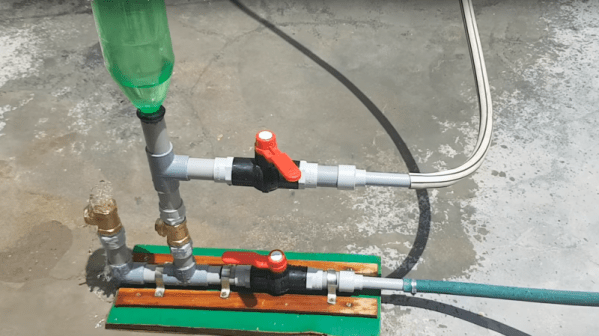
The apparatus in question is a ram pump, a technology dating back all the way to the 18th century. The version that [Junkyard – Origin of Creativity] built uses commonly available materials like PVC pipes and fittings. About the only things on the BOM that might be hard to scratch up are the brass check valves, which should probably be flap valves rather than the easier to find spring valves. And the only custom part is an adapter to thread the plastic soda bottle that’s used as an air chamber to the PVC, which a 3D printer could take care of if you choose not to hack a bottle cap like [Junkyard] did. The video below shows the impressive lift achieved just by tapping the kinetic energy of the incoming flow.

There, the Second Law of Thermodynamics remains inviolate. But if you still think you can get something for nothing, check out our roundup of perpetual motion and Overunity quackery.

Continue reading “DIY Ram Pump Obeys The Laws Of Physics”