
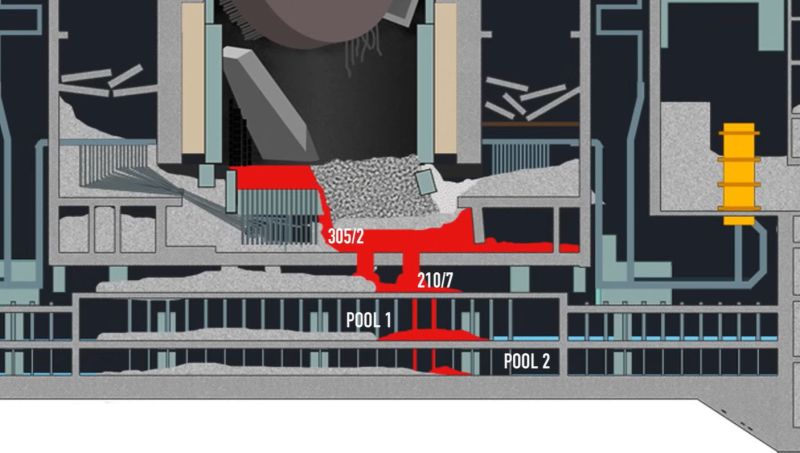
With the massive steam explosion that shredded the #4 RBMK reactor at the Chernobyl Nuclear Power Plant in 1986 it suddenly made robots that could survive a high ionizing radiation environment into the hottest item on the planet. Over the course of forty years many generations of such robots were developed, tested, improved upon or discarded, all to explore and handle hazardous waste throughout the depths of the #4 reactor’s remains.
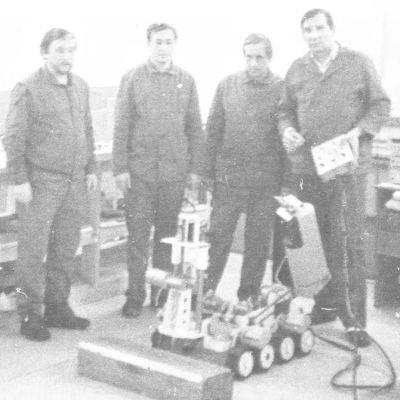
Even if the entire development and decisions here would easily fit a couple of feature length movies, the recent documentary by the [Chornobyl Family] provides a solid overview of the engineering challenges, the issues encountered along the way and the forced evolution of initially very basic designs into the robotics that today trundle and wriggle around inside reactor #4, as well as their cousins over at the couple of stricken reactors at Japan’s Fukushima Daiichi power station.
Unlike the other robots developed from 1986 onwards to provide general clean-up of scattered core material outside of the core, these robots had to venture deep inside, where radiation levels were the highest and correspondingly the challenges much more severe. This was such a problem that initially it were humans who did the exploration, as robots proved to be too fragile and too prone to getting stuck.
Until the 1990s exploration of the ruined core was quite limited, also because of a lack of urgency. While the outside clean-up and construction of the sarcophagus had to be done as quickly as possible, the core exploration was more slow and methodical, based around trying to establish its condition, what core material remained inside and try to take samples of interesting objects like the well-known ‘elephant’s foot’.
With the 1990s the TR-series of robots – developed by what is now the Ukrainian Institute for Safety Problems of Nuclear Power Plants (ISP NPP) – came onto the scene. These new robots were designed to be highly agile and versatile, capable of traversing where simple tracked or wheeled robots would have gotten stuck.
These robots would continue to work side by side with humans, going into the more hazardous zones for things like drilling samples. As the ruins decayed and dust became increasingly a problem, the TR-7 robot was developed in 1994 to apply a substance called EKOR to immobilize said dust.
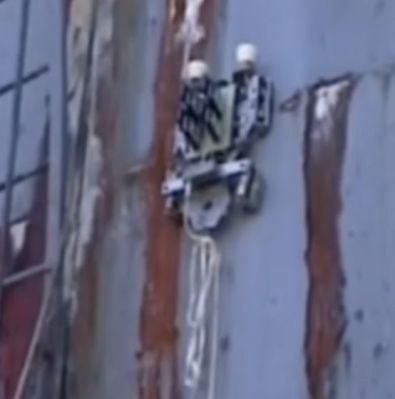
Some of the more unusual robots were capable of climbing up metal walls using magnets, which was useful for installing sensors and similar devices in otherwise hard to reach places. By the time TR-11 was developed, the focus had moved on from exploration to actively breaking down and handling hazardous material, raising the hope that one day the last bit of radiologically contaminated material in reactor 4’s ruins will have been dealt with.
What complicates this clean-up of an RBMK reactor so much is of course that these hybrid military/civilian designs were built without containment structure, core catcher or other safety features you would see with other civilian reactors of the era. Although the Generation II LWRs at Fukushima Daiichi were built before the RBMKs, it was this omission of basic safety features that would shape the 1986 accident and the resulting clean-up, even if it provided a unique opportunity to develop robots that otherwise might never have existed.












I swear there was just recently an article here on Chernobyl robots
Has link to previous HaD article.
Perhaps Io and Europa spacecraft can benefit…the melanin life forms, etc.
Pluto/SLAM nuclear jets for Jupiter atmosphere hurricane hunters…
They’re pretty cool. It’s basically the major leagues of robotics, sending one into zones so hazardous that you can’t even touch the poor thing for ten thousand years after it comes back.. but it saved a human from having to do that. These and space probes are the robots depicted in aspirational posters which all little robots hang on their bedroom walls.
Me too. I also moaned about the spelling of CHORNOBYL being wrong there as well. Spelling it in the Russian way is being a shill for Russia.
Spelling the original way as it was at the time is correct, spelling it in a silly way is being a shill for warring Ukraine. =\
it is all so tiresome…
Yes, being invaded by the evil empire next door must be awfully ‘tiresome’.
Admittedly.. yes, sorry.
The modern world is so tedious and stupid. I don’t particularly care for Russia and if I had to choose a faction it would be Ukraine, but I could do without the western stuffed shirts who make it a faux pas to use some old spelling that people have been accustomed to around the world for decades over the new politically approved one. That behavior doesn’t support Ukraine, it supports literally anybody else.
Do you still call Mumbai Bombay? This is exactly the same situation not wanting to use a name imposed by someone else.
So ‘doris’, is it the Gulf of Mexico or the Gulf of America in your world?
I’m curious.
The academically correct take here is that once Ukraine regained its independence in the 1990s its switch back to Ukrainian as an official language it’s preferred to use said Ukrainian names (‘Chornobyl’, ‘Kyiv’, ‘Odesa’, etc.), while using the Russian names and their transliterations is preferred prior to independence.
This is generally the approach that Ukrainians take to the issue as well, seeing that as a delineation event.
Politicians are always at least quarter century behind compared with the rest of us.
Though, and it is rather sad, they are usually paid princely living wages that are certainly not quarter century behind, and in many ways very advancing forward, ie, inflation compensated, planned salary raises, etc.
As far as thinking goes, most are stuck in the bronze age, and some are in the iron age, but very few are in the 20 century (or 21st one, many are visibly struggling with the mandatory transition). Others are in the stone age, but don’t have any issues using/abusing all the modern amenities. If I would be able to choose, I’d refuse them the modern medicine, too, since they are so fond of that era, and I’d also suggest they move to middle of Sakhara with their families, camels, tents, and wander around just like Moses did (supposedly) and prove all of us wrong thinking we don’t need them around.
“made robots that could survive a high ionizing radiation environment into the hottest item on the planet.”
Pun intended?
Very much so.
I was humans were it, or am it still is?