
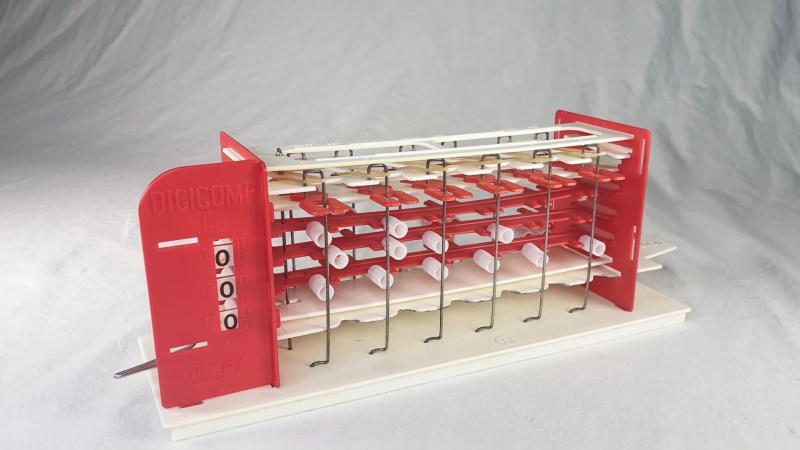
In the 1960s, the home computer was barely a twinkle in anyone’s eye. This was the decade in which computers were used by a handful of companies and organizations and took up entire rooms. It was the decade that saw the birth of the first integrated-circuit computer, the Apollo Guidance Computer, and, rather strangely, one of the first home computers of sorts: the Digi-Comp 1.
In 1963, E.S.R. introduced this little programmable educational toy computer. It relies on simple mechanical logic gates, programmed by positioning tubes on sliders. Their original intention was to create actual computers, but one thing led to the next, and E.S.R. became the premier educational computer toy company of the 1960s. The Digi-comp is a rather simple device. A program is entered by soda-straw-like tubes placed on sliding rails. These tubes interact with spring-loaded levers which move in accordance with the “clock” switch. The result is a simple binary computer you can program.
[Chris Staecker] got a remarkably well-preserved Digi-Comp I to demonstrate its unique functioning. With some rubber bands and a touch of modern technology in the form of 3D printing, [Staecker] got the toy working like new. The programming process is quite manual, and its functioning is not obvious. But it can compute binary outputs of given functions. Unfortunately, this is not a Turing-complete process, but rather a state machine with 88 (or 16,777,216) possible states. The toy, with all its limitations, is highly reflective of the state of computing at the time, and a rather neat look at what the future was, back in 1963.
Make sure to take a look at E.S.R.’s successor to the Digi-Comp I, the creatively named and quite different Digi-Comp II. We’ve looked at other old “sort of” computers like the Geniac. You can even simulate that one in your browser.












My parents got one of these for me about age 11. The instructions confused me and I was never able to make it work as it was supposed to. It eventually got trashed during a move. Wish I’d saved it…
(I went on to get a degree in Computer Systems Engineering, and a career in embedded design)
You just described my story almost to the letter.
I got a little bit of understanding of the backpanel (controlling movement) but otherwise didn’t internalize an understanding of front side logic.
A degree (B.S.E.E. The Ohio State University), and embedded work, also to this day.
I had a similar experience, not able to comprehend it at a young age, but went on and made career of embedded systems.
It would be nice if someone converted this to a cad file.
Being able to 3D print this, or perhaps an extended version, would be interesting. 4 bit, 8 bit maybe? Solenoid actuated “clock”.
Looks like that exists already:
https://www.thingiverse.com/thing:1477209
This.
People should digitze stuff to 3D for archival purposes. If we don’t remember the past we will end up forgotten like Maya or Azteca civilisations.
It looks like a toy version of the Zuse 1 computer.
I had one as a kid. I played with it for a few hours and then realized how limited it was and got bored. I later learned FORTRAN 2 at age 10 and that was where things took off.
There is a modern recreation one can buy
https://www.mindsontoys.com/kits.htm?dc1_main.htm
This computer (still have mine) got me started in computing (and I DIDN’T get bored). Formed the seed of my first two science fair entries back in the 60’s.
Ah, memories… That was my first computer.