
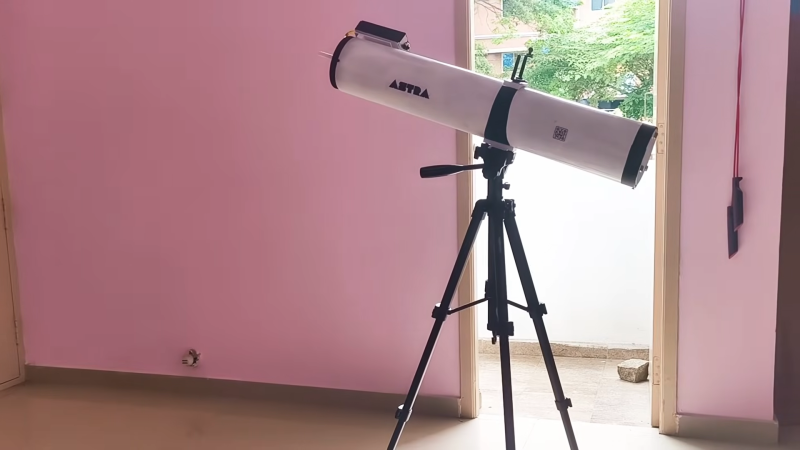
[Makestreme] had always wanted to own a nice telescope, but found that budget would not stretch to anything above a cheap model with a limited 50 mm aperture. Wanting a better view of the heavens, the way forward was obvious—it was time to build a better telescope, instead!
The build is based around a 114 mm diameter mirror sourced from Amazon. It’s assembled inside a length of 5-inch PVC pipe of just under a meter to suit the 900 mm focal length of the concave reflector. 3D printed components are used to mount the mirror and control its position for proper focus and collimation. Traditionally, a reflector based telescope would use a mirror and eyepiece to provide a view to the user. However, [Makestreme] built this as a smart telescope, instead integrating a Raspberry Pi Camera Module 3 at the focal point. It’s connected to a Raspberry Pi Zero 2W, running off an 18650 lithium-ion cell and a 5 V boost module for portability. The Pi runs a Python script that hosts a small web server allowing access to the live camera feed along with controls for brightness, exposure, and gain. [Makestreme] then uses apps like SkyMap and SkEye to help aim the telescope at astronomical elements of interest.
If you’ve ever wanted to explore the heavens from down on Earth, building your own telescope is a great way to start. A camera-based build like this one can be a bit simpler than traditional builds, too, without the fuss of having to install an eyepiece.












Wow SkEye is still around and being updated after over a decade? Bought the paid version long ago to support the creator.
I havent used it in many years because phone accelerometer just sucked back then.
But I do occasionally use that on Sky Safari. They still suck but can get you into the right ballpark naked-eye when you find yourself looking for a thing in twilight.
“I havent used it in many years because phone accelerometer just sucked back then.”
You can thank ITAR paranoia for that.
MEMS devices sold overseas were intentionaly crippled to prevent people from building drones, rockets and other nasty thing that could use a compact yet precise INS.
Looks like my old Meade DS114. Except probably not full of all the backlash.
…and with probably a lot better performance by the Meade.
Nowhere in this ‘hack’ is mentioned THE omnipresent flaw with a Newtonian telescope: “Central Obstruction”, and how much of a problem this is, with this design It appears, from the photographs, that central obstruction is a big problem here. This, alone, would account for the poor pictures obtained, and which are, instead, written off to bad weather, etc.
In order to build a good telescope, one has to understand the very basics of telescope design; telescope basic design cannot be improved upon simply by using the latest available electronic devices and coding techniques.
This is somewhat similar to the problem Boeing encountered by trying to design a new airplane…the 737MAX…from an existing airplane…a 737…using only software.
It doesn’t work that way, folks…you have to understand the very basics of the problem you’re trying to solve.
In any field.
By the way…if you want to know exactly what kinds of performance increases are obtained by applying the latest electronic and programming techniques to existing telescopes, it’s very easy to do…
just ask Meade.
The Pikon telescope’s value of pretty hard to beat. The original design is quite popular for a reason. Of course you can bet better images when you throw money at a telescope. And the example you gave about the 737 max is incorrect. I’m an aircraft engineer.
Software was never the problem. It was not disclosing the software that was the problem. Now the aircraft is quite popular. I’ve flown in it several times.
Your response is wrong on so many levels…
Here are just four—and a very big four—which are supposed to lend credibility to your assertions of nothing more than personal opinion:
“Software was never the problem.”
Volumes have been written by people and organizations, with far greater credentials than yours, I’m sure, which, in no uncertain terms, state otherwise.
“I’m an aircraft engineer…”
…and?…the point is?…
“”Now the aircraft is quite popular…”
Compared with what? According to whom? Proof, please.
“I’ve flown in it several times.”
Which proves—other than the fact that you’re still alive—what, precisely?
To be slightly more pedantic… software is not the only difference between the design of the 737 and the 737MAX.
Also, “I’m an aircraft engineer” is not an opinion no matter how you slice it. It’s either true or false. Same with “I’ve flown in it several times.” Do these prove anything? Perhaps not, but they’re not opinions.
Live by the sword and all that.
Astrograph
When my spouse saw my 26 inch mirror she said ” Well, is that one big enough? … No, don’t tell me …” and she walked away.
The one thing that forces telescope design into the realm of detailed mechanical engineering is the size of the mirror.
She knows it’s what you do with it is what matters.
Oops sorry for reporting your coment
very nice, I can make this same picture without this telescope
using phone directly
Your phone have a 900 mm f8 lens?
One could also run the open-source indi-libcamera and surf on the work of the community to capture images over the network with full camera control, and gain other nice features for free.
One thing he may be slightly disappointed about is that capturing deep-sky objects, although the scope optics may be diffidently up to it, may not work out well due to the camera not being optimized for low-light conditions (for example look for Sony Starvis based cams) and the need to have longer exposure times (thus being able to track objects in a motorized way). But that’s just more fun stuff to explore :)
My $100 telescope from hobby lobby is 100x better. Not worth all the trouble for a blurry picture.
One of the reasons for the poor images is that you need an IR/UV cut filter because the digital camera is sensitive to the invisible wavelengths. Also the double sided foam tape is a very poor choice for mounting the mirror to the mirror mount. The foam will insulate part of the mirror and won’t allow the glass to come to an equal temperature to the outside environment. This causes the mirrors figure to not to focus all at the same place and the insulating properties of the foam tape exacerbates this. Remove the tape. Use small dollops (about 5mm) of silicone glue (one per each leg of the mount at 60% of the radius of the mirror back) and use a small coin about the size of an American Dime to temporarily suspend the mirror above the mount. The silicone glue is more than strong enough to hold the weight of the mirror. When the silicone dries, remove the coins from between the back of the mirror and the mirror mount.
Do the above and allow your telescope mirror to equalize to the ambient temperature of the outside air for about an hour or at least 30 minutes. The mirror needs to quit expanding or contracting before it can focus properly.
Hope this helps
I had a friend in high school who built one, the mirror was I think 75 mm in diameter. The PVC pipe was painted matte black on the inside. At school one could use the stand drill and other nice cutting tools.
I forgot, that was 1990, we were 15
Just noticed that this project was featured here! Thanks for sharing it, and thanks for all the comments and feedback. Very helpful to improve the telescope.
I’d also like to mention the original creator of the Pikon (which Astra builds upon) is Mark (https://www.instructables.com/member/Markwrig). So hat’s off to him!
The biggest advantage of this telescope (which I later realised) is for a group of people to connect to it via their phones and take a look at what the telescope is seeing together.
I had originally thought of purchasing a telescope, but making it was not only so much fun, but it’s an amazing experience seeing something so far away with something you’ve built yourself!
I tried this project but the Focus was a nightmare and the quality image was crap.
Now im triying with a bigger mirror and better sensor since there are better sony imx sensors compatible with Raspberry than the one used here (starvis2).
But for me the Focus mechanism and the mirror área and shadow área ratio has to be improved since the sensor mount block to much and im sure you cant avoid bad alignements with this setup