
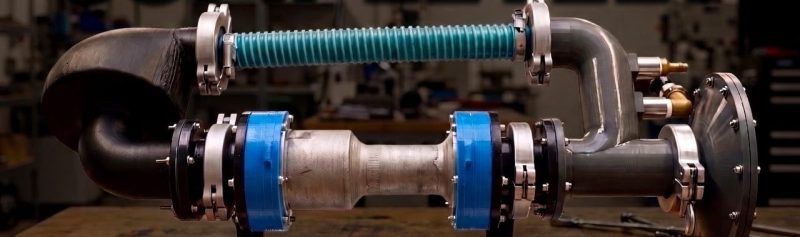
Would you like to make your own energy? Why, who doesn’t in this era of rising costs! A Stirling engine always looks like a good fit for that: highly efficient, with no risk of a boiler explosion. A thermoacoustic Stirling engine looks even better, since it has only one moving part at the output end. A thermoacoustic Stirling engine you can 3D print yourself looks best of all, and that’s what [my engines] has on offer, now that even the burner and hot end of his thermoacoustic engine are designed for SLA metal printing.
We previously reported on the open-source engine, but there’ve been some improvements worth talking about. For one thing, he’s integrated a biogas/methane burner directly inside the 3D-printable hotend. For another, that 3D-printed design allows for an excellent heat exchange geometry that would be very hard to get any other way. The whole thing is open source with plans available at OwnEnergy.org, where you can find links to the apparently mandatory Discord channel and now an old-style forum to actually collaborate on the design, which is open-source. The site is also now the home of all data and discussion about [my engines]’s homescale biogas plant, which is the power source for this little engine.
If you’d rather print a combustion engine, you can do that, too, but you’ll need more “vitamins” than this unit requires.









Sterling is money, Stirling is the guy who invented the engine.
Starling is a bird.
And all the starlings in North America are descended from a group released by the New York Shakespeare Society in Central Park in the 19th Century after the death of Robert Stirling.
So if they got jobs as hipster baristas there, would they be Starbucks Starlings Stirring?
https://en.wikipedia.org/wiki/Starling#Distribution,_habitat_and_movements
Stalin is not my dad.
Sthürling is a watch brand
“Stührling” sorry (What a complicated name…)
My favorite German brand is of course, Assmann.
Sturling is a young Stur.
And Pounds Sterling is how you measure the mass of an Archer.
Makes sense that the wacky steampunk engine should use the Scottish form of the name.
Possibly because it’s inventor, Robert Stirling, is Scottish.
https://en.wikipedia.org/wiki/Robert_Stirling
Thanks. Fixed!
But the commentary after is gold.
I hate to be that guy, but you can’t make energy. It’s like a law of thermodynamics, or something.
I made energy once, not to brag or nothin
perhaps you can make energy, but it is much more polite to ask it nicely
Actually, in end-effect, it’s E=mc2.
It is very reminiscent of modern condensing gas boilers. Extracting current using a simple coil seems archaic, considering that electronics can be used—much like with solar cells—to extract the maximum energy
If all you have is a stainless steel metal 3D printer (for sponsoring reasons) then you end up with a design like this.. Although the design is open, this makes it rather inaccessible to anybody else.
But certainly, an efficient design might be hard to build from off-the-shelf or self welded stainless steel parts. My guess: Striving for efficiency makes this setup rather expensive per Watt of electricity generated.
Once this is built, how long would it need to run to offset the cost of building by the energy it generates?
There are very good reasons why it should be made out of stainless steel or other temperature and corrosion resistant materials throughout. 3D printing services make it at least practically feasible, if not cheap.
It’s not really about efficiency, it’s about building something that has a chance to work for longer than a hot minute.
Could aluminium casting be used to make similar metal parts?
That would be considered pretty accessible right?
Probably, but aluminum doesn’t hold well to the temperatures inside the burner. You need at least 800 C on the surface to burn off soot deposits and keep the burner clean, but aluminum melts at around 600 C. The burner and heat exchanger must be made of stainless steel so it doesn’t rust through.
Besides, aluminum would conduct heat extremely well and get hot all over, melting the plastic connections at the ends of the tube, while stainless steel is a very poor heat conductor so the heat becomes localized to the burner.
“Would you like to make your own energy? ”
I think I can! I think I can! I think I can! How am I doing so far?