
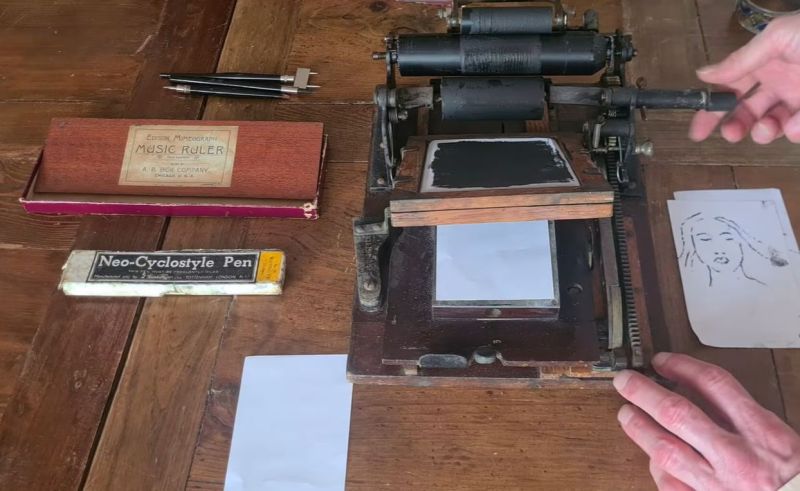

Document duplication has been a highly desirable feature long before medieval monks slaved over yet another illuminated manuscript by flickering candlelight. Fortunately, one part of the Industrial Revolution was the invention of machines like Cyclostyle copying machines, which covered a range of manual and automated devices. One such crank-powered device from 1890 is demonstrated in this video.
The Cyclostyle and neo-Cyclostyle copying system was quite simple yet elegant: by removing the wax coating on a special piece of paper, ink from a screen-printing system could be pressed through the resulting template, and allow for repeat copies to be made.
With the machine demonstrated in the video, the ink is applied to the top rollers, with the lower roller inking itself on them during the retraction cycle, before applying the fresh ink to the screen on the cycle following the insertion of a fresh piece of paper to print on. With this method, many copies of the design on the waxed template could be made before it had to be replaced, which would have saved countless hours of work by artists.
After the machine in the video, more advanced designs were developed, some of which we covered previously. These would automate more parts of the process, making it faster and more precise, before being replaced by newer technologies.











There was electric and fully automated wax copier machines in 1960’s. Wax not Fax.
German here, the telefax still is awesome, though! 😃
Not only can it transmit letters blazing fasting and electronically via modern telecommunications, but it also has a copier function!
So even if someone can’t afford an M3 copier or an LaserJet or InkJet printer due to cost (toner, ink and non-recycling paper),
a fax machine can safe the day to make a quick and economical copy on thermal paper. 🤗
Latest versions also support color image transmission, faxpolling and ISDN.
PS: Another fax technology, the weather fax (wefax), is great, too!
It works wireless over the aether and is vital for ships at sea.
The DWD sends out latest weather information on shortwave, I remember.
On 80m band, for example, on 3853,5 kHz USB.
Handy actually if one didn’t mind the quality or lifespan of the paper.
I wouldn’t call it a copying machine. It’s a printing press. A copier would create copies of an original that exists on paper.
There were blueprints even before cyclostyle, however cyclostyle allowed a (relatively) huge amount of copies in a short time for very little money compared to blueprints.
A form of Offset Printing.
Speaking of BluePrints, I miss the Smell of blueprints. :)
Offset printing uses a transfer plate. This is more like silk screen printing.
It is a printing press, but copies could technically be made by using some photochemical emulsion that cures with light to make the stencil. Unfortunately most such chemicals known at the time were pretty volatile or explosive, and toxic.