
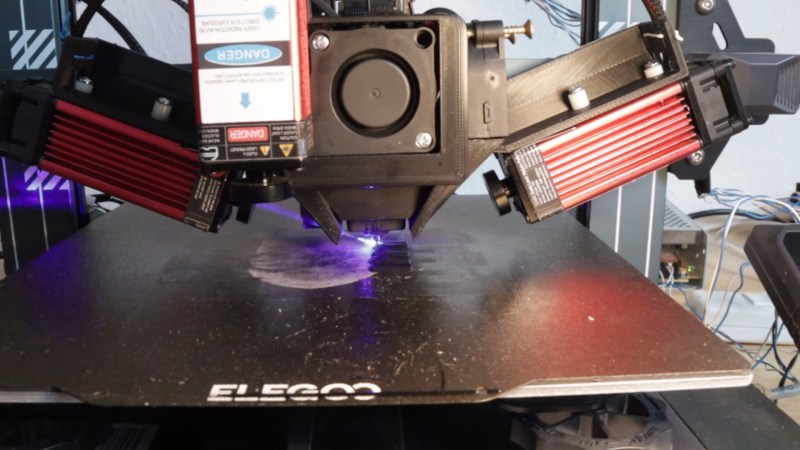
Now, not everyone minds the characteristic layer lines you get with Filament Deposition Modeling (FDM) 3D prints, but sometimes you need a smooth surface. If so we might go for filling primer, Bondo, or maybe break out the ABS and vapor smooth. Well, [I changed a thing] has an alternate suggestion: lasers. Laser melting can smooth the walls on a print, or the top surfaces as he shows in two different videos, both embedded below. The results look roughly similar to vapor smoothing, without the chemical exposure small risk of explosion.
Of course, you need a laser to do this, and [I changed a thing] has two diode lasers mounted to the X-axis of his printer. Of the two, the top surfaces were a lot easier to get right than the wall smoothing, which makes sense. Top surfaces are right there for the laser to get at, after all, while with his laser setup [I changed a thing] needs to get at the walls obliquely. [I changed a thing] tries melting layer-by-layer as well as a few methods to get at the walls of a finished print; which works best seems to depend on the size of and geometry of the object, so it looks like this technique is as much art as science right now.
This effort is closely related to the previous work [I changed a thing] did on improving layer adhesion with laser melting. It’s also not the first time we’ve seen laser-driven print smoothing, but that project used non-planar movements to do a post-print laser pass.












By the looks of those ‘before’ images they might want to invest in a better printer too.
Wonder if it’s so wobbly due to all the extra hardware they’re hanging off of the carriage? Maybe mount the lasers remotely use some fibre optics to get the light where it’s needed. A belt re-tension might help too.
The print probably looks that way because of the extra weight of the laser modules.
That’s what I was thinking. At least needs a tune-up… Those are some extremely nasty layers. I agree with the others here, it’s probably due to way too much mass on the print head and is being treated as an acceptable drawback only for the experimentation phase of this project
I am wondering, wouldn’t stationary lasers, each with an optical fibre going from it to the print head be a possibility? That would significantly reduce the weight that has to be lugged around during printing,
Or just a couple of small mirrors/prisms on each axis, no optical fibre to constantly bend or have to manage.
High power lasers, no enclosure, reflective surfaces… What could possibly go wrong?!
Hint: I don’t care what someone does to their own eyes, but I do care about what they do to other people’s eyes. I’m I’m blinded then I will have to find a way to commit suicide (since I’m extremely deaf).
I don’t think watching a video is actually going to hurt your eyes.
Strawman argument, which does make your moniker appropriate.
Geez relax. Extremely low risk-tolerance (often performative) is such a strange personality trait around here. I’m sure he’s taking precautions, and it’s an experimental build so it’s not like it’s going to end up in consumer hands this way.
I suspect clout seeking is the main driver of all these “performative risk aversion” posts.
This way you can criticize the subject of the post AND pretend to be better informed without having to, you know, have any actual subject matter knowledge.
Exactly what “clout” do you think I might gain? Silly argument!
Re your second paragraph: look in the mirror.
Clout-seeking online is indeed silly, but it’s undeniable that it happens. People try to get clout on the most obscure and absurd forums. It’s just some strange fork of human psychology, I didn’t write the software, I’m just the messenger.
Good point though, we’re doing the same thing! Fair dibs
Injuries are often caused by non-commercial equipment, so that is a poor “reasoning”.
What evidence do you have that he is taking precautions?
“Low risk” is your assessment, made without justification. The same “reasoning” can be used to “justify” encouraging people to walk into a road without looking. Unfortunately such idiocies appear to be common on TackyTok etc.
I saw that image earlier;
https://hackaday.com/2026/08/16/laser-layers-for-almost-isotropicly-strong-prints/
Yeah, that title image looked familiar..
I really don’t get the layer line hate. it seems so silly and such a pointless thing to focus on when you can literally print almost anything your heart desires for pennies. if I could print with worthless ass a new body so I wouldn’t be disabled anymore, layer lines would be the last thing I cared about 😂
good point, but although you wouldn’t mind layer lines, you may mind wrinkles, which is exactly what this laser setup seems to create. All I can think of, is ditch the dangerous and costly lasers, switch to ABS and put the printed object in an acetone bath or vapor chamber.
Switch dangerous lasers, with hazardous fumes and dangerous chemicals. Yes, sure, why not…
Acetone is literally sold in stores as “nail polish remover”. It’s an extremely common household chemical. Is it a mildly hazardous solvent? Yes. Is it as dangerous as a misused laser? I would claim definitely not.
It’s not really virulent “hate” is it though? Yes printers are great the way they are, but it’s this striving for incremental improvements like this one which made them that way. It’s good to keep upping the standards.
3D printing would be most suitable for decorative parts and items where the poor mechanical properties of the materials and the low accuracy of the printing process don’t matter so much, but the ugliness of the layer lines ruin it.
You can print a lot of plastic junk for pennies, but whether it actually works for any purpose is a different matter.
Printing slightly hotter and slower would help more than hanging heavy laser diodes on your carriage
Not according to measurements in the previous article covering this machine. The gain in z-axis adhesion is pretty impressive. And I think eventually the lasers will be relocated with fiber or mirrors delivering the photons with much less print head inertia.
Here’s the other article. Big double-digit increases for ABS and PLA, up to 94% compared to the part strength in other axes… nothing to scoff at imho:
https://hackaday.com/2026/08/16/laser-layers-for-almost-isotropicly-strong-prints/
The first video seems like a 1-1 rip-off of what TenTech has published about one year ago. But with the caveat that the results look worse. How does one achieve that lol
https://hackaday.com/2025/10/02/3d-print-smoothing-with-lasers/