
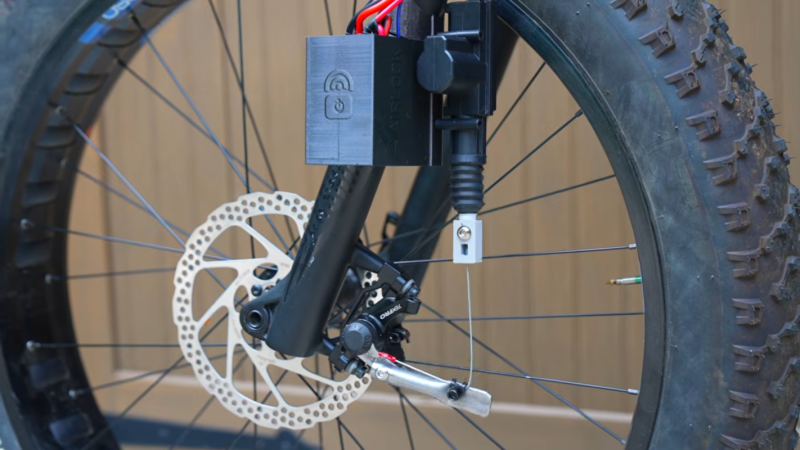
At first glance, wireless brakes seem like a recipe for disaster. For something as critical as braking, many bicyclists might prefer a physical connection to their method of safely controlling speed. But there are a number of surprising benefits of electronic or wireless braking systems. For one, they can enable systems like anti-lock braking systems and for another they can eliminate cabling or hydraulics on a bicycle. For these reasons, and just for the thrill of it, [Berm Peak] built a set of wireless brakes for his fat tire bicycle to test out the possibilities.
The system uses a set of ESP32 microcontrollers to handle inputs from the braking lever and outputs to the front and rear brakes, as well as a central control unit and display. The brakes themselves are controlled by actuators from car door locks, which when combined with the springs from the stock calipers work to apply a wide range of braking force to the wheels. These did take a bit of prototyping to get working right, by changing to higher quality calipers, increasing the angle of the actuator, and adding longer levers, but eventually a working braking system started to appear.
But replacing a hydraulic system with an electronic one isn’t where something like this shines. [Berm Peak] was able to add in a number of features impossible in traditional braking systems. Not only does this have an ABS system and the possibility to remotely slow down his children’s bikes when they’re riding, but there’s also a braking equalizer that allows the rider to control how much braking there is at certain positions of the brake lever, and another setting called “derp” which doesn’t engage the brakes at all until a certain threshold has passed. This might end up being the next big trend in mountain biking, unlike airless tires.












Yeah they’ll work great until the battery does or they drop the wireless connection on a downhill. Nofeckinthanks, I’ll keep my hydraulic ones which have never failed, ever.
the guys making electric skateboards have experience with that, when losing connection to the remote or rebooting some ESCs will slam on the brakes, with the predictable result on a skateboard, a face plant …
The hydraulic system will work only if there is pressure, and the mechanical system will work only if the cables are not broken. Everything has a way to fail.
Non-engineer spotted. Go back to writing software, boy.
@GregA did a good job explaining why @leoheck is wrong. Strange it needed explaining though… I mean anyone who has ever ridden a bike should know that…
But I have noticed this trend of engineers who think they know everything and have some sort of superiority complex regarding programmers. And yet.. every one I have ever met has a knowledgebase confined to a very precise, limited field and spends their days behind a computer just like any programmer.
As a programmer myself.. when not at my day job I’m pretty comfortable getting my hands greasy and working with physical tools on real-world machines. Most everyone else I know.. engineer, programmer or any other profession don’t even change their own oil anymore.
And I’ll tell you what.. it doesn’t take a whole lot of times working on what someone else engineered to realize that their sh1t can certainly stink just like anyone else’s. Bad design abounds.
Don’t get me wrong, being an engineer is a highly technical field (actually, several fields) and it’s a respectable career but no career is a valid reason to get full of one’s self. And honestly, unless you are working on a museum re-creation of a 19th century farm or factory every project that is actually interesting is strongly dependent on both hardware and software. It’s a lot better to not be an 422h0l3 and just work together.
that’s true. and i don’t know anything practical about hydraulic. but i’ve been using cables for a long time and i can report that they are easy to install, easy to inspect, and typically fail very slowly and show many signs that you can feel through your fingers for months before they finally snap.
that’s a philosophical thing that’s very much on my mind because of aluminum bike frames. i’ve come to think that both aluminum and steel frames are prone to failure but i am really starting to appreciate that steel frames fail slowly.
you see the same thing in building…in a wood-framed house, failure is quite common but it happens so slowly that it’s rarely dangerous. ill-advised remodels often remove crucial supports and the result is a sag that takes years to become a problem.
I’ve actually lost the rear brake while riding downhill.
Without any warning, a less-than-two-year-old Shimano SLX caliper suddenly started squirting out mineral oil instead of braking when I pulled the lever.
The real safety of the current system is that the front and rear brakes are completely separate systems. Anything can fail, but it’s very unlikely that both will fail at the same time.
” and just for the thrill of it ” lets just leave it as that. if you need anti-lock on a bike, you might want to consider therapy first.
… and anti-lock can be done while keeping the hydrologic coupling between lever and brake system.
Actually, bicycle breaks use hydrostatic principle because there’s no fluid movement in the system. When you squeeze the brake lever, the brake fluid acts through the sealed line. This engages the brake caliper, which attachnes the brake pads to the rotor. This allows a relatively small psi applied at the brake lever to produce larger psi at the caliper.
Does hydrostatic then indicate non-circulating? Because surely there is necessarily some movement of the fluid.
Same characterization would presumably apply to automotive brakes.
Of course.
When you squeeze (or step on) a hydronic brake lever, a drop of non-compressable fluid drops down into the tube that leads to the actuator. As it’s travelling down the tube, it rolls up it’s sleeves, preparing to heave. When it reaches the actuator assembly, it pushes with all its might, and amplifies the force applied to the lever.
(Non-compressable is the important quality of the brake fluid.) 👍 🙃
The same ESP32 controlling this setup wirelessly could also control it with wires and provide the same exact functions, with less of a chance of failure just because you rode by someones hose while they were making popcorn.
Except that you still have a lot of the failure modes, like a dead battery or software issue. Also, you would introduce new failure points like wire breaks and connector issues.
If you really want to do it electronically, and gain the ability to spin the front wheel, I think a short-range inductive link would be more reliable. This could be two coils just a few millimeters apart, for the rear wheel brake.
The front brake cable could just go through the headstock.
Not “wired” electronically, but wired with brake wire.
The ESP could provide adjustments on the existing brake wire, (or on hydraulics) without breaking the manual brakes. Similar to how ABS on a car is done. For safety.
…oh nice he’s putting it on his kids’ bikes, so that he can nanny their brakes remotely.. and probably have them fail completely. that seems wise.
You should really watch the Berm Peak video before criticizing it. The whole thing is just an engineering/coding exercise for the fun of it (and of course YT views). And it’s a lot of fun to watch. He freely admits that’s it probably has no commercial application because of safety issues (and he goes as far to make a fake website for monthly subscription based brakes).
Again though, he’s super talented and it’s a very fun creative exercise to witness.
Thinking: if this is the answer what was the question?
I just replaced the hydraulic brakes on my road bike(hardtail ridden on paved trails exclusively) and the brakes are so good I can’t imagine anything better. My full suspension bike had dual piston Maven brakes and they are incredibly powerful, and easy to modulate though they did take getting used to. Maybe I’m too conservative but I can’t imagine what could be done to make good hydraulic brakes any safer, more powerful, useful, and reliable, at least for my needs. My Maven brakes are confidence inspiring heading downhill!
I think the honest answer, err question is “Would this work, and how well, and what can be learned by attempting it” and I think that’s really the hack spirit to it. Everyone in the comments trash talking this for safety etc are not wrong of course, but the curiosity was the main point, everything else is narrative fluff, at least that’s how it reads to me.
Objections to the wireless aspect miss an even bigger issue: coding your own brake software is a big “No”.
I have written adaptive cruise control code in my professional life. I would still NEVER write my own code that is in the call path when someone hits the manual brakes. If a null pointer could kill someone, you need a dedicated department doing quality assurance. It is inappropriate to DIY that.
It’s a bicycle. If the whole thing fails you stick your foot in between the back tire and frame and stop that way. It works every bit as well as any other braking method.
I should know I rode a BMX bike as a kid for around a year with no working brakes whatsoever. I forget how I broke the lever off but it didn’t seem like a big deal to me so I never bothered to tell my folks. Mom asked why my right shoe was always wearing out so much faster than my left and freaked right out when I told her!
Honestly as a parent I understand being concerned, but to this day I swear I could brake just as if not more effectively than before.
Yeah, that’s fine if you’re a kid, weigh a few stone, and are going BMX speeds, on safe roads.
Not if you’re adult weight, are going 30-50mph, and are on fast roads or off roads with steep drops.
that’s a good technique and i’ll keep it in my mind, i appreciate your note :)
but it’s not every bit as good as other techniques…you have less control over the braking, longer reaction time, and your whole perch on the seat is off balance while you’re doing that. shrug
I thought sticking things against the front tyre (and causing a tumble), was something a certain segment of the U.S. population did when they needed something else to blame gamers for :)
It’s not like he’s aiming to make a product that will actually be used and sold, if you watched the video it’s essentially a glamorous proof of concept,
Its actually difficult to see how you could get a null pointer in self contained anti-lock brake code. Obviously if you were building it for mass production you’d go through a full test/certification cycle but the overall system design would have already dealt with the “fails gracefully” question — if the anti-lock logic fails the brakes still work (…and you’ll get a warning light on the dashboard).
This concept of wirelessly controlled bike brakes has no ‘graceful failure’ path. It either works as it should or it fails disastrously for the user. This makes the overall design unacceptable. The design could be made usable by making it assistive — it provides helpful input to increase the braking capability or modulate the brakes to prevent a lockup — but the better first line solution would be to “buy better brakes”. (As someone who rides an old road bike with cable operated disc brakes — yes, they’re not very good compared to the hydraulic ones on my motorcycle but then I’m riding at relatively slow speed on the road.)(BTW — My motorcycle has anti-lock brakes. I’ve yet to invoke the anti-lock facility.)
At first glance, wireless brakes seem like a recipe for disaster.
Yes, indeed. I stopped reading there.
Don’t go messing around with the most safety critical part of your bike.
One errant particle from a galaxy far away and you might be crashing into something.
Also, I think this system needs to be controlled through a phone app, and at least one cloud service instead of that old old style brake lever.
I’m being sarcastic now. This is far beyond stupid, and probably just another click-bait video that I’m not going to watch. Brakes always needs to have a direct tactical feedback. Not being able to feel how hard you are braking will be catastrophic. A brake cable/hydraulic line is simple, easy to route, cheap, SAFE, and EFFECTIVE. This brake-by-radio system offers zero benefits. Some maneuvers on a bike or motorctcle even requires a locked rear wheel at times. So, ABS isn’t even an immidiate benefit.
Looks like a really awesome project and non-mechanical lever is handy for disabled people who otherwise would be unable to ride a bicycle due to amount of effort involved. I envision a blog or site somewhere to at least side by side compare the mechanics and electronics maybe… with the protocol info being released soon?
It’s a joke video. Seth tinkers for fun, and he makes fun of the concept the whole time.
btw those chinese car door lock actuators last about 1000 cycles
It will never end. Fully certified stec technician here. YOMV. Truly also a contrarian, in that easy user service is required for me. So unless you are doing big downhill runs I find that Growtac or Paul mechanical brakes are more than adequate.
Wi-Fi jammer = lots of fun
Fat Tire Brakes Get Wireless Downgrade
Hey, here comes the next idea this folks can do! Assisted steering like cars and wheelchairs have. I predict they will need it sooner or later
There is also RFI, what if you’re passing a car with a ham radio or other transmitter in it like police etc.?
The second you’re passing the car the mic is keyed and you go flying over the handlebars at 50 mph on a downhill? No thank you. Not that it can/will happen, but there is always that possibility.
I like the KISS principle. Keep it super simple. The less complicated a machine is, the easier it is to repair.
This seems like a great idea if you’re tired of being able to walk
You can always ride an electric scooter. It’s better than walking.
I suspect commenters on this site are taking this concept far more seriously than Seth the video creator himself does.
i am super extremely opposed to this with every fiber of my being
but i shouldn’t be surprised if it takes off in some specialty markets. for example, wireless shifting is a big deal in actual racing bikes. i’m not sure all the things they take into account but for example bikes are so focused on ‘aero’ now that the drag from a cable arcing off of your handlebars is definitely something they’re taking into account. weight, speed of shifting, a bunch of things that they worry about 1% this way or that, which i think is absolutely insane but in a 3 hour race where winners are separated by single seconds, it makes a certain kind of sense.
i certainly don’t follow the details but disc brakes are generally everywhere in modern bikes now, and there’s a lot of discussion about how they’re super inappropriate on road bikes because it’s so easy to accidentally lock them at speed. the near-infinite braking power that the mountain bikers love is perhaps too much liability on skinny tires at 40mph. in that context, i could imagine some sort of ABS functionality being desirable.
i’m learning to never underestimate how weird a specialty market will get. of course i think it’s dumb that weekend warrior MAMILs (middle aged men in lycra) are buying these $5k+ racing bikes to circle their city at 15mph on a saturday morning but for actually racing it seems like a lot of things matter that i would never care about. different strokes, etc
Professional cycling is actually very entertaining to watch on a side monitor as a distraction. This year I watched entire Tour de Pologne on TVP Sport. For 80% of the race commentators are talking about anything but cycling. The last few kilometrs of every stage are pretty entertaining when those young guys on hyper-optimized bikes are pushing their bodies to the limit.
MAMILs on the other hand are lame.
i think it was just done just for fun. you know fun, right?
yeah fun is the thing i’m doing when i’m dreaming about the future of niche cycling technology :)
You all seem to have missed (or not watched the video) that this is a spoof mocking the concept of electronic breaks
Sadly the Internet makes it really non-obvious whether someone is just trolling or actually praising HitIer and calling for a genocide of an entire race.
Oh hell no I’m not actually watching the video before complaining, who do you think I am?!
Your brake subscription had expired, please contact our support team for futher information on available plans.
Oh! A reminder that I need to get new rubber pads for my well ridden caliper brakes, before they break.
Rather rubber than plastic hose and mineral oil. I make short trips in freezing weather and the bike might be sitting outside. Viscosity effects?
Am I the only one who had to learn how to get my foot around to the back tire and use my shoe to slow down? And also master the always cool step off the bike at full speed and ditch throw the bike down sideways at a wall! You could also just put it into a side ways slide if you weren’t going too fast but that one rolled the tube out sometimes. You kids and your electro-brakes, y’all have if too easy these days!
I guess it probably isn’t obvious to people not deep in the world of biking but this is a reactive parody of the growing push by manufacturers to sell wireless battery-powered shifters and other powertrain components for bicycles. It’s all extremely tongue-in-cheek and unserious while also being an amusing application of ESP32, a demonstration of the ESP-NOW direct communication protocol, and general well-produced shenaniganry.
Honestly, how did anybody watch “if it fails, stick your shoe in the front tire and the bicycle will come to a stop” and think this was in any way a serious/earnest project?