
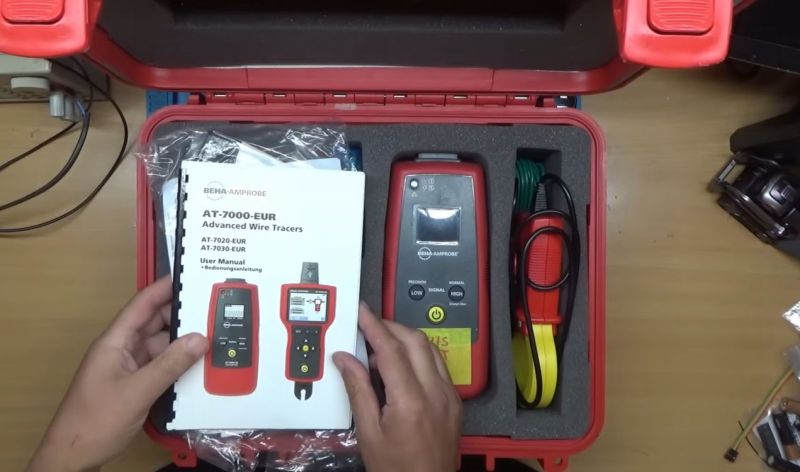
 Perhaps the most annoying kinds of faults are those that involve expensive equipment that just sit around in a cupboard, only for them to just stop working at all. Such was the case with the £2,000 Amprobe cable trace kit that [Tom] bought for work-related purposes. After sitting around unused for a few years, the signal generating part of the kit refused to power up at all, with Fluke’s service department wanting at least £600 to even attempt a repair after already having had [Tom] cough up £70 to even get this quote.
Subsequently he instead sent it to [Buy it Fix it] on YouTube for an attempted repair, which at the very least would be a less costly option. These systems use a signal generator connected to the cable, with a separate detector wirelessly tracking this signal. By itself that doesn’t sound too complex, but as it turns out it wasn’t quite so straightforward to diagnose.
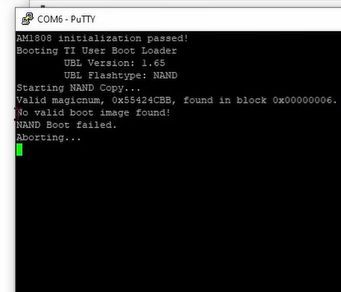
After eliminating a basic power or display issue, the SoC’s boot sequence was traced, including reading from the 128 MB NAND Flash. At first glance the unit appeared to be trying to boot and work as normal, which was confirmed after finding a serial port and seeing the log output on it. This showed that the NAND Flash’s boot image failed validation due to apparent corruption.
After desoldering the TSOP 48 Flash package and stuffing it into a reader, at first glance the data on it looked fine. After a tragic detour with Google’s Gemini chatbot that led to a lot of wasted time, the solution that the human intelligence came up with was to crack open the tracer unit in the set and ogle at its firmware, in particular the bootloader.
Comparing the two Flash dump files, there were a few flipped bits in the bootloader section, likely due to cells in the Flash having lost their charge. Writing the generator’s Flash with a corrected image led to it booting up happily again into the Linux 2.6-based firmware, seemingly no worse for wear. Of course, one has to consider here that the NAND Flash IC clearly has a few leaky cells in it, so replacing it with a fresh one could be a good idea for a long-term fix.












That type of “customer support” is an absolute scam. I went through the same thing with NEC and an LED projector once. This was a $700 projector with an advertised 30,000 hour life on the LEDs. After 2000 hours, 2 of the LEDs had partially burned out ruining color and brightness. Support said it would cost between $250 and $500 to fix, and if I decided I didn’t want them to fix it after they determined the final cost, it would cost $50 just to send it back to me. I told them that was absolutely insane and instead just tore it down to see what caused the issue. The heat management in that unit was abysmal. They had LEDs with grossly inadequate heat sinks in line blowing hot air onto other heat sinks. Some were thin blades others were thick with paint on them. What an absolute joke. Never buy NEC.
Said a lot of people everywhere.
Someone suggested a hashtag for AI related articles in the last article by Al (that’s A-L). I’m getting the feeling that Maya’s name next to the title is essentially a hashtag for the anti-AI mob. I think I’m going to start avoiding the anti-AI articles.
It’s also rather ironic that AI continues to improve but the arguments against it do not.
How is this ironic? First off there’s not a mechanism by which the expressed argument actually means the opposite of what it claims to mean, which is what irony is. Secondly, if you say your machine does X, and your machine messes up, but it messes up less than it used to, why should I change my argument of “your machine doesn’t actually do X very well”?
…Sounds like a really fancy tone probe. Is there some secret sauce that makes a fancy tone probe cost two kilopounds? What does it do that a regular tone probe won’t? Not that I’m necessarily scoffing, I’m just curious
Might have a TDR system to locate distance to faults?
I haven’t actually checked. I’m just speculating.
Yeah, for situations where you really absolutely need to know exactly where the break is before you cut into a conduit or wall. That could make sense.
mmm…no rom…sad…great tech skills none the less…good job!
“I repeat…in error in predicting the fault…”
Even a fresh nand will leak when sitting unused. The shelf life of unpowered flash isn’t infinite or amazing. Things like EMMC are slightly better. In the end, also flashes need to be ‘refreshed’, like dram… Though in the term of months, not nanoseconds :)
There are the JEDEC specifications that NAND Flash has to adhere to, including for minimum data retention which at room temperature should be years. Just powering on the device with the Flash isn’t enough either, as the data has to be actively read, corrected and written back to fix issues.
In this particular case it definitely seems that the one NAND Flash IC had some underlying issues, as random leaky cells like that are uncommon, especially in relatively low capacity ones.
Sticking them in an bag with the air removed in a freezer will typically buy you a couple of extra years before the data is corrupt beyond the ability of the Low-density parity-check (LDPC) to recover data.
this sort of failure mode for equipment really makes me anxious and sad. but having it happen in a fluke really puts their reputation in the trash! stunning.