
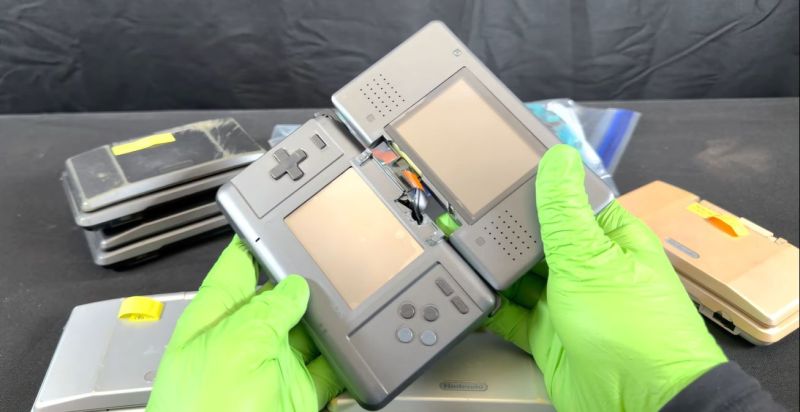
In a recent video [Sqwerks] does a deep-dive into the problem of disintegrating plastic enclosures of Nintendo DS consoles. These original NDS handheld consoles have a metallic-like coating that appears to interact with the ABS plastic, causing yellowing as well as extreme brittleness and correspondingly broken hinges. Unsurprisingly, this causes the shell to essentially disintegrate the moment you try to disassemble them for something like a screen replacement.
While somewhat the opposite of plasticizer migration into ABS from PVC insulation that we covered before, the underlying cause is probably similar, with the Transformers toy community having come to call it Gold Plastic Syndrome (GPS) based on the fact that it were mostly gold-colored parts on these plastic toys that seemed to be affected. Over time the additives used to add a cool metal sheen and swirls to the plastic appear to interact in a way that makes the ABS plastic very brittle.
Although the underlying cause of GPS doesn’t appear to be known yet, the Transformers community has documented this happening since the late 1980s and into the early 2000s, with even reports that some toys from the mid-2010s suffer from this. Whatever the underlying cause of GPS is, the result is always the same, with disintegrating brittle plastic and often a powdery residue.
In the case of NDS consoles, replacing the affected shell with a third-party replacement is still a viable option today, with [Sqwerks] recommending this solution. For other enclosures and toys where the plastic effectively is the toy, it might be that all we can do is watch them slowly disintegrate until we figure out how to revert GPS.












Soaking or brushing on something that reinforces the plastic?
My impression was that even retro-brite only affected the color, but didn’t actually reverse sun damage. I assume this is similar.
TechTangents found that it didn’t help much for color either. On an NES shell he retrobrighted, an area of the same shell that was covered by tape and spared the process yellowed more slowly in subsequent years and an area on the same plastic right next to it that was retrobrighted.
than an area*
Reminds me of the idea that soaking old hardened brittle rubber in wintergreen oil rejuvenates the polymer chains somehow. I have tried it and had mixed results. And I presume it’s going to, like, accelerate its degradation in the future somehow… kind of like putting engine oil on rubber.
Anybody have the lowdown on that? Any similar experiences? It would be cool if there was some magic oil or goo that would re-bond all the polymer chains and reverse time, but it seems suspiciously optimistic.
Methyl Salicylate is the relevant compound here (in both synthetic and natural wintergreen oil).
My layman’s understanding is that it functions as a temporary external plasticizer – it has a strong affinity for a lot of rubber polymers, so it is readily absorbed into the rubber polymer matrix, where it essentially hangs out in between the polymer chains and helps “lubricate” them.
Alas, it does nothing to actually repair or revitalize the rubber polymers themselves, nor can it magically bring back any of the original rubber additives or plasticizers that may have been lost or degraded over the years. And (as you mention) the results can be pretty inconsistent due to the sheer number of formulations we call “rubber”, and the different ways they can degrade over time.
But at least it can help, it’s a relatively safe compound to work with, and most people think it smells quite nice.
This is something called “consolidation”, and it’s often done to preserve museum pieces. It won’t stop the problem, but it will keep the bits together.
That transformers wiki page about the gold plastic syndrome is kind of hilarious. That little community seems to be having fun.
The whole wiki is, ehem, gold.
On polymers
https://phys.org/news/2026-08-composite-retains-response-strain.html
https://phys.org/news/2026-08-monte-carlo-method-simulations-densely.html
The same thing happened with my pearl blue ags101 gba sp. I noticed that the edges were starting to turn almost greenish and when a relative accidentally dropped it two feet onto carpet, it literally shattered. There was apparently a bad batch of those floating around.
I’d imagine that it affects just about any devices produced between the late 1980s and 2010s based on what I have read so far, so it’s probably the same problem. These NDSs in the video also suffered that discoloration that you mentioned.
Whether it’s just a particular additive that’s sometimes used or something else that causes it is still a mystery, sadly…
Were you able to reshell? A 101 is a terrible thing to waste. I prefer them even to a screen modded GBA.
At least good aftermarket/reproduction plastic shells are available for common gadgets like the DS now.
I always blamed my sister for breaking my Nintendo DS but I never accused her. It just broke one day, inexplicably. Its nice to find closure on this one…
I found an interesting recent paper that looked at plastic degradation and might suggest some possible mechanisms for this “gold plastic syndrome”.
(Additive topology governs structural degradation of weathered plastic, https://www.nature.com/articles/s44454-026-00045-1)
It’s an extremely dense paper, but I’ll try and summarize what I understand. the researchers analyzed some samples of degraded polyethylene and found evidence that two common metal additives (Ti and Cr) contributed to the weathering of the samples in interesting ways. As to why:
a plastic sample with larger metal inclusions (several hundred μm), appeared to encourage breakdown by providing concentrated points of stress. Pockets of metal additives created weak points where cracks could form. These cracks would then connect to, and expose, more pockets of the metal additive particles, and so on.
a sample with smaller and more diffuse metal inclusions broke down in a visibly different way; UV and oxidation damage caused the plastic to form a network of tiny cracks at the surface, which also appeared to redistribute some of the additives down the cracks. Both of these things then allowed UV embrittlement and oxidation to happen deeper in the plastic, once again creating a destructive cycle.
Of course in addition to the “appeared to”s and other caveats of the paper, we don’t know what the problematic “gold” and other metallic plastic pigments are, nor are we even consistently talking about the same type of plastic, but the degradation effects witnessed in the paper don’t seem to be particularly dependent on either. It looks like you just need a plastic that becomes more brittle over time (which, unfortunately, is most all of them) and a metal additive that’s prone to oxidizing and/or has particles of a particular size and hardness.
I guess what we really need is for someone with access to the right equipment to perform an analysis on such affected plastics, to see what additives we are talking about. Right now I’m not even certain that metal was actually added to these additives, but we do see that discoloration over time as apparently the underlying polymer matrix is being altered.
Thanks for the paper at any rate, at least it provides some insights into a possible mechanism here :)
I think I understand the cause. In order to metallic plate plastic, there is often a process that involves removal of butadiene (the B in ABS) to make room for inclusions of copper or nickel. Why? Because the copper layer acts as something for the subsequent metallic layers to adhere to. The reason why this is an issue is the butadiene provides flexibility and the removal of it makes the plastic inherently brittle.
There’s still the question of why this only affects certain metallic colors, though. As well as why it takes sometimes literally decades for the issue to become apparent.
Definitely an interesting lead here, though. It might be one of the underlying causes.
Same thing is happening to some vintage laptops as already covered in https://hackaday.com/2025/11/09/recreating-the-destroyed-case-of-lgrs-rare-1980s-laptop/
and external Zip drives https://www.youtube.com/watch?v=I68NKXXwV3o
In those cases it appears that the plasticizer is migrating out of the ABS, leaving the base polymer matrix rather brittle. Somewhat like how ABS gets all squishy after the PVC plasticizer migrates into it from power cables and subsequently said power cable PVC insulation crumbles into dust.
Gold plastic syndrome is a big issue in Beyblade plastic generation too. Actually reading that wiki, it’s from the same companies too: Takara Tomy and Hasbro
In the plastic model space there is a pattern of delayed embrittlement, often called spidering, that can happen to ABS plastics depending on what solvents were used in your paints and how long those solvents lingered on the plastic before evaporating off. I think it’s actually every common paint solvent except water that can do this with alcohol needing the most time and contact to ruin ABS and and whatever solvents are used in lacquer paints that do it the fastest. So, I suspect most painted ABS is going to become brittle and breakdown regardless of painting process.