
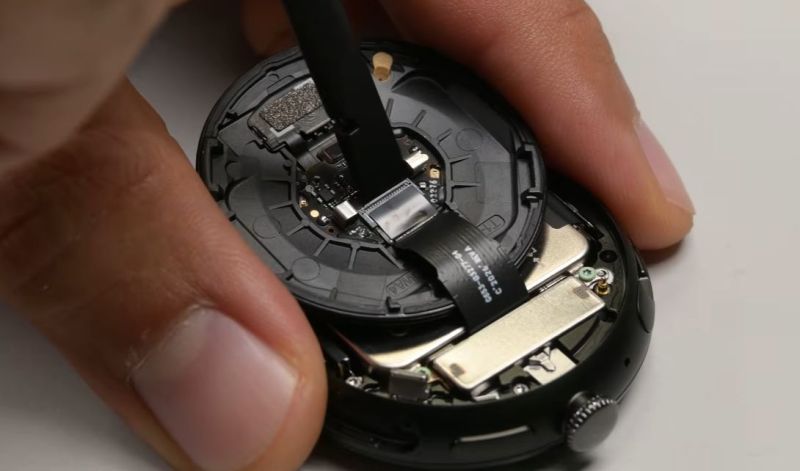
Although we often find ourselves drowning in a seemingly unending sea of portable devices that are effectively e-waste once an internal component gives out, it’s good to remind ourselves that there are a few examples out there by large brands that manage to tick all the fancy feature boxes, while still being very much repairable. Case in point the Pixel Watch 5, a smart watch which much like its predecessor gets a 9/10 on [iFixit]’s repairability score.
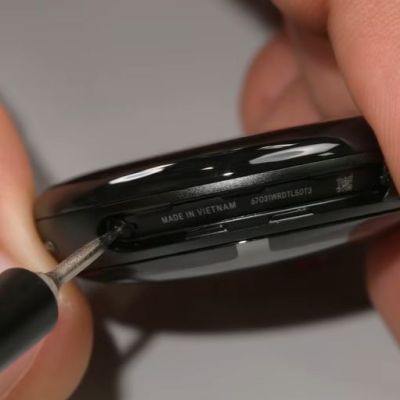
Despite featuring an IP68 rating, opening it is as easy as taking out a few screws to release its latch. This allows the back to swing open, with not a drop of glue in sight, just an O-ring gasket that keeps moisture out and can be reused many times. Digging into the guts, there are color-coded screws that guide one’s hand as the very modular design is taken apart in a matter of minutes.
Being able to simply unlatch the back, and also easily obtain spare parts are two aspects that are a very welcome sight indeed. Although it’s much easier to just glue everything together, something like this latch-and-gasket approach is something that we hope that more manufacturers will copy for these small devices.
It’s potentially also an idea for one’s next DIY smart watch project, as tempting as reaching for that tube of glue may seem.












I was looking through the specs of that thing, and I was stunned. I don’t even need to ask why, I want to know how does a watch OS need 3 gigabytes of RAM?
In comparison, Zepp OS watches have about 64 MB or RAM and couple gigabytes of flash memory for storing music and that’s it. They also run for two weeks on a charge.
I never understood the point of these Google/Samsung/Apple smart watches that run extremely bloated operating systems and burn through the battery in a day. They’re terrible products and also terribly expensive, they cost 2-3x more and yet they don’t do anything interesting for the money. Who buys these things? They seem to be a total rip-off.
You are absolutely right. My Huawei gt2 pro watch cost $204.00 and it will not cracked or scratched compatible with android and ios with a 14 day battery. My newer gt6 pro has a 21 day battery and it was $319.00. I hate to admit but the chinese are 10 years ahead.
Garmin has perfectly functional smart watches with 2-3 week battery life as well, though they’re more expensive than the Chinese ones for obvious reasons.
I want one feature from my (android connected) smart watch: A really good and functional map view when walking.
I’ve a terrible sense of direction, and google maps (and TomTom before that) was life changing, but I dislike needing to keep looking at my phone while walking around.
The Apple watch is pretty damn good at this, but I’ve yet to find anything for android that comes close, and I don’t want to buy into the iPhone ecosystem
Vibe coding used to embed local AI slop generation?
Those of us of a certain age can remember when K became the new b, then M became the new K, now G has become the new M, and soon(ish) T will become the new G. And at each stage you think how can that possibly be necessary?
Megabytes is reasonable, because that’s on the scale of the size of your assets, like bitmapped images: the watch display is about one megabyte of data.
The “how” question is, what else do you add to blow that up to gigabytes? Do you wrap your assets and code all in uncompressed markup language where each byte is surrounded by 100 bytes of metadata?
Gotta shove it full of consumer behaviour tracking. How else do you sell consumer info to advertisers?
“Nobody will ever need more than 640k of RAM!”
Rather depends on if these watches are meant to be effectively a full smartphone in their own right, or merely a Bluetooth device tethered to the real device offloading all the work – in which case whatever fittness tracking etc they might be doing will be draining your phone battery faster and using up its resources instead.
As with the full scope of features people actually expect (though why they want them all, or would want them on the even smaller watch screen is beyond me) you end up needing more resources than if all you want is to tell the time and see if this text/email is worth digging the phone out of your pocket at a glance…
They don’t offload the fitness tracking to the phone – those things work even if your phone is off. The watch has its own GPS, etc. The actual business that they do doesn’t take much resources at all.
I know I was listing the two extremes the device could take, that one extreme actually exists, while the ‘dumb bt’ version is still basically still a full fledged android device that just doesn’t have the WWAN connection of its own does make it less clear. But the point was think how little Ram the watch would need in that case as to hold a transmitted framebuffer and buffer the sensor data for transmission is nothing. Plus the ASIC would get so basic offloading all the work that batterylife for the watch is going to soar.
Even the cheapest dumbest versions that cost $50 do stuff on their own without being connected to the phone. It takes more power to run the wireless communications than compute the stuff in the device.
Indeed, but that doesn’t change the question on how much RAM they need which was that start of this. The more they do for themselves the more they start to need that significantly large number of MB, maybe even handful of GB. Especially as almost everything android is rather bloated, supposedly isolated/secure and highly ‘portable’ applications that are inherently more wasteful.
Where offloading everything you can means you might not even really need RAM at all if your processor comes with enough cache. How the power consumption actually works out is going to depend hugely too, but highly streamlined optimised embedded code on the watch with it being basically as off as can be till the tilt switch says you might want to know the time or the parent device sends the wakeup package, and with it only needing a really really low power core as the parent phone does basically all the work I can see it being vastly better than the actually existing options at how people really seem to use the watches in battery life.
They do pretty much all the major functions by themselves because the connection to the phone is not reliable and they have to be able to operate for at least some periods independently.
To that end, a lightweight smart watch OS like Zepp needs about 40-50 MB and the apps you can download and add to it, like a calculator or a voice recorder, weather app, take some hundreds of kilobytes each. It’s like an early 2000’s feature phone in a sense.
The Notes application on my smart watch is 540 kB and the scientific calculator is 160 kB. The spotify companion app is 3.88 MB, Sonos Control is 2.13 MB… etc. etc.
The biggest app is perhaps the offline navigator, which is 1.55 MB but it needs to download the map data as well.
Again I agree practically it makes some sense to do things the way they are done – though I’d argue its not actually required.
You could have a perfectly ‘smart’ good watch with little more than the sensors, enough RAM to cache the data to make up for the potential for dropped/missed packets and extend the period the radio can effectively be parked in its lowest energy state waiting for the wake up packet. And the ability to tell the time on its own – once the radio link is in a high power mode you shouldn’t have any worries about its reliability of connection, a wifi-direct or BT connection without concern for maximal power savings while the watch is actively in use as the portal to your phone shouldn’t really have issues outside of the most crazy situations that your phone probably isn’t working right either..
This is good because if they have anything close to the same failure rates as their phones youll need to fix them.
Based on personal experience, pixel phones have the highest non-abused hardware failure rates of any modern electronic. Failed batteries, display modules, and memory chips are the unfourtunate norm.