
Drones have become a potent military threat, particularly on the small scale. Nimble multi-rotor drones are fast, difficult to spot, and can cause plenty of harm if allowed to go about their work unhindered. The first step to dealing with this issue is detection—a problem that [Agam Rossen] has put some work into.
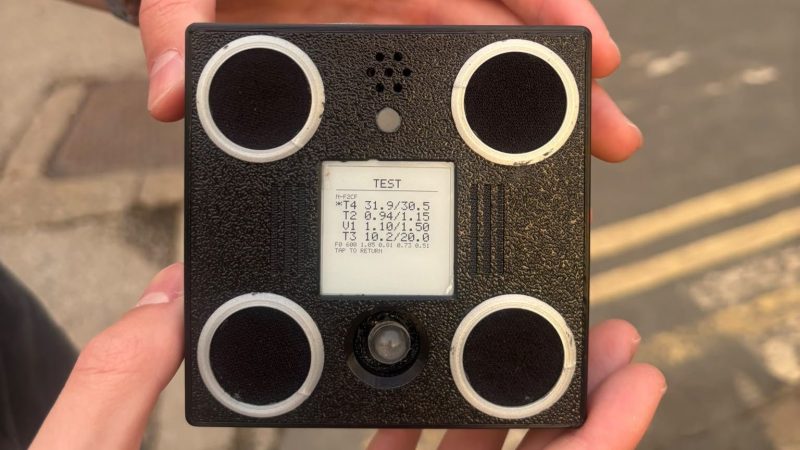
The result is VolAnti—an open-source drone detector. This route was chosen as a reliable way to detect incoming multi-rotors, since spinning propellers tend to create a telltale sound that can be plucked from the noise quite specifically. In a world where fiber optic drones eschew RF emissions, it also proves particularly useful for early warning of such craft.
VolAnti relies on a small four-microphone array, with the I2S output of all four mics summed together. The output is then fed into a 2048-point FFT running every 32 ms on an ESP32-S3. A comb score is given to try and pick out different blade rates from 70 Hz to 2000 Hz. Multiple detection algorithms run in parallel, because [Agam] noted a problem—using an adaptive noise floor would miss drones that arrived in the area and hovered in place. With the noise not varying, it would get filtered out by the adaptive floor, so one algorithm in the four runs with no floor to catch drones that aren’t moving. Files are on GitHub for those curious to learn more.
We’ve featured other acoustic detection projects before, too. If you’re working on something similar, or conversely, you have the inside scoop on how to hide a drone’s noise signature, don’t hesitate to let us know on the tipsline.












Okay cool project.
I’m pretty sure it’s just me, but the mutilated bike in the video got most of my attention.
seems like he doesn’t need to detect a drone, he needs to detect whoever ran off with those wheels!
That’s why you should lock it with a chain that goes through both wheels and the frame.
Which quickly weights more than the bike itself. Alternative: a crappy bike no one would steal.
It’s a law of practical physics: bike + sufficient lock/chain theft deterrence = 30 pounds
There is no such thing as a bike sufficiently crappy to prevent theft, if the bike operates at all. Bikes without front wheels get stolen, bikes without seats get stolen. If it can be ridden, it will eventually be stolen.
I was hoping it would pinpoint the direction, because that would be very useful to point out where the mosquitos are in my bedroom
There is a laser mosquito killer for that, look it up!
https://hackaday.com/2025/03/25/supercon-2024-killing-mosquitoes-with-freaking-drones-and-sonar/
One of many LIDAR and ultrasound mosquito detector/killer rigs on Hackaday. There is a product from China as well on preliminary search.
Makes me wonder if one of the acoustic imagers I’ve seen lately might be able to detect a mosquito.
Fluke makes one:
https://forms.fluke.com/easy-industrial-facility-leak-detection
Countermeasure idea: Spread-spectrum PWM control of the drone’s motors.
The noise you can hear (and the noise the project is tracking) is caused by the blades, not the PWM. Spread-spectrum PWM will give you the same propeller speed and the same sound as a regular PWM.
The PWM frequency might cause the motor to whine, but that’s not what this is tracking.
As the blades are usually directly driven by the motor and able to ramp up and down rapidly (that is what the control loop that keeps the things flying is actively doing!) erratic PWM of anything but the craziest short duration variations so the inertia overpowers the signal will change its noise output from the blades potentially very significantly. Also likely make the thing lurch around the sky as it interferes with the flight controller’s idea of optimal stability…
So the theory you could beat a particular filtering algorithm and microphone array with PWM driving the signal you produce out of bounds isn’t entirely implausible. But I rather doubt it could be done practically – beating systems like this probably requires either going much larger blades so the noise profile is massively different or just going fixed wing glider so you don’t need to rum the motor very much if at all to stay in the air making catching and identifying the noise much trickier. Maybe even lighter than air glider concepts where you use the aerodynamics to control your direction and speed and the lift alternating with gravity as the energy source (but while that sort of concept has been proven in submarine it seems like it would be rather harder to actually build a working airframe in air)
Accelerating and decelerating physical devices with inertia will consume more power. So the range would be shorter.
I think a better Countermeasure would be to zig-zag(-zeg/-zug/-zog) in three dimensions to make interception more difficult. And yes it would also use more power to travel the same distance, but being tracked is useless if being intercepted becomes extremely difficult (Check out the 1979 comedy “The In-Laws” for how excellent zig-zag/serpentine works).
Babou! Serpentine!
I was wondering why 4 mics summed, but the write up says 6dB amplifier noise suppression which is not bad at all.
Now hook it up to a ZU-23.
This could be expanded to detect individual types of drones by training a Random Forest model with feature extraction just the same as is used to detect song birds etc.
I wonder about drones that use those quieter whisk shaped blades perhaps if the drone was quiet enough, you put a phased ultrasonic array under it to project a false acoustic location.
Add more sensors with baffles for direction finding, and ranging, MCU with ballistic trajectory calculator, and mount on a gimbal with a programmable detonation delay mortar. Zig zag all you want. Blast radius don’t give a damn.
PS: Don’t build this in a country where they frown upon such entrepreneurial endeavors.
Send out a sound with an audio spotlight at the resonant frequency to match the rotor speed and make the blades wobble to destruction.
If this pinpoints 3d coordinates and works well enough to guide a counter-drone then you may have a military career in your future
Countermeasure idea #2: Mechanically altering the airflow paths into the propellers (solenoids? servos?) to continuously randomize the audible signatures of each blade.
#3: Multiple sets of different sized rotors selected at random by the motor controller.
A dog trained to listen for drones and to look in the direction of the sound and the watch the dog !!
Just a thought !!
Dogs have good noses, but directional hearing? I’m not convinced.