
 After the Orion capsule of the Artemis I lunar mission returned to Earth, it was found that massive chunks of its heatshield had been ripped off, posing a serious risk to any future missions. In a recent video in which [polymatt] takes a break from repairing old laptop shells and the like, he tries to recreate the Orion’s heatshield using a variety of methods and materials.
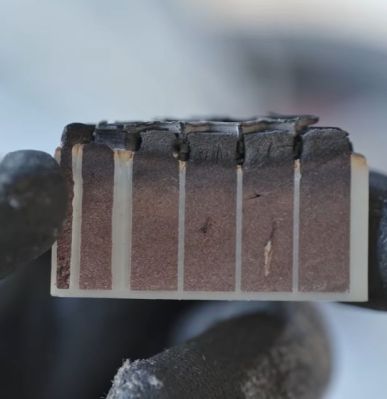
For this test a number of samples were created, each using the same kind of segmented structure as the larger Orion heatshield. The filler was created from the published materials for the heat shield by NASA, requiring just serious mixing.
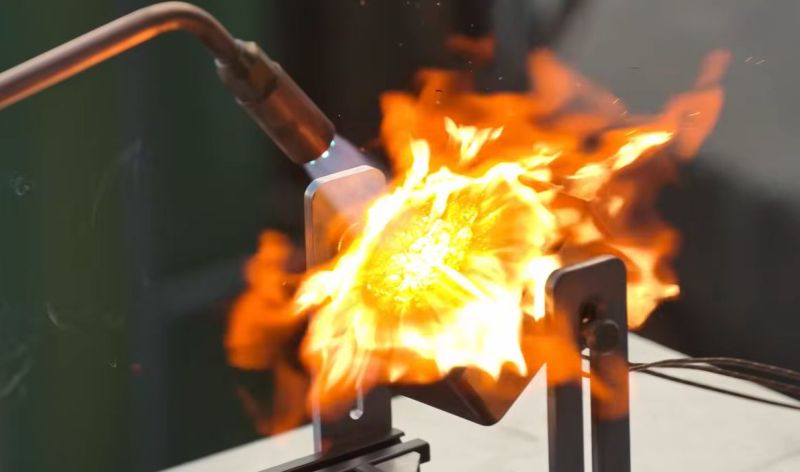
The resulting samples were then cured with thermocouples inserted, before they got blasted with the heat from a propane torch, trying to simulate the various re-entry patterns.
Perhaps unsurprisingly, the results matched the findings by NASA for why the Orion’s heat shield had failed, being the build-up of gases due to the sustained pyrolysis processes that eventually fractured the material. Despite some experimental flaws that injected residual heat from the copper structure, this still seems to be a pretty good setup to test ablative heat shields in DIY lab conditions.












mayhaps the heatsheild needs a tread, like a car tire, to shed the gasses more effectively
…Or some kind of strategic internal weak areas designed to break and shunt those gasses somewhere safe without compromising the critical outer layer
Artemis II was fine
https://arstechnica.com/space/2026/09/it-turns-out-that-orions-much-maligned-heat-shield-performed-really-well/
Pure nitrogen can be a problem
https://phys.org/news/2026-03-titan-entry-lab-flag-nitrogen.html
Take a look at the 7:19 minute mark here:
https://m.youtube.com/watch?v=HxaPVRh3Bgs&ra=m
Sounds like some at SpaceX got humbled.
Maybe NASA could use toilet paper for the heat shield: https://youtu.be/nxlnSQhIRvQ?is=rRCwz3z2D_yDcP23
There’s a video out there suggesting hemp.
People could do spacewalks to cover the ISS in used toilet paper to help it survive the re-entry into the atmosphere. This way we could preserve it for future generations. Maybe it could be repaired / modernised and launched into orbit again using many rockets working at the same time in cooperative (like drone light shows).
The latest research
https://phys.org/news/2026-10-nasa-generation-shield-technologies.html
Off-topic but this is another Youtube post, so…
Can anyone explain why Youtube turns off their RSS feeds for ~4 hours every night? WHY? They aren’t technically ‘off’ I guess, since they randomly alternate between 404/not found, 500/server error, and about one in 200 or so will load the real actual .xml file. Usually it begins at exactly 0300 GMT and they start working again at exactly 0700 GMT. Sometimes they start craping out earlier but it mostly sticks to that schedule. It’s been doing this for like 8 or 9 months. For a while there it was only on weeknights, and never on Friday/Saturday/Sunday. Utterly bizarre. Can’t find anything relevant in searches, but then I can’t ever find anything relevant through a search these days.
They probably don’t know, and any tech support method of contact leads to some bot that doesn’t understand
I never noticed this pattern. I thought I was going crazy with youtube constantly making my reader give me ‘failed to fetch’ errors. No answers, but thanks for pointing it out. Not sure if we’ll ever get an answer given that google really doesn’t want anyone to use an RSS feed.
my wildest guess: backend DB is down for dumping/vacuuming.
Sure, but would some requests still make it through? What kind of condition do they have it in where it’s a spin of the wheel whether it’ll return a 404 or a 500 or the true .xml? What kind of system do they have there that needs 4 hours of downtime for maintenance out of every 24? I don’t think that makes any sense. If every request came back 404 then I’d say sure, sounds plausible. Still incredibly dumb.
Well, running an RSS feed is complicated and you can’t expect a tiny company like Google to be able to reduce their downtime.
/s
Offgassing is definitely the #1 problem to solve. I worked on varying Avcoat’s long chain polymer crosslinking dynamics to create a more deliberate density gradient and to control heat flow. Basically a novel deposition technique to create offgas venting in the right places, to yield more stable pyrolization in the other right places. A bunch of regime changes happened right when I was submitting to NASA SBIR that caused their priorities to change toward non-ablative, reusable TPS, so I’ll bring it out of the lab when the mood changes again.
Some of you might remember the “Starlite” formula bandied about.
Wonder if that works for neo-Pykrete:
https://phys.org/news/2026-09-scientists-super-ice-ten-stronger.html
When I read the URL there I could not help but think of Kurt Vonnegut’s Ice-nine :-)
Really appreciate the post and all the comments. This was a fun build. One slight correction is that the flame I used was oxyacetylene. Propane wouldn’t have gotten close to the temps.
I was impressed by the testing procedure. I have no background in materials science. I have, however, delved deeply into another field: the development of computer-controlled electronic musical instruments. I found your tests fascinating; everything required for the tests demonstrated a deep level of expertise. Thank you for this informative project, which shed light on many aspects of heat shields and their complexity.