
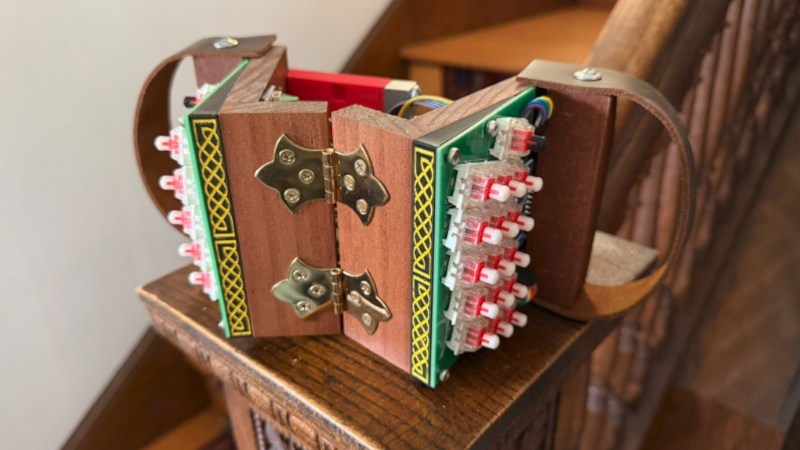
The concertina is an instrument that features heavily in European folk music, of which there are a variety of types. [Xcott Craver] has built one, an anglo concertina of the type you may recognise accompanying sea shanties, but this is no ordinary squeezebox. Instead it’s an electronic concertina, and it’s a project with a significant attention to detail.
Perhaps the most obvious thing most of us know about a concertina is that it’s an instrument with two ends separated by a set of bellows, and manipulation of the bellows lends a lot to the music it produces. This instrument doesn’t have bellows, but its innovation is to simulate them through means of a load cell. The two sides of the wooden chassis are fixed, but the force exerted on them is measured.
The keys are Cherry MX switches with custom keycaps, mounted on a pair of PCBs. Driving the whole thing is a Teensy 4.0, and to avoid unfortunate accidents with ripped-out connectors there’s a USB extension lead as a bit of strain relief. You can hear the result in the video below.
This is like no other instrument we’ve seen here, though we’ve had a few electronically enhanced conventional concertinas and accordions. We like it for its interesting design.












I am a concertina player and synth designer also working on a similar project on the side. I’m a bit skeptical of the load cell approach since as a player the physical movement is so important to the dynamics of the music. I would love to try this of course but the dream would be to have one that moves and responds like an acoustic.
Load cell + IMU on each side?
Good to see this; load cell and key switches was exactly my plan. If there’s enough detail published, I’ll have to build one. Note that if you make the keyboards interchangeable, with a bit of additional software this should also be able to emulate other members of the family, from English to Duet to (possibly?) bandoneon (band onion?). Might need to replace the hand straps with English – style grips, but …
As far as physical movements are concerned, think of it as infinitely efficient bellows; if coded right it should respond to press and draw in exactly the same way a real instrument does but never run out of air in either direction. It doesn’t give you the visual drama of waiving the ends around in the air, but on the other hand you never have to resort to the breather button. If done right, it should be very easy to adjust to.
(“Why start with Anglo?” It’s what we already happen to play. And good Anglo concertinas command a high price these days, since they are hard to find but traditional for Irish music — despite arguments about whether they are the best choice for that set of styles — so an affordable alternative might get significant interest beyond those of us who want it as a synth input or for headphone rehearsal.)
I’ve published what I think is everything you’ll need (see the first link above) including instructions and tips, links to the needed files, and links to Tinkercad for the handful of printed bits. My goal is to make this build available to any sufficiently motivated hobbyist.
If you want a different layout from Anglo: aside from CADding new PCBs, you may need a different schematic or topology to read more than 16 buttons per side — the MUX boards on each side have 16 channels, suitable for an anglo with a very simple schematic.
Awesome, thank you.
Very, very interested. I already have too many projects hanging fire, but this one may be relatively high priority for me. Among other things, I have a couple of specific events in early 2027 that I might want to use/demo it at.
Yes, I assumed that keyboard mux and scanning routines would probably need to be tweaked to extend this further. Most folks don’t overdesign unless they have future plans that will need that extendability. (Trade-offs of designing for core function versus designing for reuse…)
Interesting that you decided to use a 16:1 mux chip to individually access the switches, rather than using traditional switch grid with diodes to prevent aliasing. It does keep the parts count and build complexity down, but it limits you to a 30 button (ok, 32-button) instrument. I play a 38 button, and while I use most of them fairly rarely (I’ve yet to use the two innermost at all) there is at least one (low Bb) that I do use fairly often.
And I am interested in playing with (as opposed to playing?) a duet-system instrument at some point, which will again require a whole lot of buttons. (I’m not sure about how tightly spaced; haven’t gotten my hands on one yet.)
So that part of the design and code may want a bit of hacking upon, at some point. But the right answer is probably to build as you’ve designed first, then consider variants.
As a mostly stylistic thing, I might consider adding some face plates over the switches and a piece of leather or fabric encapsulating the back. I’m going to want to travel with this, and I’m a firm believer in not letting random objects fall on electrical contacts.
Suggestion for another wood finish, if you haven’t tried it: ebonized oak. Black with metal trim is one of the traditional colors for the instrument.
Perhaps a “Linear Stroke Potentiometer” with a spring to tune the force required? I’m with you on how load cells give insufficient feedback – technically the buttons on game controllers have been analog for decades but I only manage on and off consistently
Yeah it seems like it would need some mechanism to dynamically change the resistance. On a real concertina, or at least one with no leaks, you can’t move the bellows in or out until you open a key, and the more keys you press the easier it is for air to rush in or out, and the faster you run out of play. It would be a handy feature to have an infinite electronic bellows, but it would probably cause a bit of a learning curve for people who already play the analog ones. There’s even an air key that has no reed under it that allows you to quickly inflate or deflate the bellows without making sound.
As someone who plays the instrument (though not especially well): For me the actual movement of the instrument is an awkwardness that one has to plan/arrange around, with the exception that it can be a visual element during performance. I actually have two concertinas (pitched differently, and having different sounds), and much of the difference between playing the basic instrument and the serious one is that the latter is more efficient in its use of air. The better one is also more responsive; the reeds start to “speak” more rapidly.
As the immortal Tom Waits said, “a gentleman is someone who can play the accordion but doesn’t”.
Haha that’s the first time anyone’s called me a gentleman
I am not an electronics expert, but have played lots of little MIDI controllers into my iPad, and have played the Anglo concertina (reeds and bellows) for about a dozen years, and I am here to tell you that the Craver is an amazingly capable little instrument. While I needed a few minutes to get used to the lack of movement, the load sensor really does allow great dynamism (volume control through pressure, in this case) and the buttons respond as well (or nearly) as my modern hybrid “real” concertina that cost in the $2.5K range. Add the “instant capo” key changes and the limitless voices available for the iPad at a pittance, and it’s a real home run! With an iPhone, battery pack, mini external speaker fed from the 3.5 mm headphone jack, you have a lunch-box sized portable system weighing in at less than 4 pounds, while the part you hold to play weighs just 20 oz. Thanks, Scott, for your work and your sharing!
Many thanks for the review! Yeah, gotta get this onto my queue … and then, of course, see if I can contribute back to the project.
Yes, the ability to capo/transpose would be wonderful and is one of the reasons I’m interested. (Guitar player: “We tune because we care.” Me: “You tune because you can… ”)