
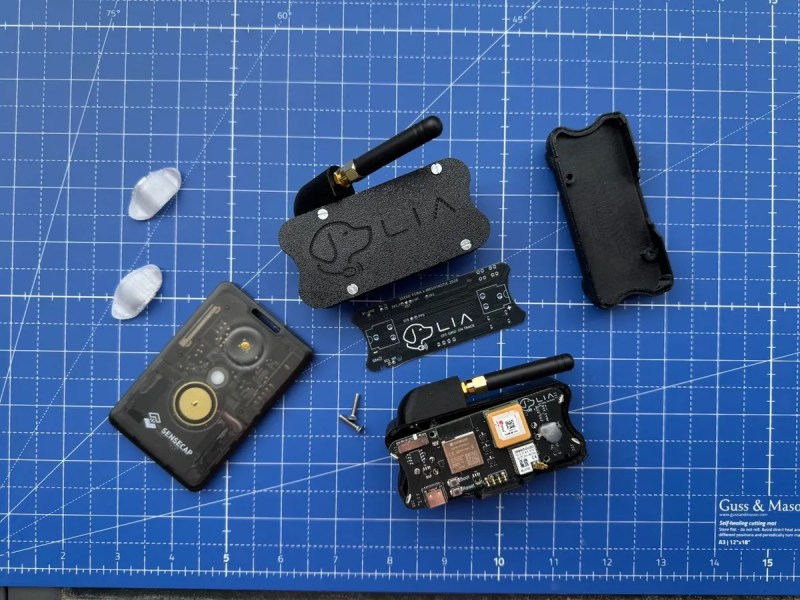
Most commercial pet trackers require a subscription or network connection to function. [Jon G Aguado] wanted a better way and designed LIA, a Meshtastic collar tracker.
LIA uses a custom PCB containing a ESP32-S3, LoRa radio, GPS/GNSS receiver, and a charge controller for the 18650 or 5023450 pouch Li-ion cell powering the device. Everything fits inside a 3D printed enclosure, and the device is charged via a magnetic 4-pin USB pogo connector to increase weather resistance.
One of the neat features of this particular tracker is that [Aguado] gave it two different power modes. High power gets a location fix every 30 seconds and has a pair of bright LEDs for visual assistance, low power only gets a fix every minute or so, and it can also be set to off, which is something we wish more device manufacturers remembered should be an option.
We hope anyone planning on using Meshtastic and LoRa in the US is aware of the issues surrounding FCC compliance, and if you want to track your pet another way, maybe KineFox is an option?












When I first read the headline, I thought the post were about tracking PET (plastic) recycling.
Mwhuaahahahaaa …
I hoped it to be about the Commodore PET computer series, but this is fun too. Cool project.
Where as I went to positron electron tomography…
Does anyone have a rough estimate of the cost of pcb and parts?
I know i could just upload the provided files to a manufacturing service, but I don’t have an account with seed fusion, and maybe someone else already has a rough ballpark number at the ready?
ChatGPT-assisted Seeed Fusion quote:
I ran the project files through Seeed Fusion to get a ballpark figure.
One complication: the supplied BOM is not directly in Seeed’s expected format. After converting it and supplying manufacturer part numbers, Seeed automatically matched 20 of the 29 component groups. Nine groups—including the magnetic pogo connector, LEDs, switches, charger IC and protection components—still require manual review.
For the automatically priced portion, including the ESP32-S3, SX1262 module, SAM-M10Q GNSS, IMU and fuel gauge, Seeed quoted:
1 assembled board: $200.15
5 boards: $492.53 total, or $98.51 each
10 boards: $809.33 total, or $80.93 each
20 boards: $1,476.03 total, or $73.80 each
40 boards: $2,709.94 total, or $67.75 each
Bare ENIG PCBs add $39.90 for the minimum five-board run or $58.92 for 40 boards.
Allowing for the nine components still awaiting manual quotation and their assembly, my estimates for complete boards are approximately:
1 board: $285–315
5 boards: $620–680 total, or $124–136 each
40 boards: $3,250–3,550 total, or $81–89 each
Those figures exclude the battery, LoRa antenna, enclosure, programming, and possible shipping or tariffs.
I hope he linked it to meshmapper as well! heh. Warpetting?
Still not as bad as what a certain camera doorbell manufacturer was planning on giving to the general public. Although I do wonder if it’s not been retained at some level. At least something like meshtastic is still more or less under the control of the end user by design.
this is big in my community. we are very rural. ive designed several pet trackers based on the heltec v4 for a handful of my neighbors, for free, as long as theyve contributed to expanding our groups infrastructure by setting up a base node or repeater. this design here is cool but from experience the form and antenna attachment is likely to get snagged on brush or caked with mud. i have since switched to an outer adhesive antenna. something like how the sensecap antenna is assembled, only mine is sealed in resin on the outer case wall. provided the infrastructure has no gaps the transmission is never missed. its also minimized the amount of “my dog got out again, has anyone seen them” posts on FB.
Have you published anything on your device?
You should share more of this, sounds great
Cool cool cool but that thing is almost bigger than my cat.
How low power can ESP32-S3 get? iirc there was a quirk where the actually decent low power modes of ESP32 family of chips were only possible if you were okay with the application resetting the CPU after sleep, no way to have __WFI() or similar scheme where code continued after waking up. You had to store the application state in NVS for this to work, which was just not good for flash life, in general. Or an external EEPROM.
And even then the sleep modes were not very good, more than 20uA or so even at the lowest one. Much worse than Nordic, STMicro or SiLabs offerings
I may be remembering wrong though
If using RTC timer, can store data in RTC memory with RTC_DATA_ATTR , see
https://docs.espressif.com/projects/esp-idf/en/stable/esp32s3/api-guides/deep-sleep-stub.html#load-wake-stub-data-into-rtc-memory
Between 7uA and 10uA while sleeping.
Does anyone know what the state of the Meshtastic code is… with respect to the FCC violation seemingly implicit in its current form?
Has FCC- compliant code been released, yet?
This is very timely. I’ve already got a Meshtastic setup for my own dog who likes to roam over (and beyond) our 4 ha property, but the tracker I bought (RAKWireless WisMesh Tag, slightly bigger than a SenseCAP) dwarfs the poor guy — he’s just a little corgi. This one is cool, but doesn’t appear to be that much smaller than a SenseCAP.
The power connection on one of them died, so I’ve ripped it apart and I’m contemplating hacking its form factor so that it’s more compact — same volume, but folded in half. I want to use it as an opportunity to put a pager motor in there for training too. (I can use the message LED as a GPIO for it, I think.) The only tricky bits will be making the buttons and charging port both accessible and waterproof — haven’t figured that out yet. That’s why I’m looking forward to looking at how this project solved it.