
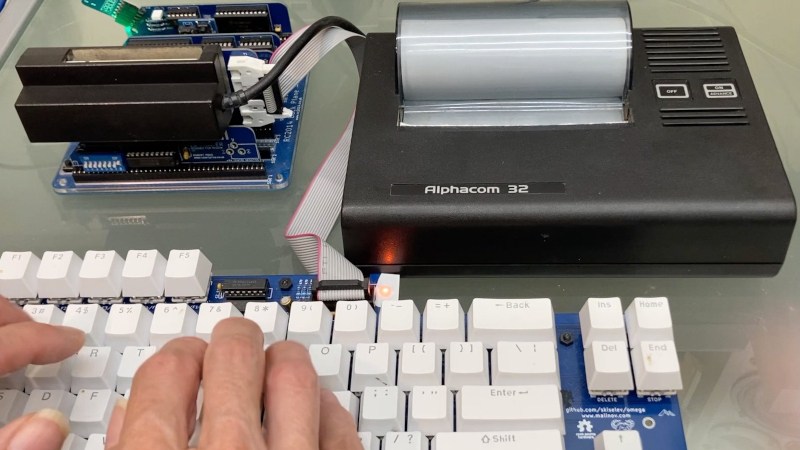
Here in 2026 if we need a terminal the chances are we fire one up on our computer and continue on our way without a thought. What we are doing of course is emulating the experience of earlier hardware terminals, ones with a serial port on the back, a keyboard, a screen, or if they are a bit older, a teletype printer. [Sheila Dixon] is recreating that experience for the RC2014 retrocomputer, and she’s using some period-appropriate hardware and techniques.
Perhaps the most obvious thing about her build is her choice of printer. Sir Clive released a notoriously bad thermal printer for the ZX81, and it wasn’t long before a third-party alternative appeared in the form of the Alphacom. This printer connected directly to the ZX’s bus via its expansion port, and like the Sinclair printer, was serviced by ROM routines linked to BASIC commands. This is joined by a keyboard, first an MSX item, and then one she’s made with some retro typewriter keycaps.
She’s interfaced her Alphacom to the RC2014’s Z80 bus in the same way as it would be with the ZX81, and with a few teething troubles created some routines in a ROM to drive it as though it was the RC2014 terminal output. The keyboard is scanned using an 8255 I/O port card, much as it might have been back in the day.
If you’re curious about the Sinclair printer, we used one (without harming it!) for an April Fools’ joke during the pandemic. Meanwhile we have reviewed more than one RC2014 model, the most recent one being in 2019.












I have one of those printers laying around. That would be a fun project.
Wasn’t the original one a spark printer, the exact reason why it was notoriously bad?
It was. On shiny silver “paper”. The output, though, was marginally more robust than that of the Alphacom, which, like all thermal printers, was prone to fade/darken over time, or if left in a slightly warm room.
Oh yes. I remember that after listing a long BASIC program to the ZX Printer, the whole room smelled of ozone.
Heh, I remember using a TI Silent 700 terminal, it sported a thermal printer terminal and acoustic coupler.
The Sinclair 2040 printer is an Alphacom. Alphacom made them for Sinclair.
They’re quite robust. Mine are completely original and still work quite well, and thermal paper is still easy to find.
I designed that printer around a mechanism that Olivetti used in its calculators. Used with the correct paper (JUJO Japan Paper & Pulp Co) the thermal printout was bright and persistent, and the print heads would last a long time. The printers were actually made for Timex, which bought the computer product from Sir Clive and rebranded it as their own. IDK where the Alphacom 32 label came from; the original 10,000 units were labeled as Timex units by Alphacom. The processor inside was an Intel 8041 but we bought them from NEC in Japan. Bob Krivacic programmed the 8041 ROM to deal with the somewhat bizarre printing output of the computer (it was not any standard ASCII output), using the UV erasable 8741 version. The big lump of a connector had several ferrite beads inside to deal with RF noise on the connector coming from the circuit board of the computer. Without them, the combination would not have passed the FCC Class B computing device noise standards; IDK how the original computer did by itself; it had hardly any shielding inside.
The printer was designed to be simple and cheap to assemble (less than 1 minute); only 4 screws held everything together. The PCB was a single sided punched phenolic board. Molded posts positioned the print mechanism in the case. The paper cover was designed to pop off without damage if it was accidentally hit. The two “switches” on the top snapped into holes above two button switches that were on the PCB directly below them, the kind used in many game consoles at the time. The “power supply” was a simple transformer in a wall wart; actual multiple DC voltages used were produced inside on the PCB. It was the simplest printer Alphacom ever made, and the most reliable when used wth the recommended paper.