
One of the most fun challenges in paleontology is determining characteristics of long-dead species like their behavior and body temperature based on nothing but some fossils and traces that are usually millions of years old. Something that has long vexed the paleontological community for example has been the question whether non-avian dinosaurs like the well-known Tyrannosaurus rex was cold- or warm-blooded, and if the latter, what temperature this was. Cue a recent study by [Randon J. Flores] et al. in Science Advances in which they seek to answer this question.
Although modern-day dinosaurs in the form of birds are all warm-blooded – meaning capable of regulating their body temperature – species like crocodiles, who also lived alongside non-avian dinosaurs, are cold-blooded and have to cycle between sun-basking and a cool dip in a nearby river to maintain their body temperature.
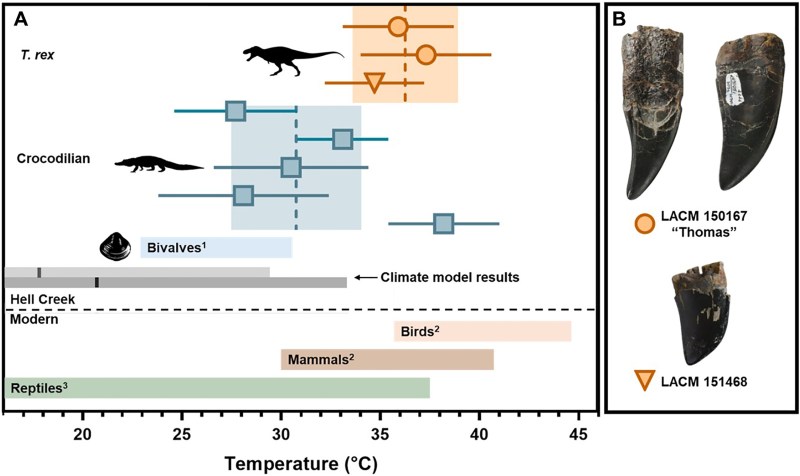
By looking at the temperature-dependent formation of carbonate clumped isotopes in three T. rex teeth from the Late Cretaceous Hell Creek Formation, they were able to deduce that these dinosaurs had a body temperature of 36.3 ± 2.5°C, comparable to modern-day endotherms. This was also much higher than that of contemporary crocodilian teeth found in the same area.
When popular dinosaur movies like Jurassic Park showed T. rex and other non-avian dinosaurs as being active, warm-blooded hunters, this was pretty much based on cutting-edge science at the time. Fortunately for its creators, later paleontological findings have largely confirmed that portrayal, although these days non-avian dinosaurs have often gained more feathers and other details – even outside of feathered theropods that became birds – that were absent in these early 90s reconstructions.












Also of quite fascinating note, the atmospheric pressure and gas composition, as well as daylength, were significantly different than todays making biology unique to its time. Magnetic sphere fluctuations have also seen radiation shielded/soaked crust and a whole range of surface albedos and cloud cover characteristics. Earth in its history is a multitude of worlds
Which struck me as a plot hole (yeah, yeah, willing suspension of disbelief and all that) in The End of Oak Street. Other than some characters blithely remarking that it’s a little warmer outside, there’s no reference to what must have been a different atmospheric composition and climate in the era their neighborhood found itself in.
That said, it’s still a crackingly good movie, and I’m glad I saw it.
What determines if a dinosaur is avian, if it can fly? Or if it has feathers? T. Rex was a theropod, same as all modern birds, so it’s a pretty safe assumption it was warm-blooded. Clever technique though, I wouldn’t have thought that isotopes could pinpoint a body temperature that accurately.
wings
The disturbing part is that this is climate-change funded. How will this save the planet from evil fossil fuels and CO2 pollution? Just kidding, of course. It does illustrate how climate-change funding, is used to buy tools, which get used for other things. Where an office worker could get fired for running off a few dozen lost pet flyers on the clock. These critters aren’t coming back to life. Really no value, other than a curiosity. Another speculation, that changes nothing. Unless the plan is to GMO food animals into monstrosities. In which case, the should quit messing with reducing CO2. Plants really like a CO2 rich environment. Monstrosities require a lot of food.
I didn’t look into the specific grants, but which ones are climate change specific finding?
Funding Information
National Science Foundation: EAR-1352212
National Science Foundation: ICER-1936715
Royal Society: RSWVF\R2\212004
Royal Society: NIF\R1\231802
Heising Simons Foundation: 2021-3137
Heising Simons Foundation: 2022-3314
Heising Simons Foundation: 2024-5453
BBC Natural History Unit/AppleTV+: A100198-102
BBC Natural History Unit/AppleTV+: A100198-102
I highly doubt The-vile-one’s american government is funding climate related studies.
Just a guess though.
I concur. I just don’t see the practicality of this pursuit…. except perhaps to generate doctoral theses.
Plants like CO2 but on the other hand do not like being on fire or living in a desert I hear. So fussy, the dears.
And plants don’t need humans really, humans could go the way of the Dodo and they’ll get by.
Amusingly, there actually is a plant (a tree) that is functionally extinct (living individuals, but no viable seeds), and the best guess is that they needed the dodo. As of a few years ago, passing seeds through a turkey’s digestive tract didn’t produce saplings, but came closer than anything else had.
I’m all for the pursuit of knowledge, however…. what would knowing the body temperature of T-Rex bring to the table in terms of “scientific advancement”?
Certainly not improving the health of such a specimen currently being held for study in captivity. Not really applicable to improving the health of extant species, either…. after all, none of them are T-Rex.
Paleontology exists whether you find it of relevance or not.
The primary consumer of facts and speculation about dinosaurs is ten-year-olds, who are well-known as one of the segments of the population with the most disposable income.