Determining The Body Temperature Of Tyrannosaurus Rex

One of the most fun challenges in paleontology is determining characteristics of long-dead species like their behavior and body temperature based on nothing but some fossils and traces that are usually millions of years old. Something that has long vexed the paleontological community for example has been the question whether non-avian dinosaurs like the well-known Tyrannosaurus rex was cold- or warm-blooded, and if the latter, what temperature this was. Cue a recent study by [Randon J. Flores] et al. in Science Advances in which they seek to answer this question.

Although modern-day dinosaurs in the form of birds are all warm-blooded – meaning capable of regulating their body temperature – species like crocodiles, who also lived alongside non-avian dinosaurs, are cold-blooded and have to cycle between sun-basking and a cool dip in a nearby river to maintain their body temperature.

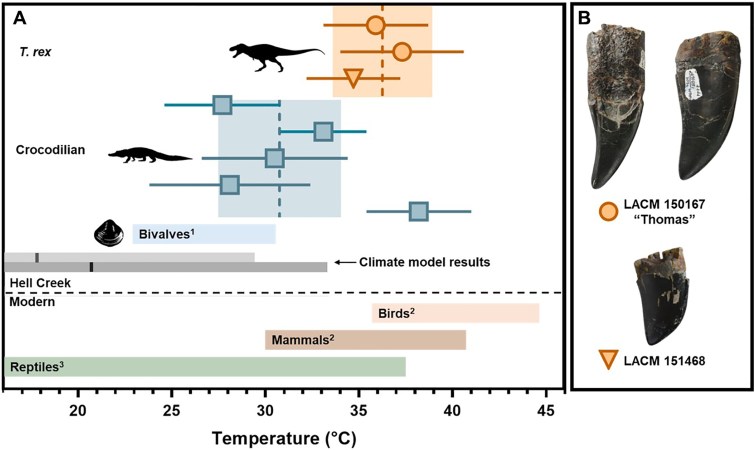
By looking at the temperature-dependent formation of carbonate clumped isotopes in three T. rex teeth from the Late Cretaceous Hell Creek Formation, they were able to deduce that these dinosaurs had a body temperature of 36.3 ± 2.5°C, comparable to modern-day endotherms. This was also much higher than that of contemporary crocodilian teeth found in the same area.

When popular dinosaur movies like Jurassic Park showed T. rex and other non-avian dinosaurs as being active, warm-blooded hunters, this was pretty much based on cutting-edge science at the time. Fortunately for its creators, later paleontological findings have largely confirmed that portrayal, although these days non-avian dinosaurs have often gained more feathers and other details – even outside of feathered theropods that became birds – that were absent in these early 90s reconstructions.
Pong-like Cabinet For Classic Dinosaur Jumper

Back when Google ran a functional search engine, there used to be all kinds of quirky, fun antics hidden in their products. From Easter eggs in certain search results, to a flight simulator hidden in Google Maps, to funny, engaging April Fools jokes, it was a lighter, less corporate time. Now, though, to recreate any of that early Google magic, we have to do it on our own, and [Paul] has come up with an arcade cabinet for the classic Google Chrome dinosaur game that does just that.

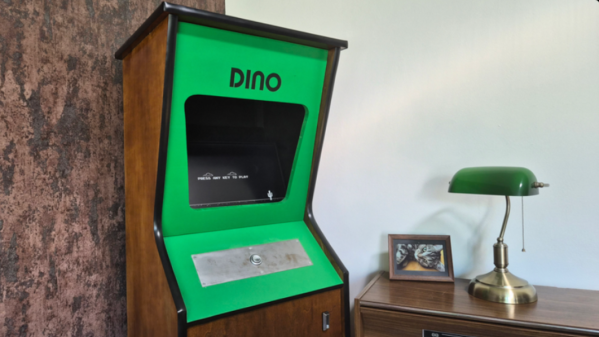
Although the Dinosaur Game is still available in modern versions of Google Chrome, it lends itself almost perfectly to an arcade cabinet. Built from 18 mm plywood, the cabinet is standard DIY arcade fare with a built-in shelf to house the electronics and a 4:3 flatscreen monitor for a display. The Raspberry Pi 3B is also just enough to run the game, but the software running on it is unique. The Pi runs an operating system called FullPageOS, which automatically loads a modified version of the Dino jumper in full-screen mode. It’s been changed to look more like an arcade game than a browser Easter egg, with features like a leaderboard and an automatic-play screensaver mode, and the build is rounded out by a cactus-shaped scratching post to accompany the cabinet.

As for gameplay, we couldn’t ask for a simpler user interface. A single button is all that’s needed for this game, and it’s surprisingly engaging. It is a bit large for a single-button game, even with its reduced-width cabinet, so if you’re looking for something smaller, you could always base it on a tabletop arcade system instead.

The Google Chrome Dinosaur Game, In Real Life

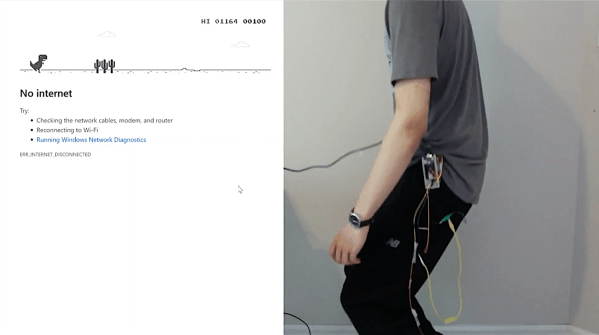
[Ryan] wanted to hack the Google Chrome Dinosaur Game so he could control the dinosaur with his own movements. The game only requires two keyboard presses (up and down arrow keys), so controlling the game with the Arduino Keyboard library only requires a few simple function calls.

He uses the Arduino MKR board in his build, but notes any number of other boards would work as well. A force sensor detects his jumps and a stretch sensor detects him ducking. Both the stretch and force sensors are resistive transducers, so two simple voltage divider circuits (one for each sensor) are needed to convert changes in force to a voltage. You may need to adjust the sensor threshold to ensure the code responds to your movements, but [Ryan] makes that pretty easy to do in software as both thresholds are stored as global variables.

It’s a pretty simple hack, but could make for some good socially-distanced fun. What other hackable Google Chrome extensions do you like?

Continue reading “The Google Chrome Dinosaur Game, In Real Life” →

512 Bytes Ought To Be Enough For Dinosaurs

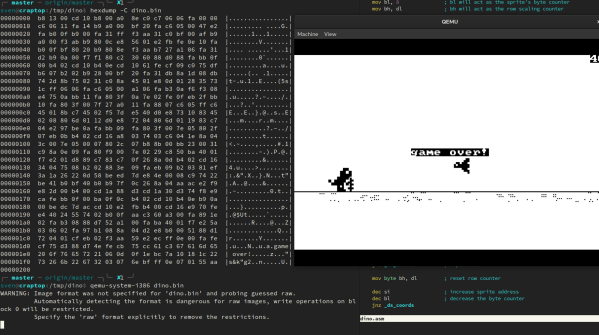
It’s said that slow internet is worse than no internet at all, which is mainly a matter of continuously crushing all hope and sanity vs. finding peace in accepting a fate out of your control. Plus, you can easily pass the time of being catapulted back to the prehistoric ages by navigating a jumpy little creature from that same age through a field of cacti — at least if you’re using Chrome or Chromium. But neither a browser nor actually an operating system are really necessary for that, as [franeklubi] shows with a boot sector implementation of the same game.

Sure, the graphics aren’t quite on par, but compared to the original’s 3000+ lines of JavaScript, [franeklubi] managed to implement it in a few hundred lines of assembly, and was of course constrained by the 512 bytes of the boot sector itself (well, 510 plus the signature). This constraint causes a few limitations, like a slight lack of randomness in the obstacle arrangements, and a constant running speed, but it also makes it the perfect playground and starting point to delve into the world of nifty knacks and hacks, trying to squeeze every last byte.

If you want to give it a try for yourself, all you need is NASM and QEMU — and while you’re at it, why not have some Tetris along the way? We could also see this nicely combined with the real-world jumping version from a few weeks back, and turn it into a standalone arcade game. Bounce Crouch Revolution anyone?

Lifelike Dinosaur Emerges From The Plumbing Aisle

Despite the incredible advancements in special effects technology since the film’s release, the dinosaurs in 1993’s Jurassic Park still look just as terrifying today as they did nearly 30 years ago. This has largely been attributed to the fact that the filmmakers wisely decided to use physical models in many of the close-up shots, allowing them to capture the nuances of movement which really helps sell the idea you’re looking at living creatures.

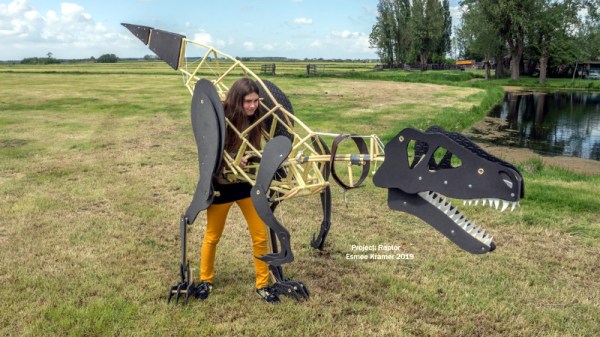
[Esmée Kramer] puts that same principle to work in her incredible articulated dinosaur costume, and by the looks of it, Steven Spielberg could have saved some money if he had his special effects team get their supplies at the Home Depot. Built out of PVC pipes and sheets of foam, her skeletal raptor moves with an unnerving level of realism. In fact, we’re almost relieved to hear she doesn’t currently have plans on skinning the creature; some things are better left to the imagination.

In her write-up on LinkedIn (apparently that’s a thing), [Esmée] explains some of the construction tricks she used to help bring her dinosaur to life, such as heating the pipes and folding them to create rotatable joints. Everything is controlled by way of thin ropes, with all the articulation points of the head mirrored on the “steering wheel” in front of her.

Now to be fair, it takes more than a bundle of PVC pipes to create a convincing dinosaur. Obviously a large part of why this project works so well is the artistry that [Esmée] demonstrates at the controls of her creation. Judging by her performance in the video after the break, we’re going to assume she’s spent a not inconsiderable amount of time stomping around the neighborhood in this contraption to perfect her moves.

In the past we’ve seen the Raspberry Pi used to upgrade life-sized animatronic dinosaurs, but even with the added processing power, those dinos don’t hold a candle to the smooth and organic motion that [Esmée] has achieved here. Just goes to show that sometimes low-tech methods can outperform the latest technological wizardry.

Continue reading “Lifelike Dinosaur Emerges From The Plumbing Aisle” →

Let A Dinosaur Show You The Future

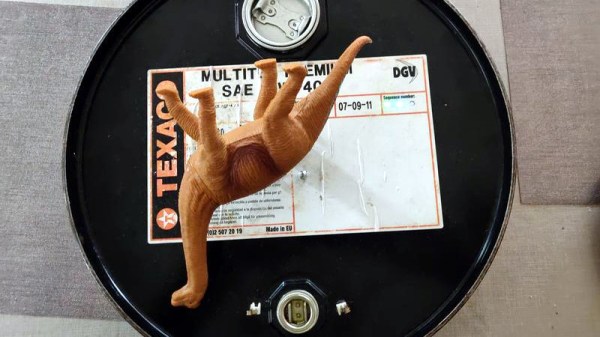
Our lives in the 21st century are in part governed by a series of systems which we rarely encounter directly but which can have a great impact upon our lives. The oil futures market, for example, for which [Igor Nikolic] has created a real-time visualisation in the form of a clock in which the “hand” is a plastic dinosaur (As ever, XKCD reminds us that oil contains homeopathic quantities of real dinosaur, but it makes a good talking point).

The clock is part of a series continuing from his previous grid balance lamp project which monitored supply and demand in the electricity grid, and takes a feed of oil futures pricing to an MQTT server which is then picked up by an ESP8266 in the clock. The dinosaur hand is attached to a stepper motor, the position of which is set according to the market movements. There are also three LEDs whose colours change according to price. The whole is mounted on a plaque made from the top of an oil drum, and placed for effect over a map of the Port of Rotterdam, one of Europe’s busiest trading hubs.

Monitoring of these invisible socio-technical systems is a fascinating subject, and in the past we have brought you news of the very real impact they can have on entire continents when international politics intrude.

Popup Notification Dinosaur

There’s a lot going on our virtual spaces, and anyone with a smart phone can attest to this fact. There are pop-up notifications for everything you can imagine, and sometimes it’s possible for the one really important notification to get lost in a sea of minutiae. To really make sure you don’t miss that one important notification, you can offload that task to your own personal dinosaur.

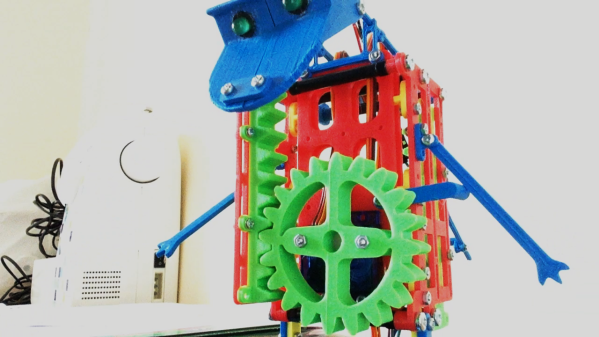
The 3D-printed dinosaur has a rack-and-pinion gear set that allows it to extend upwards when commanded. It also has a set of LEDs for eyes that turn on when it pops up. The two servos and LEDs are controlled by a small Arduino in the base of the dinosaur. This Arduino can be programmed to activate the dinosaur whenver you like, for an email from a specific person, a reply to a comment on Reddit, or an incoming phone call to name a few examples. Be sure to check out the video below the break.

With this dinosaur on your desk, it’s not likely you’ll miss its activation. If you’d like something that has the same function but with less movement and more lights, there’s also a notification 3D cube made out of LEDs that’s sure to catch your eye as well. Continue reading “Popup Notification Dinosaur” →