One of the most fun challenges in paleontology is determining characteristics of long-dead species like their behavior and body temperature based on nothing but some fossils and traces that are usually millions of years old. Something that has long vexed the paleontological community for example has been the question whether non-avian dinosaurs like the well-known Tyrannosaurus rex was cold- or warm-blooded, and if the latter, what temperature this was. Cue a recent study by [Randon J. Flores] et al. in Science Advances in which they seek to answer this question.
Although modern-day dinosaurs in the form of birds are all warm-blooded – meaning capable of regulating their body temperature – species like crocodiles, who also lived alongside non-avian dinosaurs, are cold-blooded and have to cycle between sun-basking and a cool dip in a nearby river to maintain their body temperature.
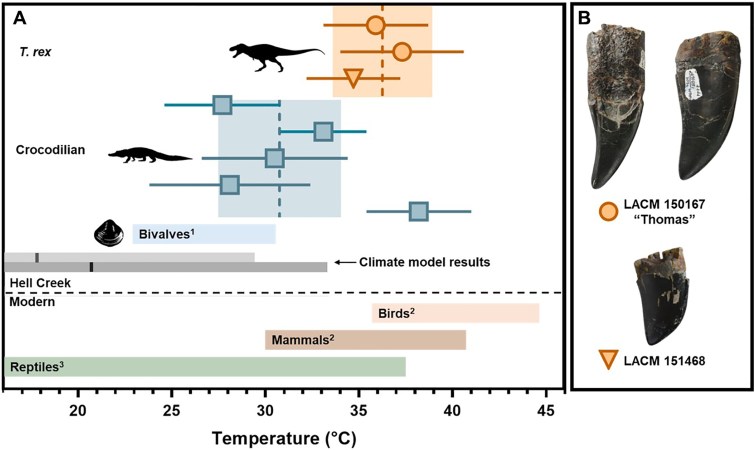
By looking at the temperature-dependent formation of carbonate clumped isotopes in three T. rex teeth from the Late Cretaceous Hell Creek Formation, they were able to deduce that these dinosaurs had a body temperature of 36.3 ± 2.5°C, comparable to modern-day endotherms. This was also much higher than that of contemporary crocodilian teeth found in the same area.
When popular dinosaur movies like Jurassic Park showed T. rex and other non-avian dinosaurs as being active, warm-blooded hunters, this was pretty much based on cutting-edge science at the time. Fortunately for its creators, later paleontological findings have largely confirmed that portrayal, although these days non-avian dinosaurs have often gained more feathers and other details – even outside of feathered theropods that became birds – that were absent in these early 90s reconstructions.