
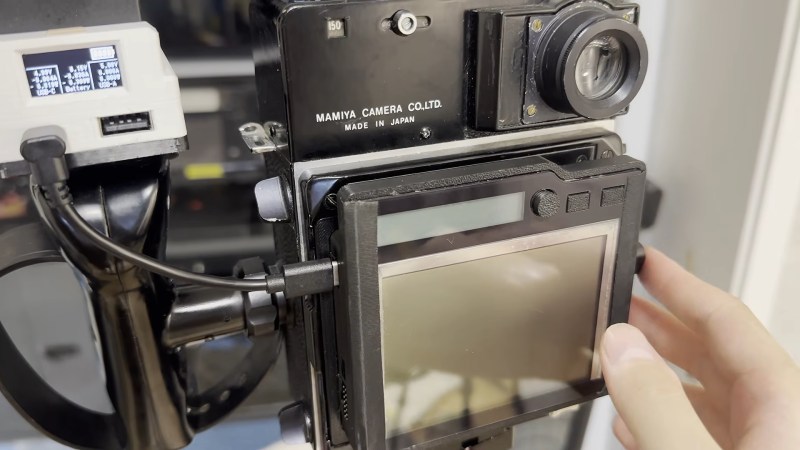
Large format cameras can produce amazing shots, but are a bit too bulky to be practical. Medium format is a different story, as [Wenting] demonstrates with his Sitina B220M — an open-source digital back for the Mamiya Super 23 camera using a full-frame Kodak CCD.
“Digital back” just means he’s replacing the rear of an existing film camera in order to put a sensor where said film used to live. The sensor is a 22 Megapixel Kodak KAF-22000CE, which measures in at a very respectable 38.8 mm by 50 mm. That’s only a touch smaller than the rolls of 120 the camera was designed for, whose large dimension was 56 mm. How much was exposed at a time was determined by the back you put on the camera, but would never have been below 41.5 mm. Again, the CCD is pretty close.
With Mamiya covering the optics, [Wenting] could focus on the digital end. He’s got a Xilinx Zynq 7010 running the show, making use of both that SoC’s Cortex-A9 cores and its built-in FPGA. There’s some decent info on how that works in the build video embedded below, if you don’t want to dig into the code at the GitLab repository above. The photos look great, and start at 8:25.
[Wenting] has been around the bush with FPGAs before. Not least in his e-ink monitor project, but also with the last iteration of his mirror-less digital camera. This version is perhaps less ambitious, being merely a digital back and not the whole enchilada, but it solves some design issues he had on the “camera” part while he focuses on the “digital” for now.












First sentence has an error – the camera isn’t large format, it is medium format as the title states. If there was a digital sensor that was affordable and could cover the same size as the most popular large format (4×5) that would be extremely interesting.
Medium format cameras aren’t so large to be impractical – as I often carry a medium format as a my travel camera of choice. Usually it is either a Mamiya C220, Bronica EC, or Fuji GS645.
Interesting project slightly let down by inaccuracies in the article!
I recall that observatories often use arrays of multiple sensors to approximate a large sensor. It could be interesting to do the same for a large-format field camera.
I recall they also use image stacking to fill in the gaps. That means pointing the camera slightly off target and snapping another picture.
I think scanning backs are actually more common for large format, so kind of yes, but stretched in time.
Did you read the second sentence that said medium format cameras aren’t impractical, and then introduced the project as medium format?
Dissing large format is a tacky way to start but aside from stating a subjective opinion as fact the article doesn’t seem inaccurate.
A linear ccd can cover a large format. It is slow to image a wide area though.
It doesn’t claim to be a large format. The point of the first sentence is to explain why someone might use a smaller (in this case, medium format) camera.
Very cool. I have toyed with something to use with Mamiya RB67’s. Either fitting in a film holder or the Polaroid back which has a lot more room. I have hundreds of rolls or 120 B&W film and I develop then scan it. But a digital back and the various RB67 lenses? YES! I did not know how big the Kodak sensor is. I thought it was smaller. Thanks a lot for the work.
I believe you can get a genuine Mamiya-branded digital back for the RB67.
For AUD$14,000.
Third party options are available and a lot less pricey, but presumably fewer features or lesser quality.
I’m used to professional medium format backs being more like 127 film: 40mmx40mm. And I’m used to homebrew backs being a Raspberry Pi camera module swimming in empty space with a huge crop factor. This is actually something reasonable.
My medium format cameras don’t use 120 film backs, but my large format Graflex can, apparently “merely” requiring enlarging the chassis the electronics attach to make it mount.
While interesting hardly advanced or ground breaking, leaf, phase one and hasslblad all produce digital backs that will fit certain medium format cameras, the hasslblad being 100mp, I’m back who makes digital backs for 35mm slr is developing one for medium format.
But 20mp isn’t taking any advantage of medium format size, with the technology of the last 5-10 years the average full frame DSLR will still be superior. I’d love to see the potential of digital backs for medium format cameras being pushed further but this isn’t it.