Tearing Down Aircraft Weather Radar Avionics

If you’re flying high in the sky, it’s useful to know if there’s turbulence, heavy rain, or other nasty weather ahead. Onboard weather radar is a useful tool that pilots use to scope out conditions ahead. [Thomas Scherrer] came into possession of a weather radar display from a vintage aircraft, and decided to tear it apart for our viewing pleasure. 

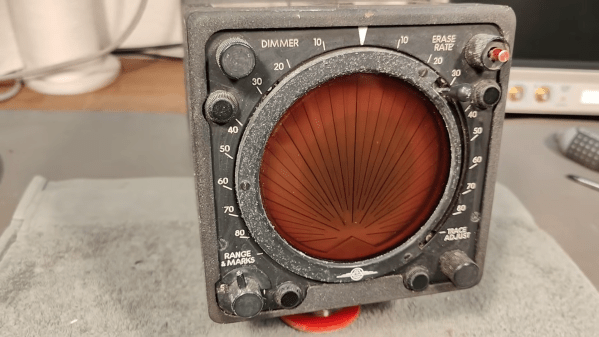
The unit in question is a Bendix PPI-1 plan position indicator. This particular 1971 example was scored from a McDonnell-Douglas DC9. [Thomas] only has the display itself, not the radar that would feed it or the power supply to turn it on. Still, even just the readout unit is super interesting to look inside. Right off the bat, there’s a neat dimming filter on the front, and the case itself is really beautifully designed for service. The design is very much of its time, full of neat wire harnesses and chunky through-hole components.  There are some neat surprises inside, too, like an interesting device shaped like a triangular prism whose purpose we won’t spoil here.

If you’re wondering what one of these units looks like in action, you can see such an example on YouTube. The display basically lights up in areas where there were stronger radar returns indicating weather to be avoided.

We love radars around these parts, and we feature them all the time. Video after the break.

Continue reading “Tearing Down Aircraft Weather Radar Avionics”

Building A Portable Weather Radar

If you run a large meteorology bureau, then you probably have access to a wonderful weather radar for scrying the heavens. The rest of us aren’t so lucky. If you find yourself bereft of such hardware, though, you could build your own, taking your lead from [Koakno]’s fine example.

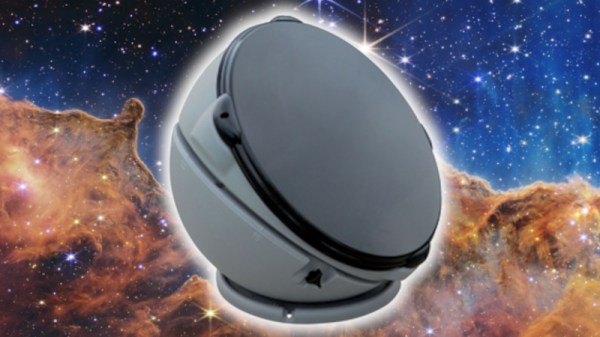
The build uses a satellite dome salvaged from an old RV that [Koakno] scored for just $5. Specifically, a Winegard Carryout Anser GM-5000. The motorized parabolic dish was designed to track TV satellites, but here it’s been repurposed into a scanning radar antenna for X-band signals. It’s paired with a cheap SDR—you can use several on the market—which injects an 850 MHz signal, which is up-converted to 10.4 GHz by the low-noise block (LNB) in the GM-5000 and sprayed out towards the weather.

Echoes come back from rain, hail, and debris, and get down-converted by the LNB back into an 850 MHz signal that the SDR can capture. The echoes are then plotted on a Plan Position Indicator (PPI) display, showing what’s going on in the atmosphere around the dome. [Koakno] reckons detection ranges span out to 40 km for things like heavy rain, while a supercell hail core could be spotted at up to 60 km in the right conditions.

It’s worth noting something important, though. [Koakno] explains that this system is currently in violation of FCC regulations, and shouldn’t be used without the proper licenses to access given spectrum. It’s a useful study of how to build a weather radar, but perhaps not something you can just wire together and fire up without getting in a spot of bother.

If you’re a die-hard tornado chaser or you’ve just always longed to stare meaningfully at a PPI display, this could be the build for you. We’ve featured other DIY radars before, too. We’d also like to see yours, so when it’s done and written up, fire us a note on the tipsline!