Screenshot of the survey webpage, saying "Invitation to participate in a new fun hardware discussion in the PINE64 Community Pine Store may have stopped production on Linux hardware, but that doesn't mean all production has stopped. Hardware like the Pinecil, PineTime and PineVoice that use MCUs will continue production as normal. This is a great opportunity to come up with new ideas for MCU powered hardware. Now that the PinePhone has stopped production, there is a gap in the hardware lineup for a "fun" device. This definition of "fun" boils down to whether a device can have multiple use cases or purposes. The PineTime, PinePhone and PineNote can be considered "fun" as they can be used for multiple purposes and multiple projects can naturally form around them. An example of the opposite would be devices like the Pinecil and PineBuds which serve a single purpose and build less of a community around them as a result (but both are still great). OKAY, SO! We'd like to share some initial ideas on what a cheap fun tinkerers device could be. 1.What hardware do you prefer?Required Please drag these items from most (1) to least (5) preferred. ?Alarm clock ?PinePhone-esque device but MCU powered (attachments possible?) ?Handy multi-tool with screen, fido hardware key, nfc, etc ?Other (next question) ?MP3 player"

What Should Pine64 Build With Microcontrollers?

Pine64 is an open-source-community-centered project of mostly-open hardware, known for such hits as the PinePhone, the Pinecil soldering iron, and the PineTime. Now, the Pine64 project wants to know what kind of MCU-powered device you’d want to see built next, and there’s an online form you can fill out to let them know about any fun ideas they could bring to reality, as we all recover from the second round of Hardware Horrors Of 2020s.

In the age of RAM and storage shortage, it’s evident we’re not about to see a new Pine64 Linux SBC – but there’s plenty that can be done with regular microcontrollers, especially seeing how far modern microcontrollers have come in capabilities. On their Discord server and other linked platforms, you can see the announcement post giving you more details, as well as examples of devices that would fit the bill. An MP3 player? An alarm clock? Some sort of electronics multi-tool? PinePhone-esque device but based on an MCU? Digital camera? Whether you have full-on device ideas or specific feature requests for the aforementioned, check out the form and let them know.

Of course, any suggestions will ultimately have to be considered for viability by the Pine Store, the Pine64 hemisphere that actually decides on what to manufacture, so no promises can be made, but we consider this more than promising enough that you ought to have a say. Pine64 has come incredibly far in the 10 years it’s been around, and despite the troubles, we hope they’re here to stay, doing their thing releasing hardware that so often runs circles around the competition, and dropping by hacker cons all over the globe.

Hackaday Links Column Banner

Hackaday Links: May 12, 2024

Don’t pack your bags for the trip to exoplanet K2-18b quite yet — it turns out that the James Webb Space Telescope may not have detected signs of life there after all. Last year, astronomers reported the possible presence of dimethyl sulfide there, a gas that (at least on Earth) is generally associated with phytoplankton in the ocean. Webb used its infrared spectrometer instruments to look at the light from the planet’s star, a red dwarf about 111 light-years away, as it passed through the hydrogen-rich atmosphere. The finding was sort of incidental to the discovery of much stronger signals for methane and carbon dioxide, but it turns out that the DMS signal might have just been overlap from the methane signal. It’s too bad, because K2-18b seems to be somewhat Earth-like, if you can get over the lack of oxygen and the average temperature just below freezing. So, maybe not a great place to visit, but it would be nice to see if life, uh, found a way anywhere else in the universe.

Attention Fortran fans: your favorite language isn’t quite dead yet. In fact, it cracked the top ten on one recent survey, perhaps on the strength of its numerical and scientific applications. The “Programming Community Index” is perhaps a bit subjective, since it’s based on things like Google searches for references to particular languages. It’s no surprise then that Python tops such a list, but it’s still interesting that there’s enough interest in a 67-year-old programming language to make it onto the list. We’d probably not advise building a career around Fortran, but you never know.

Continue reading “Hackaday Links: May 12, 2024” →

Subterranean Uses For LIDAR: Cave Surveys

LIDAR has gained much popularity as a means for self-driving cars to survey the space around them. At their most basic, LIDAR is a surveying method that uses lasers to paints the space around the sensors and assembles the distances measured from reflected light into a digital three-dimensional representation. That’s something that has quite a number of other applications, from surveying ancient ruins and rainforests from a bird’s eye view to developing 3D models of indoor spaces.

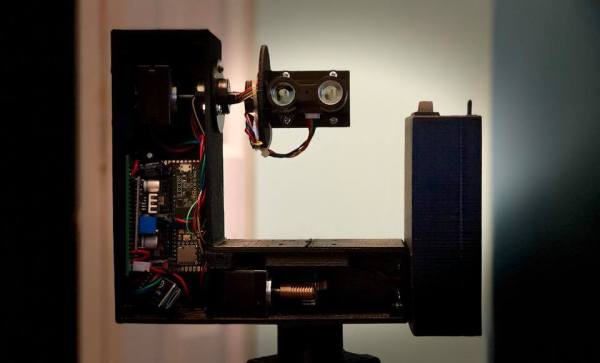
One fascinating use of LIDAR technology is to map out the routes inside caves, subterranean spaces that are seldom accessed by humans apart from those with specialized equipment and knowledge of how to safely traverse the underground terrain. [caver.adam] has been working on his Open LIDAR project for a few years using an SF30-B High Speed Rangefinder and laser device for a dual-system atop a gimbal with stepper motors for cave scanning.

Originally an entry in the 2016 Hackaday Prize, [Adam] has continued to work on the project. The result shown in the video below is a cheaper 3D LIDAR setup that works by rotating the laser distance module on 2 axes with a sensor centered at the center of rotation. It works for volumetric calculations, detects change over time, and identifies various water patterns and rocks on a surface map. Compared to notebooks, tape measures, and compasses, it’s certainly a step up in cave surveying technology.

Check out some other past underground surveying projects, such as Iowa City’s beer caves scanning projects and National Geographic’s 2014 expedition of the Titan Chamber in southern Guizhou Province in China.

Continue reading “Subterranean Uses For LIDAR: Cave Surveys” →

Getting Your Feedback And A Staff Update

had-staff-update-9-2013

Please join me in welcoming four new members to our crew. I published a post calling for applications almost two weeks ago. I wouldn’t say we were overwhelmed with applications. But I would say we were overwhelmed with qualified applicants. Hackaday writers need to be Jacks of all Trades in order to recognize and feature the best hacks from a wide range of disciplines. To this end we chose writers who have interests in areas what will complement those already represented by the team. I couldn’t be happier with the new contributors. Please join me in welcoming [James Hobson], [Todd Harrison], [Phillip Ryals], and [Adam Fabio]. They’ve already been hard at work dishing up fresh hacks, but you can learn more about their backgrounds by reading the biographies on our Staff Page.

You may have noticed a change this week. Although we’re an English language blog based in the United States, our statistics show readers throughout the world (in fact, almost a third of our writing team aren’t Americans). For this reason we changed our post scheduling earlier this week to a 24-hour cycle. This means more time between posts, and of course new posts being published in the middle of the night. Keep reading for a few more tidbits and a chance to give us your feedback.

Continue reading “Getting Your Feedback And A Staff Update” →

Hackaday Links: March 12, 2013

Thankfully saved from steampunkers

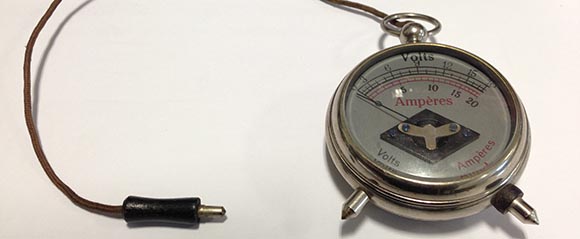
meter

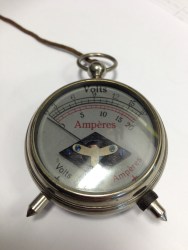
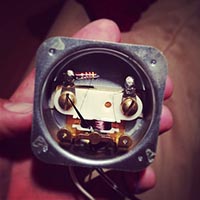
[Chris] found a really cool pocket watch-style multimeter in a box of junk that was passed down from father to son. There aren’t any markings on it, so he’s looking for any information he can get on it. It’s a cool piece of vintage tech in any occasion; check out the pics he sent in below:

Here’s a fix for your illegal stuff

pi

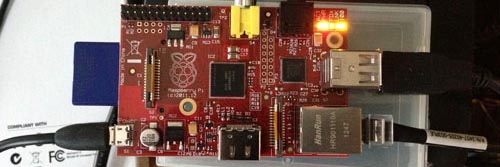
[Don] ‘acquired’ one of those China-only Raspberry Pis, but after plugging it in, only the power light would stay on. The fix, apparently, is putting these three files in the /boot folder of a Red Pi SD card.

Not a pocket watch

meter

[Tom] picked up an old DC volt meter in an antiques shop. He quickly gutted it to make an analog meter display for his Raspberry Pi. There’s  a few status lights to remind [Tom] of something he hasn’t figured out yet. Bonus points for a cheap buck boost converter, though.

Smashing monitors? Really?

NESIT Hackerspace

The Meriden, CT hackerspace, the New England Society of Information and Technology, was vandalized last week. They’re dealing with some real punks here; their computers weren’t stolen, they were just smashed. NESIT is looking for donations (both money and equipment), so if you have a few monitors or old boxxen and live around there, consider donating them.

Help a guy out here.

survey

[Jonathan] is a real cool dude that’s working on his master’s thesis on ways to build a sustainable company through the development of open source hardware. He wants you to take a survey. How do we know he’s cool? He had something posted on HaD back when we had the old black and white and scotch tape images.

DIY Shade Finder Tool Takes The Tedium Out Of Solar Surveys

diy-shadefinder-tool

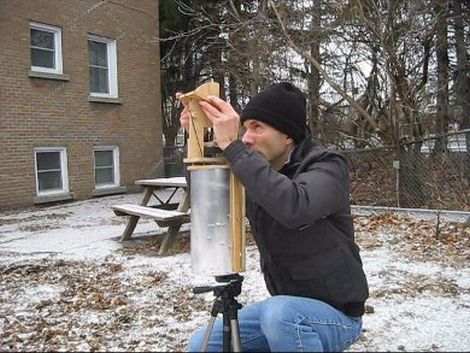
[Steven Dufresne] does a lot of tinkering with solar-powered applications, a hobby which can be very time consuming if done right. One process he carries out whenever building a solar installation is creating a sun chart to determine how much (or little) sun the target area will get.

The process requires [Steven] to take elevation and Azimuth measurements of many different points, which often consumes about half an hour of his time. While taking measurements recently, he started thinking about how he could improve the process, and came up with a stellar solution that reduces the process down to a one-minute task.

In short, his shade finder tool uses a pulley, a pair of rollerblade wheels, and a pencil to accomplish a full shade survey in under a minute. The science behind the tool is best explained by [Steven], so be sure to check out his site for plenty of details and diagrams.

We have to say that we’re extremely impressed by his shade finder – hopefully his work can help others maximize the efficiency of their solar solutions.

Stick around after the jump to see a short video of the shade finder in action.

Continue reading “DIY Shade Finder Tool Takes The Tedium Out Of Solar Surveys” →

Complete The Hack A Day Survey, Win A Shirt

Take our reader survey. Do it. Do it right now.  Do you think we should run more articles on the dietary needs of Llamas? Here is your chance to let us know.  We got a lot of great feedback from [Jason]’s post, and now we’re ready for more. We’ve put together 10 quick questions that will help us get a feeling for what you want. We will be choosing 5 participants at random to give free t-shirts (the basic logo one).

Update: While we wait for our survey slave to get the changes made, please just put something in the fields that are mandatory(questions 7-9). Even if you put “no opinion”, we’ll get good info from the rest of the survey.