
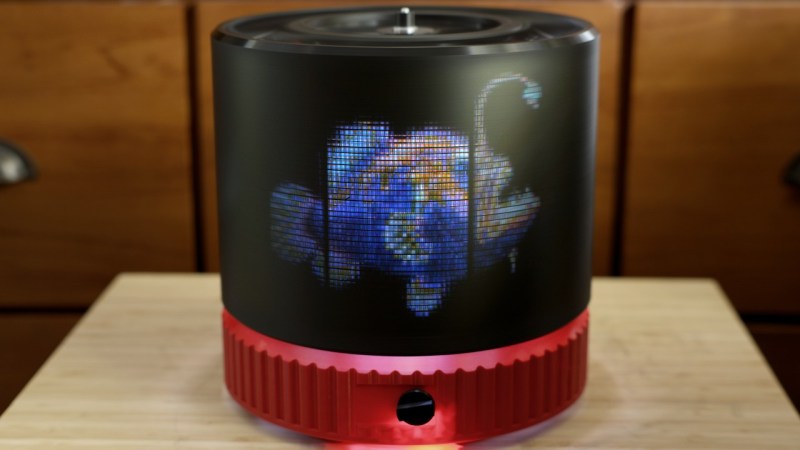
A mechanical TV — the kind that makes an image with a Nipkow disk and a single lamp with some help from persistence of vision — is easy enough to wrap your head around. Moving that technique into the third dimension, though? That’s a bit of a head scratcher. Luckily for us [AncientJames] provides a simple visual explanation for how the magic happens.
Instead of a disk doing a raster scan of the display, he’s using a rapidly-spinning drum with holes in it. In place of a single lamp, he’s got an array of LED matrix displays, each 32 pixels by 64 pixels in resolution. The trick is splitting the model up into a light field, so each hole projects its own image of the object at the proper angle.
In this demo there are three matrix displays, though that does limit the viewing angle as they’re arranged as one half of a hexagonal prism — you’d need more screens to get a full 360. The effective resolution through the drum is only about 100 pixels by 48 pixels per eye, but that’s still enough to play DOOM with.
This isn’t the first time this particular [Ancient] has got DOOM going on a volumetric display, and based on previous results, it probably won’t be the last time either. This implementation, which keeps the displays stationary and does not require a pricey laser projector, looks the most accessible to us, as long as you watch your fingers.












I love [AncientJames]’s work so much, every single one gets my creativity flowing and makes me jealous of the time and skill demonstrated.
This one makes me want to put the whole assembly in an evacuated glass cylinder to get the speed up even higher without air friction. Maybe not practical (and probably dangerous?), but I’d love to see it.
I doubt this design is anywhere near being limited by air friction yet in terms of rotational speed. That aside, he mentions in the description to the video that performance is actually Limited by the refresh rate of the display panels. 7500fps!
This for sure. Each LED has to do essentially the work for multiple different viewing angles, so it’s that much more than the frame rate of the displayed video.
There is a great bit in the video around 7:00 that makes the pretty clear. Watch as the image spins up N times faster than the disk.
Insane!