
Lithium batteries have become the backbone of many modern devices ranging from toothbrushes to semi trucks, so what are we going to do with them when these rechargeable cells finally die? Researchers at Cornell have identified a way to streamline the recycling process.
Most current lithium battery recycling involves grinding up the batteries and separating active material from other components like the casing, current collectors, etc. These materials are then processed and turned back into fresh material for a new batch of batteries. Taking everything all the way down to rebuild it is time and labor consuming, and therefore expensive, especially in light of increasingly lower prices for lithium.
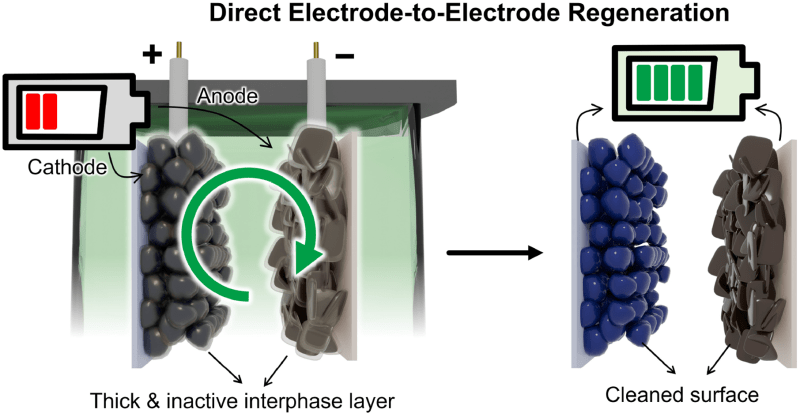
The researchers found that by electrochemically dissolving the inactive electrode–electrolyte interphase layers that built up over time, they could rejuvenate the electrode without completely taking it apart. This direct electrode-to-electrode regeneration (DEER) uses 1,3-dimethyl-2-imidazolidinone (DMI) as a solvent for the process. Once reassembled, these regenerated cells have up to 95% of their original capacity while cutting the cost of recycling by over half.
If you’re looking to reuse a pack before sending it to the recycler, may we suggest a whole house battery from an old EV pack and how to integrate them safely.












“These materials are then processed and turned back into fresh material for a new batch of batteries.” [ citation needed ]
Hey check out this new cloth, we call it ‘microfiber’, you can make it from recycled soda bottles! Do you actually make it from recycled soda bottles? Well, we could, but nurdles are cheaper right now so…
As long as it’s cheaper to not do something, humans aren’t going to do it. Not at a scale that’ll make any real difference.
100%
Are the same people ignoring every regulation in their way going to:
A) lovingly hand craft and artisinally restore every failed 18650 cell in your car battery
B) Ship them to whatever country has cheap labor and fewest environmental laws where they grind them up and recycle them.
Or
C) Say they recycle them but actually throw them away and only use brand new lithium for their batteries?
Regulation (EU) 2023/1542 concerning batteries and waste batteries places, Article 3(1), producer definition, under which an operator that places a battery resulting from preparation for re-use, preparation for repurposing, repurposing, or remanufacturing on the market or puts it into service may become the responsible producer. Chapter VIII define the extended producer-responsibility provisions, which transfer obligations to the economic operator placing the refurbished or remanufactured battery on the market.
What that means is, if you refurbish a battery with cells from another battery, you may become its legal manufacturer and have to provide the necessary specifications and safety guarantees as a manufacturer of a new battery. The original specification from the factory no longer applies, even if the battery was built to the original spec using original parts.
What that means, independent rebuilding of waste EV batteries could turn the repair shop into a regulated battery manufacturer/producer, with substantial compliance and take-back responsibilities. For smaller repair shops, this is not practically feasible, so the battery refurbishment falls on the original manufacturers to maintain legal compliance, i.e. the car manufacturer can easily refuse to fix your battery and instead sell you a new one.
It depends on where in the recycling chain the used batteries are sourced. If the donor batteries were still in use in vehicles, you’re on the safe side, but if the donor battery comes from a vehicle that was already designated as waste or the battery was removed and designated for disposal, then the battery may become a waste battery and repairing it or using its parts to repair another battery becomes re-manufacturing or “preparing for re-use”. This limits the availability of suitable spare parts for battery repair for the independent repair shops that cannot afford to take on the responsibilities of an original manufacturer.
That’s just to say, the regulations on recycling batteries turn out to make it harder to recycle batteries, except for the OEMs who don’t have an incentive to do it because they want to sell you new products instead of fixing what you already own.
Or we dont do anything and let it run at 80% capacity per article. Since the recovered is only 95%.
The efficiencies or not doing anything.
The capacity might be there, but the SEI prevents you from using it because it slows down the cell operation by increasing internal resistance. Dissolving the SEI restores the cell to a usable condition.
I’m not quite seeing how you can rejuvenate an 18650 electrode without pretty much having to dismantle and unwrap the entire cell anyway? At which point could you really roll it back up and make a new cell out of it practically?
I can only see many more battery fires in the process because of the unwrapping and rerolling. Especially when done in less scrupulous countries.
First you have to test each cell that they’re actually still functional, because the cell might be in deep discharge below 2 Volts and the current collector electrodes might have dissolved into the electrolyte. Otherwise there’s no point in trying to rejuvenate it.
The problem of handling the cells individually, test them, open them up, etc. is what makes the whole process expensive. The cheaper process is to just freeze them with liquid nitrogen and throw the lot in a chipper/grinder under nitrogen atmosphere, and the resulting powder is then mixed in a bunch of solvents and acids to separate the chemical components.
Yes, but there are a lot of styles that would lend themselves to this, especially the “blade” style modules we’re starting to see. Pouch and stacked prismatic cells would also work well, depending on their enclosure ofc.
Makes me think we took a wrong/cheap turn away from the fully serviceable kinds (I think last serviceable ones were military lead acid kinds) towards speed-sold-the-hell-with-the-later-throw-em-in-the-ocean. Now that the regulations require those to be reused, and tax subsidies had mostly dried up, it falls down to average consumer to figure out the rest.
Years back, when I was in high school, looking at the average simplistic lead-acid thing, electrolyte and all, I kept thinking “WHY one has to wait for one of the electrodes to thin out? Why not add a third electrode made from some exotic alloy that would reverse the thing, ie, deposit dissolved metal from the electrolyte back on the thinned electrode? That would extend the battery life nearly three-fold, eventually something else would wear out, but in the interim it would stop the decay.” I am guessing solutions do exist, no, not with three electrodes, with batteries made of materials that don’t wear out so badly after each charge/discharge cycle.
Meaning, there has GOT to exist a better non-mechanical solution of partially restoring nearly dead battery. Back when average lead acid batteries had tiny caps to fill in to level out electrolyte, one could probably come up with the solution that would double as electrode restoration; though, thinking this a bit further, this would mean that the electrode growth would have to be controlled, ie, no spikes towards the other electrode, which would just short-circuit the thing. Maybe electrodes grown as crystal lattice so it is confined to the lattice and not sticking out everywhere? Too much thinking, I don’t really thing electrode making is advanced science, at least not at the level of, say, car engine making, probably it is, too, the cheapest/fastest method that delivers okay results for now, think about it later.
(personal experience dealing with purely/simply recyclable things, like bottles, left me mostly apathetic, not only recycling companies suck in my tax dollars, they CHARGE me for giving them things to recycle, ie, double-dip, I simply have no desire or spare finances to voluntarily help for-profit companies make even bigger profits with zero return to me; actually, a lot of local places that “accept consumer grade refuse” look like shady frontends for something else behind them, no real Big Name Company, some kind of local “agents” making quick buck here and there, not very trustworthy, and I honestly suspect they mostly eat my taxpayer moneys and get rid of refuse in the middle of the ocean instead).
If it’s worth recycling, they pay you. If the economics don’t work out in favor of recycling, they make you pay.
Nobody seems to want the dead lithium batteries. I was wondering if they could be burned to produce electricity like old tires. Lead acid ones get recycled.