
I started writing this from a commuter train passing at speed through the outskirts of London, and my headset had just broken. The flexible joint that attaches one earpiece to the headband has snapped, leaving the earpiece dangling on its cable. This is annoying on its own, but what is annoying me enough to write about it is that this isn’t the first time. This is only the latest in a succession of headsets I’ve taken on the road with me has broken, not because of rough treatment, but simply due to flimsy or bad design. What on earth can I do about this?
Failure Built-In
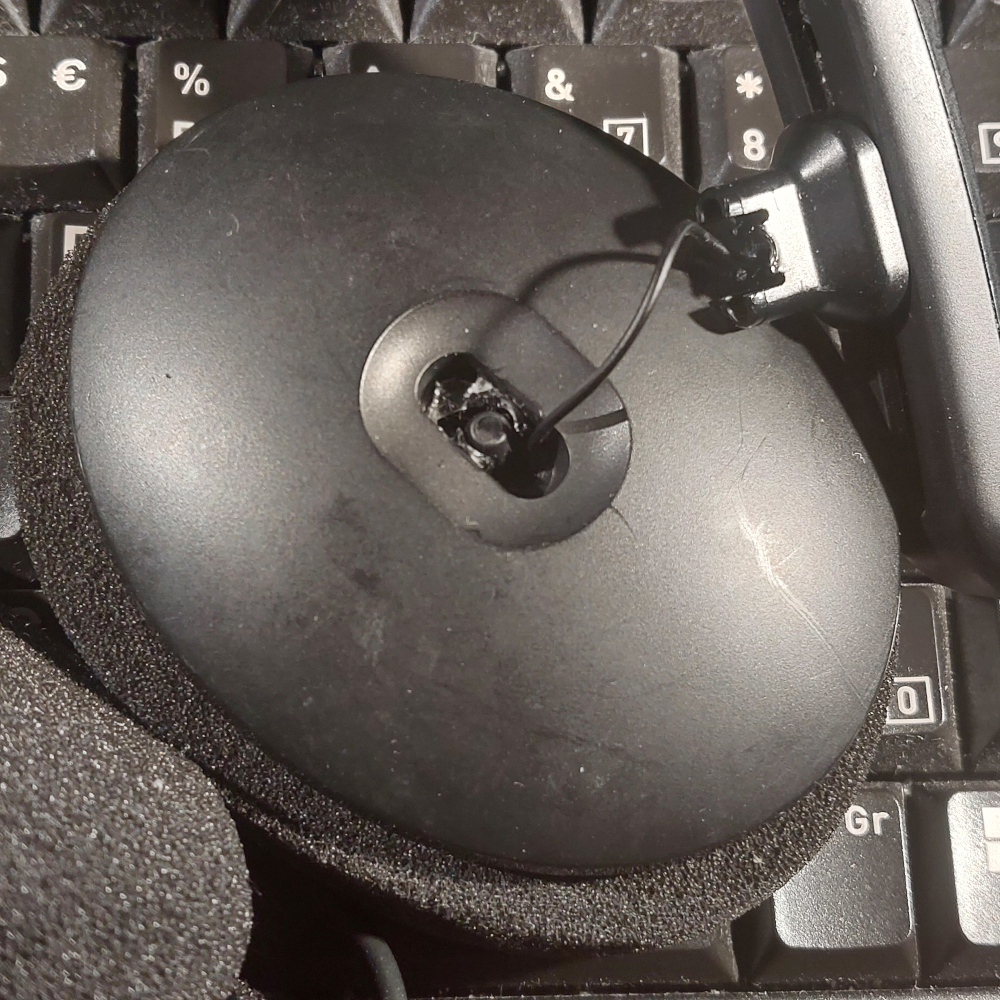
The most recent three have been a JVC whose rotating joint allowing the earpiece to lie at a slight angle with my ear has failed, a quite expensive Logitech whose ear sponges failed closely followed by its USB cable, and now an EPOS whose ball joint has failed.
I repaired the JVC and got a bit more life out of it and I’ll have a go at repairing this EPOS, but that’s hardly the point. I’m paying not inconsequential money and I’m getting good sound quality and electronics, but I’m not getting anywhere near the mechanical quality I need. I could buy a set of tough DJ headphones such as the Sennheiser HD25, but they don’t come with a microphone, they’re not a headset.
So if I can’t buy a decent headset without spending military grade money on one from an F16 fighter, what can I do to make my own? I’m an engineer, damnit!
At its most basic, a headset is a springy band that goes over the head, with an earpiece at its end. But a human head is not a cube with vertical parallel sides, it’s a complex shape and every one is different. So those earpieces have to have some “give” in them in order to fit comfortably against the ear. In the simplest case this is achieved by giving the earpiece a soft surround that moulds itself to the ear, but most headsets incorporate some articulation. The earpiece must rotate a little around a vertical line parallel with the ear, and also with a horizontal line at right angles to the axis of the ear. The EPOS managed both axes by means of a ball joint, while the JVC had a stirrup with pins to achieve the horizontal motion, and a circular joint — the part which broke — for the vertical. In both case the weak point was a thin part of the plastic moulding which broke, on the EPOS a short stalk for the ball in the ball joint, and in the JVC a similar stalk for the circular joint. Any design I come up with must avoid this type of weak point, and spread the load of an earpiece over considerably more material than my broken headset.
So, How Do I Make This Thing?
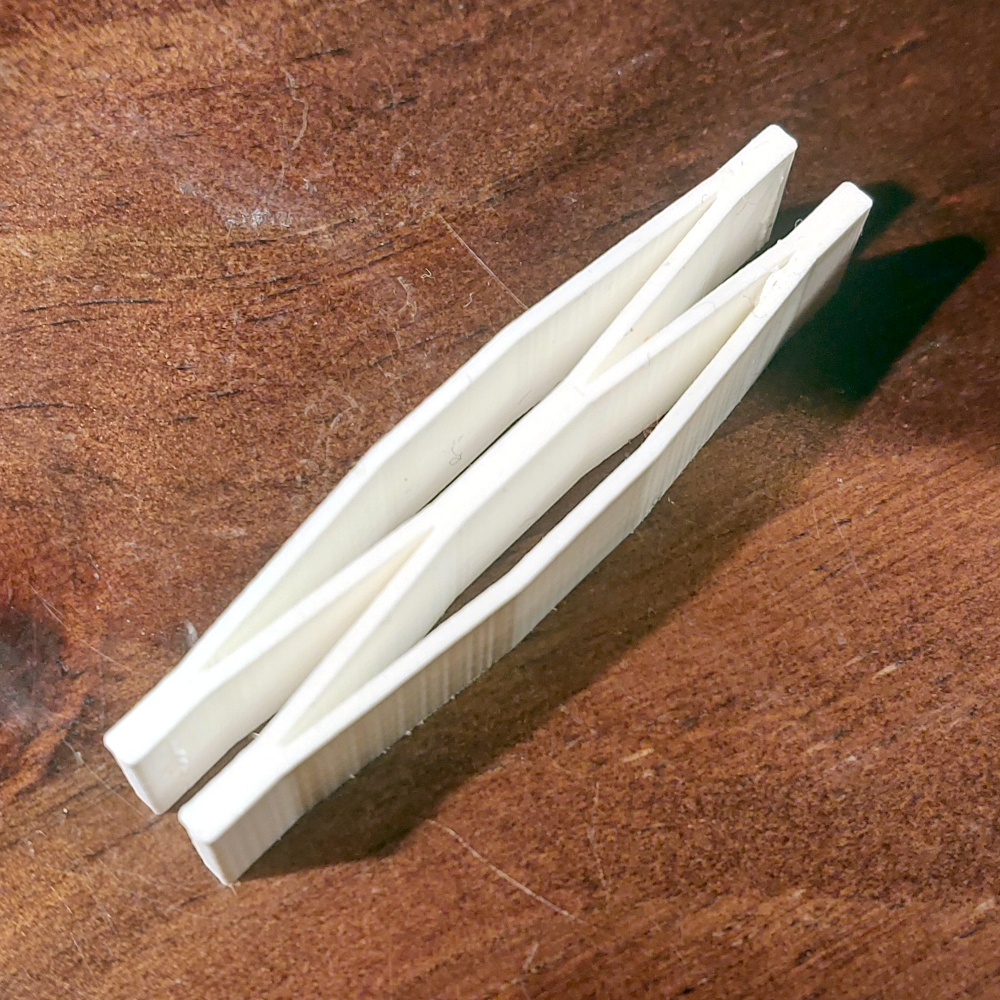
For the headband I could re-use the ones I have from my broken headsets, find one of the many 3D printable designs online, or the choice I took, design my own. And since I can re-use the drivers, microphone, and electronics, aside from designing a physical adaptor to take them, my problem becomes one of making a tough version of that articulated joint. And there my choice is to either replicate the ball or rotating joints of the originals but in a much tougher form, or to make a one piece design with elasticity and flexibility in the planes I need. It’s time to break out OpenSCAD. I like things I can print in one go when it comes to builds like this one, as when it comes to assembly there is invariably a weak point where the different parts meet. So I’m going for the latter choice, and making my earpiece mount on a spring rather than a two-piece joint. My spring is a simple zig-zag leaf spring, which is both robust, and has some movement in X and Y rotational axes, and Z displacement. It’s an OpenSCAD library, and my little test print has all the compulsive manipulation of a fidget toy.
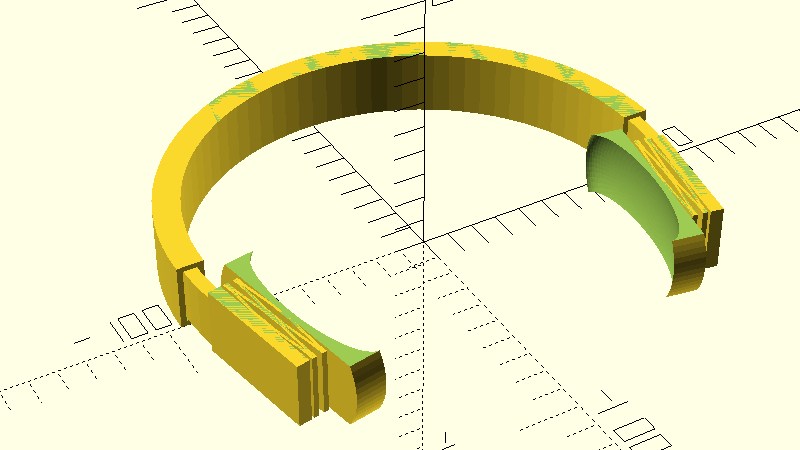
So with a bit more OpenSCAD bashing I have a sliding print in place headband with my springs attached. You can take a look at it in this GitHub repository, and even modify it for a broken donor headset of your own if you want.As I write this it’s not yet printed, the 3D printer gods have not smiled upon me with extra speed. Will my crafty print in place springs solve the problem? At least if they break I have only myself to blame.











I have a sony headphone with a particular foldable joint. despite he is falling apart after 15 years of severe use, i keep going back to them, because the other tree that came after broke some connector or joint. It is a masterpiece of engineering.
The soft part of my premium sony headphone earmuffs are glued rather than sewn – and come apart – but is otherwise sturdy, while my jabra failed just as yours, breaking the infinitisimal wire in the proces. Whether by profitmaxising design or by rubbish design, it’s infuriating. Even moreso because here’s nowhere to go shake my fist and say argh!, fix it bastards!
Because I didn’t look like Lobot enough already
I’m happy your headset broke otherwise we wouln’t have this article, but the aforementioned (awesome) Sennheiser HD25, owing to it’s modularity and openess (easy to swap parts and fix them) indeed has microphone options, either DIY or commercial ones
https://terrytew.co.uk/product/sennheiser-hmd-25-1-headset-with-dynamic-mic/
The second link was cut, here it is : https://www.printables.com/model/133067-sennheiser-hd-25-modmic-adapter
In a nutshell, if you need to have one headset in your life that just endures, get an HD 25 #BITFL
I use headphones to communicate with my computers. I need good noise cancelling in both the microphone and the ambient environment. I broke dozens of $50-$60 headphones from many manufacturers. (Logitech was the worst, Ryobi was the most disappointing.) The failure point was invariably the flexible joint at the cup. If a set of headphones lasted 3-4 months, I was lucky. I finally spent the money on on two Sennheiser BT450-class headphones which have lasted me over 4 years. I usually now pretty much depend on a pair of Soundcore Q45 headsets (one near the computer and one in the car in case I forget to pack the one near my computer), because the ambient noise-cancelling is much better. Good quality is worth paying for.
If you want almost indestructible headphones look at the 3M Worktunes Hearing Protectors with BlueTooth, the audio quality is OK too. Can’t speak for the cheap copies from the usual sources but you never know…
Long long ago, there was this miracle material called “metal” which was used to make things like headphones so that they didn’t snap in half
I think you are confused, but I can see where it came from. You see, that was the name of a genre of music that people used to listen to. Hope that helps.
I must be doing it wrong, when I listen to that the headphones explode off my head instantly. Basically the opposite of what I wanted
A sham buzzword. What it really means is something made very cheaply and then sold for military use at high price. Example would be getting screws from Temu and selling them for $1,000 each.
Wrong, I worked on military electronics for a very long time and they are much more robust mechanically and electrically than anything else I ever worked on. Of course thos was US military equipment.
I was handling my beloved Koss foldable headphones as if they were made of brittle glass, but I still managed to break said ball joint. I fixed it with superglue, removing a tiny bit of nearby plastic that wasn’t critical, and then I welded that tiny piece to the socket to strengthen its structural integrity (using my soldering iron at a low temperature). Works for me. ;)
Would pay for sturdyer version …
The Marshall ANC foldable headphones are among the best and sturdiest engineered out there. Look at their construction for inspiration.
Or, if you want more isolation and repairability, go for the other ‘broadcaster’s favourite’, the Beyerdynamic DT100 and family. Every possible combination of ears and mics, suitable for hammering in nails with, great isolation, consistently clear sound, and every single part is available and replaceable if you do manage to destroy it. And, like the HD25, it’s not unlikely the sound you are listening too was monitored with the same headphones while it was being recorded.
My DT-109 headset has spent 30 years in use, being sat on, stepped on, dropped, crushed under flightcases, bashed around in toolboxes and generally abused, and has only needed replacement earpads and a mic boom hinge through all that. They are a bit light in the bass end, so I have a ‘new’ (maybe 15 year old?) DT-150 for even nicer sound when I don’t need the boom mic, but I can wear the DT-109 all day and enjoy every minute of listening
kudos for using OpenSCAD : I love it
tl;dr: get headphones/headsets from companies revered for the quality of their headsets. JVC, Logitech… headphones aren’t their main line, and I guess even EPOS are built to a price.
I have headphones going back 40+ years. The longest-lasting ones have all- or mostly-metal headbands and pivots, and use a bow for the earpiece pivot instead of a ball-joint. Some of the studio-purpose headphones are near indestructible (eg AKG); they can survive being dropped or sat-on… but kind of big. My newest headphones are Audio-Technica ATH40x. Biggish but they fold up nicely, and the mechanicals seem robust. SONY MDR7506 are popular for field and location recording, and repair parts are available.
Honorable mention to SENNHEISER HD 414 – a simple, flexible all-plastic design that’s also near indestructible. They might be a good engineering candidate for 3-D printing.
Boom mics on headsets are a whole ‘nother level of fragile…
Plastic ball joints allowing headphone earpieces to pivot with respect to the band is a design blunder that’s been around for a long time. My Yamaha YH-1000 from the 1980s snapped after about 5 years of light use.
Another big problem in headphones is foam pads; they inevitably decompose. The person who solves that problem will be a hero. (In-ear designs don’t qualify.)
The plastic ball joints replaced a loose metal rivet design for the swivel on my old school Koss headphones. Value engineering at work. The old Koss headphone from the 70s actually cost like $80-100 back then bit people bought stuff that was not intended to be disposable. They are heavy though.
I still have some KOSS HV-1A headphones that were around $40 to $50 in the late 70s. I’ve had to replace the wire running through the headband. And the soft foam deteriorates, but KOSS, to their credit will still sell a pair of pads for like $10.
(I almost spat out my coffee this morning when looking up the HV-1A’s; a vintage hifi store was selling a set for like $500+! I currently have two sets! :-) )
I regard earpads as consumables. Many naturally deteriorate – foam crumbles, vinyl hardens – but you want to be replacing them once in a while just for hygiene reasons, if they’re not washable. Fortunately, for most popular headphones, there are usually OEM and 3rd party pads readily available.
I got a warning for you Jen.:
“DEPRECATED: Variable names starting with digits (“2dspring”) will be removed in future releases. in file headset-spring.scad, line 26″
And to be fair, is it ever a good idea to get in the habit of starting vars with numbers in the first place? There are more languages that don’t like that.
Personally I’d go for making the ball joint metal to make it robust.
Of course the proof is in the pudding and if you in practice experience this design as comfortable then all theory is defeated eh.
I feel so seen.