
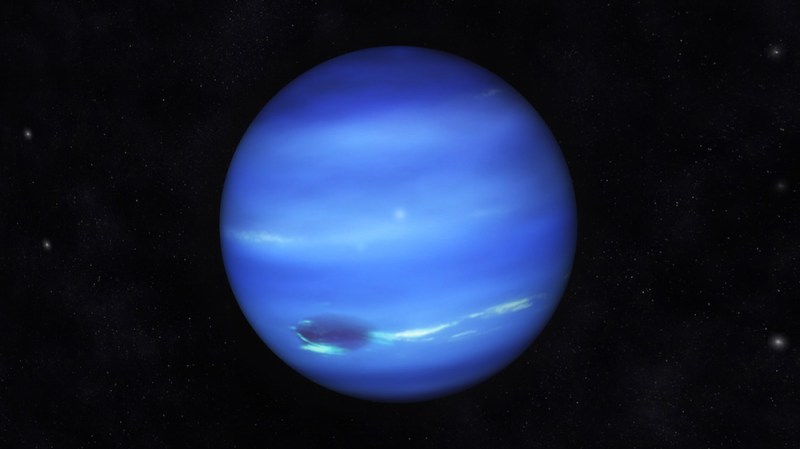
One of the problems with planetary science is that you generally cannot easily investigate the exact conditions in their interior, so you’re left to extrapolate what is happening inside them based on surface scans. One of the resulting questions is what ice giants like Neptune and Uranus in Earth’s solar system have exactly at their core. We do know that it is mostly rocks and ice, but what kind of ice you end up with at these intense pressures is a good question that [Alexis Forestier] et al. set out to answer, with their results published in a Physical Review Letter paper (ArXiv preprint).
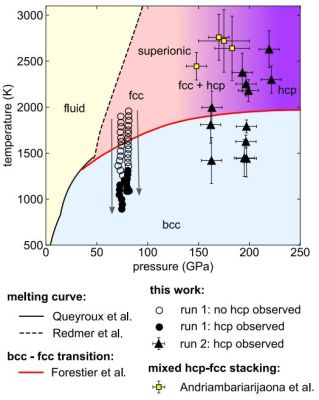
It’s noteworthy that there isn’t just water ice at these planetary cores, with this study only investigating water ice specifically. In order to get the water to the pressures it would experience courtesy of ice giant gravity, a diamond anvil was used, with synchrotron x-ray diffraction allowing for the changes to the sample to be observed.
The phase diagram of water includes a number of phases beyond what us Earth-dwellers would call ‘ice’, with at higher pressures above about 80 GPa the formation of ice X, featuring a body-centered cubic (BCC) oxygen sublattice. Subsequent discovered phases were face-centered cubic (FCC) and now hexagonal close-packed (HCP) ice, all differing in the packing of the oxygen sublattice.
In addition to extreme pressures, temperatures also had to be increased by using the laser heating feature of the diamond anvil. At around 2,000K and over 200 GPa the HCP phase was found, with a mixed FCC-HCP phase at intermediate pressures.
Although not immediately providing answers to questions pertaining to the aforementioned ice giants, it gives planetary scientists yet another clue that they can use in future investigations, as well as provide more insight into this most fascinating phase of water that’s actually its own little galaxy of phases.











Strange how in earth we have a bias towards thinking of water as a liquid when a majority of ice in our solar system is a mineral.
Not really, our perceptions should naturally be oriented towards what is relevant to us.
I wonder if there is any substance that isn’t a solid at those pressures… I have no idea. Is there some stubborn molecule that stays liquid at gas giant core pressure without being a bajillion Kelvin?
I don’t know either, but frankly I doubt it. Apply enough pressure and (I think) it’s most likely that the molecules would stay in a lower energy crystal lattice rather than have the ability to move freely. (On reflection, it might be like temperature. In plasma “temperature” has several definitions — electronic, translational, rotational — which can differ widely. Perhaps there is a different definition of “move freely” in extreme conditions, creating a “pseudoliquid” state.)
I think Helium? (like always)
That’s how you tell apart average Joe from those who did pay attention in advanced science classes. Liquid water only exists in a small range of temperature and pressure, and that’s excluding super-critical liquid area.
My question is, at what temperature/pressure is solid state fusion conceivable for hydrogen or deuterium packed in a metal lattice?
Gemini says “room temperature and sea-level pressure” but somehow that doesn’t sound right…
Whatever the temp/press is at Jupiter’s core, plus a handful of Monoliths.
I don’t know the answer except to say that it’s not STP unless you think Pons and Fleishmann were right. ;-)
I am pleased that someone has discovered ice-X, since ice-9 was invented so long ago.