

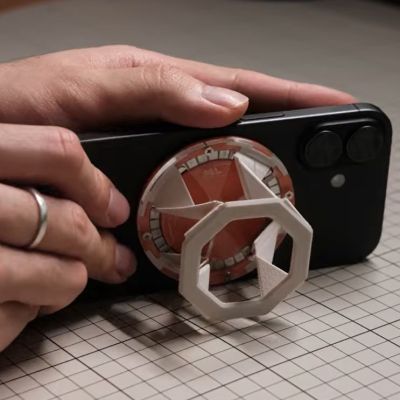
The variant of origami called kirigami (‘cut paper’ in Japanese) also starts off with a sheet of paper, but it allows for cutting the paper to increase the number of shapes that you can create. It is this technique that [Matthew Lim] used to create a number of three-dimensional designs that can convert between a flat configuration and some kind of functional object without any bolts, glue or similar. These include everything from a phone grip to a pretty sizeable side table.
 The video starts with an interesting demonstration of how to fold an origami crane that has a smaller crane on its back. This is documented in a 1797 book on the many ways to fold a crane, with one of the first known instances where cuts are made in the single sheet of paper, which becomes the second, much smaller crane.
The same book extends that idea into making an origami grid that can fold into a grid of cranes after making a series of cuts. Later this form of origami got the name ‘kirigami’, with the video demonstrating how a few strategic cuts in an original flat shape can make it much more functional, based on scientific papers like this 2024 one by [Liu] et al. on cylindrical origami with tunable mechanical behavior.
For these functional mechanisms a laser cutter and FDM printer are used to prototype and test increasingly more advanced versions of the pop-up mechanism, before moving on to make full-sized furniture using plywood panels and 3D printed hinges. The coolest part about the resulting table is that it can be changed into different configurations, with the mechanism locking into its new position to make a relatively stable new shape.
Even if not immediately practical, these mechanisms provide interesting options for robotics and flat-pack furniture alike, as well as in applications like space exploration where every gram and cubic millimeter of space counts.












I wonder if we might ever see this used at the microscopic scale like MEMS devices.
You could make a device that folds up to form a more complex shape with integrated electronics and at insanely small scales.
With the right tweaks I could see a silicon swan with flapping wings that gets power from chemical reactions on some tiny electrodes.
Working really hard on it right now, and just got a beautiful pic of a microscale folding part print going horrendously wrong https://ko-fi.com/post/Alien-Print-S0F128PDEU
Also just discovered eSun Standard Clear Resin glows in UV, which makes it a damn sight easier to locate the little objects when the RepRapMicron prints them somewhere on the microscope slide!
Next up a micron-3D kirigami benchy?
Wow, even the mess-ups are impressive. Really cool, good work
This article reminds me of an advanced micro-manufacturing conference I attended right around 2015, where I saw some incredible early work on this exact concept out of the Harvard Microrobotics Laboratory (and the Wyss Institute).
They were working on me so-scale assembly by developing a ‘pop-up book’ MEMS fabrication technique. Instead of traditional pick-and-place assembly, they used laser-cut laminate sheets comprising carbon fiber, polyimide (Kapton) films, titanium, and adhesives, utilizing stress alignments to let complex 3D mechanisms automatically fold themselves into place.
They built the insect-scale flapping-wing RoboBee project, which used tiny piezoelectric actuators to drive high-frequency flight. It’s wild to see how far these structural origami and kirigami fabrication methods have scaled since then. For anyone wanting to dive down a rabbit hole on the sheet-manufacturing side of things, their overview page on Pop-Up MEMS: Origami-Inspired Micromanufacturing is a fantastic read.
https://wyss.harvard.edu/technology/pop-up-mems-origami-inspired-micromanufacturing/
Available for licensing. Anyone have a spare million?
How long before he dumps the table?
Never sit on something that pinches when you put weight on it. The very thought. 00 -> 8.
Chindōgu
Pretty useful techniques to squish big solar panels and antennas inside rocket fairings, like the recent NISAR, Bluebird-6, or the Miura-ori techniques used since (at least) 1995.
Or you could just roll them, ROSA-style.
Starship has the slit opening as a Starlink pez dispenser….so this tech is perfect for pop-up designs at scale.
A chomper Starship is going to be limber, so I see a slit opening being as good as it gets
Spacewalks are to be avoided.
Now, can you feed a large, one piece kirigami structure into the Starship through the slit–totally filling the payload hold–such that it can slide out of that narrow slit–then open up into powersat acreage?