

The Sony PlayStation Portable, better known as the PSP, is now over two decades old. In its day it was an impressive handheld gaming machine, not least because of the inclusion of wireless networking and a web browser.
We tried the browser back then, and it’s fair to say the experience was a little underwhelming. We’re thus mightily impressed at [Steve Janovitz], who has produced Tilefinch — a modern web browser for the PSP.
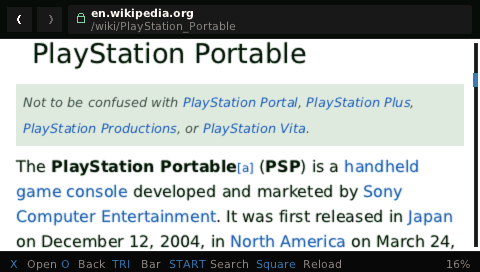 Depending on the model, the PSP came with a 333 MHz MIPS32 processor, and for all but the first model, 64 MB of RAM. Powerful back in 2004,but leagues behind something that would run any modern web browser. So how’s he doing it? The answer seems to be by careful choice of software components and use of the PSP’s built-in capabilities for jobs such as video decoding. The browser engine is Lexbor for example, while JavaScript is handled by QuickJS.
We don’t have a PSP to hand so we can’t tell how it would render Hackaday or even how fast it is, but we’re suitably impressed by this project. For PSP enthusiasts it’s a game-changing browser, but for us it also points the way towards web browsing being a possibility for other platforms. As the distinction between a high-end microcontroller and a low-end SoC becomes blurred, we’re starting to see exciting new hardware emerging with devices such as Espressif’s ESP32-P4 that, on paper at least, might be capable of running this browser. Exciting times in limited hardware web browsing might be upon us.












Interesting. I’ve had several PSPs and i also have one now. I quite recently (within a year) tried to go to websites with it. You cannot access much with it. Google(dot)com and a funny image site opened. Kuvaton(dot)com.
This is great news. Dont plan on doing any browsing with it, but for some reason getting stuff on it that i could use on it makes me giddy.
It is modded of course.
I have a handwritten browser (bare metal/from scratch parser, css, js & ecmascript engine) running on the P4. The biggest issue is RAM – modern pages are ridiculously large (often for no good reason), the P4 boards don’t come with the 2GB needed to cache some ridiculous CRUD PWA.
Setting up a DNS sinkhole (e.g. Pi Hole) would probably help immensely with that. One can even be run on an ESP32.
Absolutely. Modern pages are pure bloat and look worse than some plain HTML sites from the 90s.
Plus, what should be server-side processing (anyone remebering CGI?) is now a burden to the browser/end device.
That causes extra bandwidth on a global scale.
https://en.wikipedia.org/wiki/Common_Gateway_Interface
“That causes extra bandwidth on a global scale.”
It’s also a waste of energy on the server and the client side. Probably Terawatts worldwide get turned into heat by inefficient coding.
I can only second here. I’m working on e-ink friendly browser that is able to render natively into low bit depth formats and it’s hard to get a single page into a 32MB. Fortunately I’m working with RPi + e-ink display so I have enough RAM to render a few pages at once.
Y’know, seeing the specs in the PSP and ESP32-P4 makes me wonder how close we are to being able to effectively make a PSP equivalent with an MCU kit.
Nowhere near, the PSP also has a GPU where all the heavy lifting is done for games and UI.
All it takes is for a MCU company to find a cheap GPU design they could add to a subset of their chips. IIRC there are still companies selling that sort of IP.
The main point is that the CPU and RAM already seems to be equalled in the MCU space. Which means there really isn’t that giant of a gap and getting a tiny GPU is an interesting question.
Oof I remember buying my PSP when it was new.
Great system, terrible battery life.
If the Esp32 can run psx/n64 emus, PSP seems reasonable.
Me too! Then I picked up a used one and started making mods on it. I made the original ring of light by pulling off the silver metal ring and drilling some holes and adding in small LEDs. Then I cut a bit of CD case with a dremel and sanded it to make a cheap diffuser. Those were the days. =D
Before that I basically bitbanged a few LED mods on the DreamCast in similar fashion. Adding a LED to the modem without killing the signal was a challenge with no knowledge of how PCBs are usually laid out nor how a modem was built. Just tap a contact, see if it lit up, then see if I could still connect. I think I got that one in about 4-5 tries. Knowing more about everything kind of kills the magic, but it’s still fun to hack and repair. I don’t understand how people are content to finish school and then stop learning.
I made the dual analogue…..think it ended up on hackaday once upon a lifetime ago!
…. and we still don’t have a modern browser for Mac OS 9…
Hi, there’s one that’s promising.
https://hackaday.com/2026/07/17/macsurf-hits-2-0-to-bring-powerpcs-back-online/
I’ve been working on a browser based the netsurf libraries (with a custom rendering engine). I’ve been sending fixes to libcss and libhubbub. It would be awesome if the upstream for them got more lively…
I’ll be interested to see if something similar comes along for the PsVita