

A Modern Browser For The PlayStation Portable

The Sony PlayStation Portable, better known as the PSP, is now over two decades old. In its day it was an impressive handheld gaming machine, not least because of the inclusion of wireless networking and a web browser.

We tried the browser back then, and it’s fair to say the experience was a little underwhelming. We’re thus mightily impressed at [Steve Janovitz], who has produced Tilefinch —  a modern web browser for the PSP.
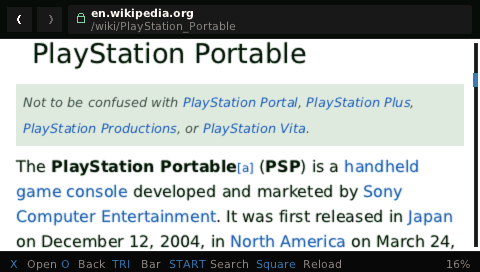
Depending on the model, the PSP came with a 333 MHz MIPS32 processor, and for all but the first model, 64 MB of RAM. Powerful back in 2004,but leagues behind something that would run any modern web browser. So how’s he doing it? The answer seems to be by careful choice of software components and use of the PSP’s built-in capabilities for jobs such as video decoding. The browser engine is Lexbor for example, while JavaScript is handled by QuickJS.

We don’t have a PSP to hand so we can’t tell how it would render Hackaday or even how fast it is, but we’re suitably impressed by this project. For PSP enthusiasts it’s a game-changing browser, but for us it also points the way towards web browsing being a possibility for other platforms. As the distinction between a high-end microcontroller and a low-end SoC becomes blurred, we’re starting to see exciting new hardware emerging with devices such as Espressif’s ESP32-P4 that, on paper at least, might be capable of running this browser. Exciting times in limited hardware web browsing might be upon us.
Open Firmware Fixes Dead Onkyo AV Receivers

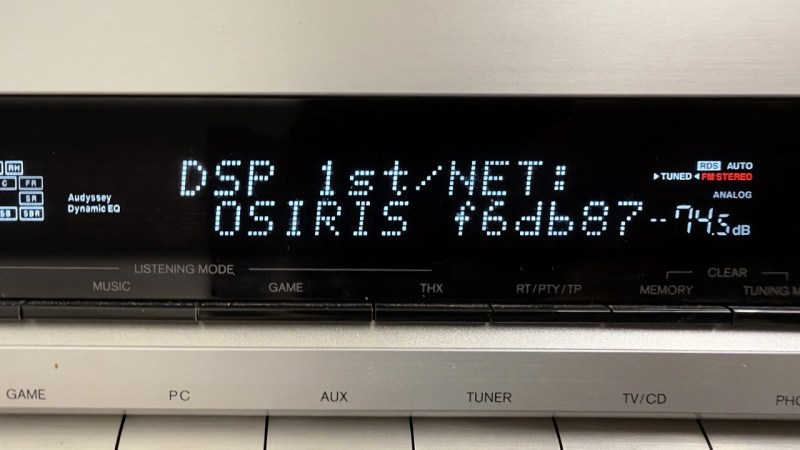
If you’ve been reading Hackaday for any length of time, you’ll know we love seeing hackers replacing the stock firmware on their devices with open source alternatives. Usually this is done because the open firmware offers more features, or lifts some arbitrary limitation. But if you find yourself installing OSIRIS on an Onkyo AV receiver such as the TX-NR717, it’s probably because you’re trying to bring the thing back to life.

As developer [Jokūbas] explains, certain Onkyo receivers that use the Texas Instruments D830 are known to suffer from a very specific failure — the device will power on and appear functional, but no audio will come through. When this happens, it’s either because the D830 itself has failed or the 64 MiB NAND flash chip that holds the firmware it runs is cooked. Unfortunately, replacing either component is a bit more difficult than you might expect.

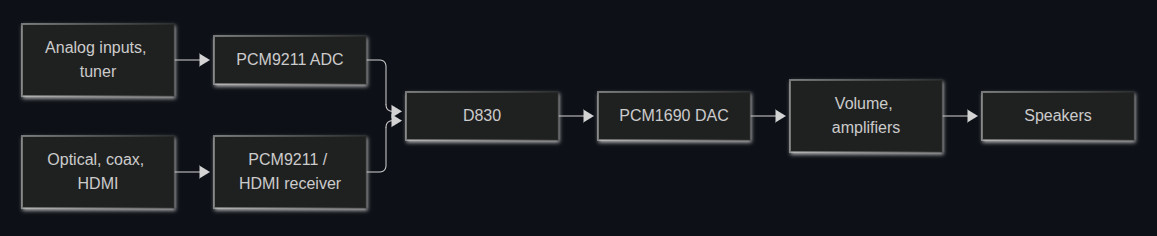
Everything passes through the Texas Instruments D830. If it goes, you’ve got a problem.

If you swap the D830 with a pin-compatible chip that’s easier to find and less prone to failure, the stock firmware won’t boot. If you try to replace the NAND, you’ll find that the original software is only capable of addressing 512-byte pages, while the flash you’ll find on the market today uses 2 KiB or 4 KiB pages. In both cases, it’s OSIRIS to the rescue.

The open firmware not only supports D830 compatible chips such as the OMAP-L137, but it’s able to address modern NAND flash, making the replacement of either or both component far more practical. With fresh hardware and the new firmware installed, your Onkyo receiver should spring back to life. That said, OSIRIS isn’t feature complete yet, and truthfully the items listed as untested or not implemented on the feature list currently outnumber the entries for what actually does work. But at least it’s a start.

Of course, not all the burned out parts on your Onkyo receiver require a firmware flash to replace. Sometimes a misbehaving unit just needs to have a few of its passive components replaced.








