
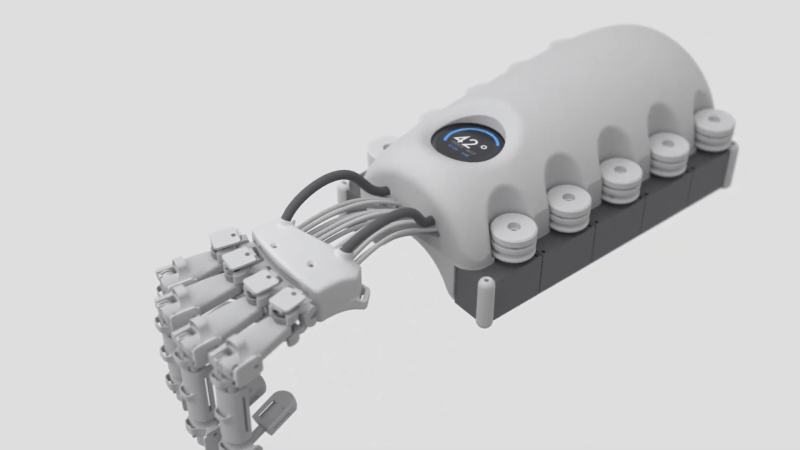
Hand tracking in VR/AR can add a substantial amount of immersion and added interactivity. Unfortunately, most camera based tracking suffers when fingers get covered, intertwined, or simply out of view of the headset’s camera. What’s even less common are methods of giving feedback to the user’s hands. [Sebastian Molano] saw these issues and decided if anyone was going to make an open-source solution, it was going to be him with his thesis on TAKTO.
TAKTO aims to remove the prior issues mentioned with visual tracking by using magnetic encoders to tell where the device is and the finger’s position inside it. Actuators are able to pull on the fingers themselves to add even further information to the user. Of course, none of this is too crazy, as we have seen similar projects before. Where TAKTO stands out is the extent of the support outside of a one-off hand tracker.
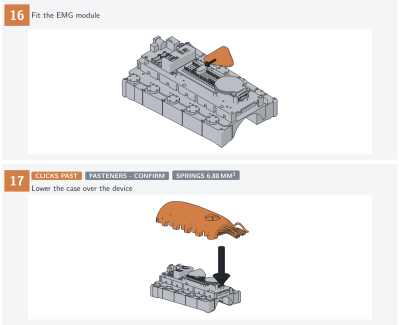
TAKTO.one not only holds general information about the project itself, but also an entire digital twin of the live device. This console can give you a visual of using the glove and general status information. Documentation on how to assemble one for yourself is presented in clean visuals, which should make the build process painless.
Everything else about how to make the hand for yourself can be found on the project’s GitHub. The price tag is steep for the actuated version, though there is a sensing-only version for hand tracking, and most of the cost comes from the quality actuators used. If you want to look into implementing some usability into existing VR hardware, make sure to look at what Valve has released publicly!












I thought camera-based hand tracking was getting pretty good with some ML algos that generally fix the glitches, but I guess nothing compares to mechanically measuring each joint angle at 3000Hz
It’s limited to 100Hz for some reason
Rather blatantly missing the thumb
Ooh. Memories of the Data Glove / Cyber Glove / Power Glove mini-craze from the 1980s.
New! Improved! Can move your fingers for you!
But, my, am I ever getting tired of seeing AI-generated prose describing a project/product. I get it’s easy to do, efficient, and even useful. But there’s gotta be a way to tone that slop down and give useful information without sounding like a punchy, breathless, TV ad, all. the. fscking. time. It’s tiring and tiresome.
Yeah. At least spin up the skill that gets it to stop talking in that grating style. Feels like talking to a drop-ceiling tile or a cubical wall, so corporate.
https://github.com/FeedHive/ai-slop-detector/blob/main/skills/ai-slop-detector/SKILL.md
Ah. Useful. Thanks.
There is a reason most commercial datagloves rely on either resistance or fiber optic bend sensors, direct joint monitoring projects like this are very user specific as the maker takes specific measurements of their own hand. The distances between joints is highly variable between people. Additionally, this form of construction introduces 2 issues, the first and most obvious is that the construction itself introduces a degree of finger splay preventing natural hand postures. The second, issue is that our fingers do not have rigid pinned joints, each joint has a degree of lateral flexion that these sorts of constructions fail to allow causing the finger positions to be further limited. While dynamically tracking the full range of human motion might be unnecessary for VR use, artificially limiting the range of natural motion is generally undesirable, which is why soft glove based systems tend to dominate the field.