Streaming Games Means The Nintendo DSi Will Never Be Obsolete

There comes a point where you have to acknowledge that your beloved console is out of date and– barring the odd homebrew title– won’t be playing new games ever again. You’d think that Nintendo’s 2008 DSi handheld would be in this category, but [gavff64] has a workaround. What if the odd homebrew title streamed games over the network?

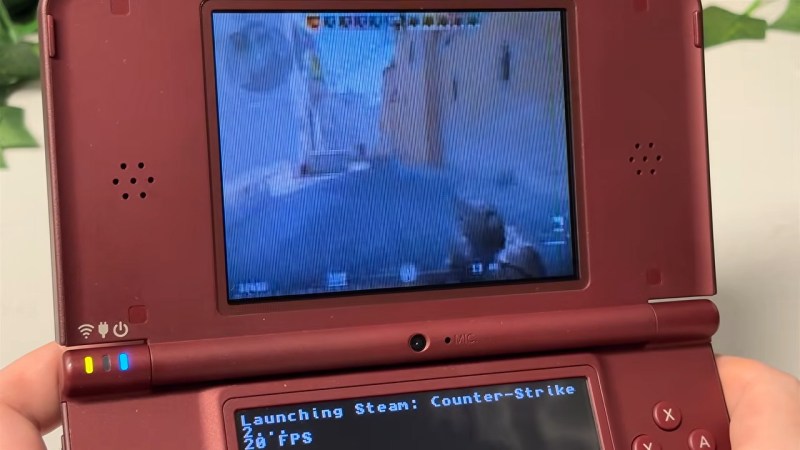
At its core the RNDS-Stream is just decoding an MJPEG stream from a server on a Linux PC, giving you the content of an X11 or xWayland window with relatively low latency at around 15-20FPS. So while you won’t be entering any e-sports tournaments, you can enjoy more relaxed, casual games like Counterstrike. Well, at least there’s no audio streaming yet, so you won’t have to hear the other team’s trash talk. That ought to make it more relaxed.

Sound may come; the project is very much a work in progress, and also a showcase of RubyNDS, [gavff64]’s Ruby-based homebrew framework for the DSi. Why Ruby? Why the DSi? For no other reason than [gavff64] likes both of those things.You can observe it in action after 4:48 in the video embedded below– just be warned, it’s editing is tuned to a TikTok-using audience and won’t be to everyone’s taste. Don’t let videography get in the way, though, because the hack is the thing and it’s up on GitHub for all and sundry under an MIT license.

The DSi is no stranger to hackers, having gotten its first flash cart the year of its release. In spite of that, we’ve seen surprisingly little homebrew for the dual-screen device, this augmented reality app being an exception.

Continue reading “Streaming Games Means The Nintendo DSi Will Never Be Obsolete” →
Raspberry Pi 4 Brings Cloud Gaming To Nintendo Switch

Companies like Google and Microsoft have been investing heavily in the concept of cloud gaming, where a player uses their computer or a mobile device to stream the video feed of a game that’s running on powerful machine tucked away in a data center somewhere. With this technology you can play the latest and greatest titles, even if the device you’re using doesn’t have the processing power to run it locally.

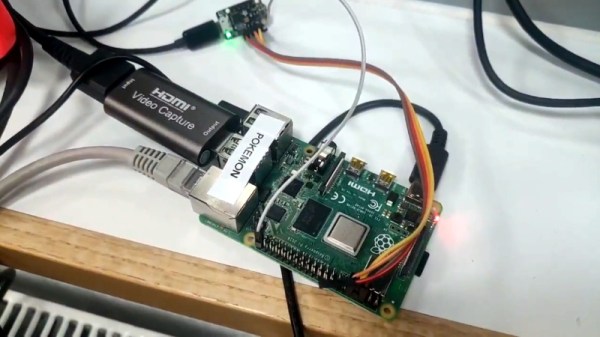
Considering the Switch is already a portable system, it’s not too surprising Nintendo doesn’t seem interested in the technology. But that didn’t stop [Stan Dmitriev] from doing a bit of experimentation on his own. With little more than a Raspberry Pi 4 and Trinket M0, he’s demonstrated that users can remotely interact with the Switch well enough to play games in real time.

The setup is fairly straightforward. A cheap HDMI capture device is used to grab the video from the Nintendo Switch dock, which is then streamed out to web with the help of the Pi’s hardware video encoder. Input from the user is sent over the Pi’s UART to the Trinket, which itself is running a firmware specifically developed for mimicking Nintendo Switch controllers. With so many elements involved, naturally some latency comes into play. The roughly 100 millisecond delay [Stan] is reporting isn’t exactly ideal for fast-paced gaming, but is certainly adequate for more relaxed titles.

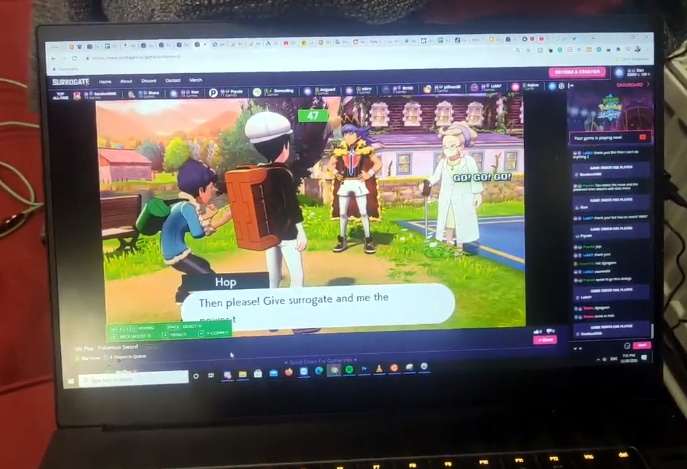
On the software side of things, the project is using a SDK developed by [Stan]’s employer SurrogateTV. Right now you need to apply if you want to get your game or other interactive gadget up on the service, though he says it will be opened up to the public next year. But even without all the details, we’ve got a clear idea of how both the video capture and user input sides of the equation are being handled. For personal use, all you’d really need to do is put together a simple web interface to tie it all together.

This isn’t the first time we’ve seen a microcontroller used to interface with the Switch. Other consoles are a bit more selective about what kind of hardware they will talk to, but the Microsoft Adaptive Controller could potentially allow you to do something similar on the Xbox.