
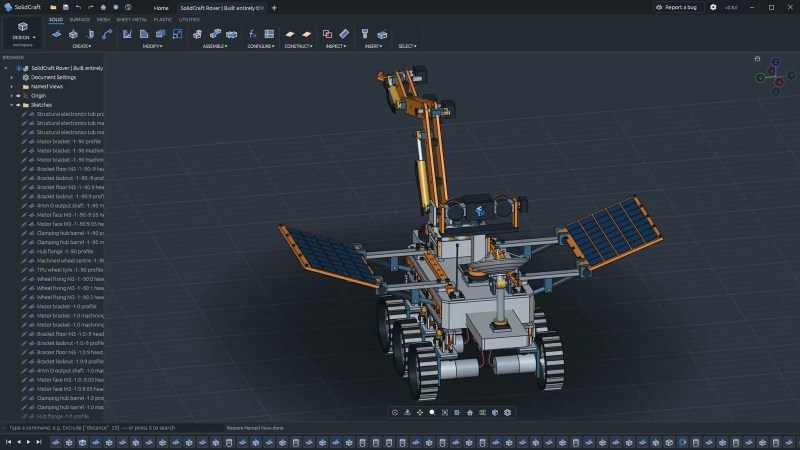
If you’re looking to try a new, open source 3D modeling CAD suite, especially one with automation-friendly interfaces, take a look at SolidCraft. It’s under development but there’s support for all the usual features like sketches, solid modeling, and constraints as well as a full parametric feature timeline.
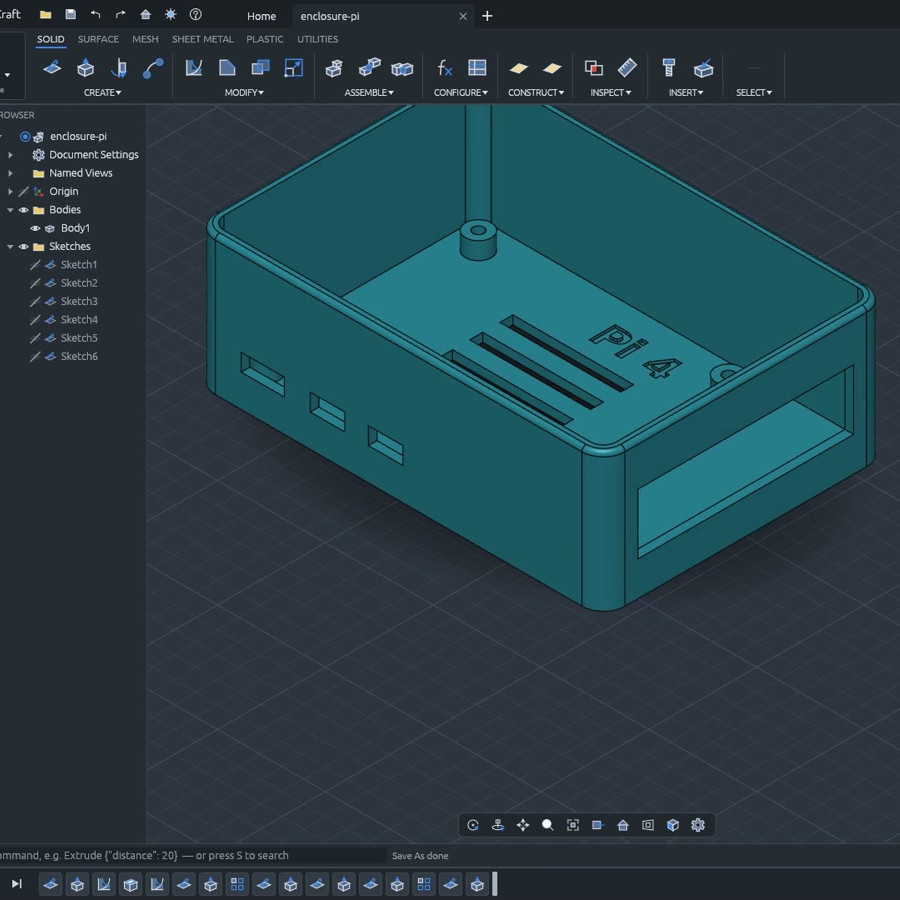
A parametric timeline essentially means the model exists not as a single discrete object, but as the sum of a sequence of operations. One advantage of this is being able to set things up so that if one changes a value (like wall thickness), all the features that depend on that change automatically get rebuilt as a result. But there’s more!
Written entirely in Rust, SolidCraft can run as a desktop app or as a web app in a browser. Everything the user can do in SolidCraft is a command with JSON parameters, and it offers a built-in headless command line interface and even an MCP (Model Context Protocol) server built specifically to give AI agents a way to use the program, should one be interested in experimenting with that sort of thing.
SolidCraft is still in early development, but so far quite a few features seem to work as they should. Check out the development roadmap for details, and there’s a live online demo if you’re in the mood to click around and get a feel for things.
We have seen quite a few open-source, browser-based CAD efforts over the years and it’s encouraging to see developers continuing to explore fresh ideas and features in the CAD landscape.












Just because you wrote it in Rust™ doesn’t mean it’ll match 40 years of Parasolid development anytime soon.
If it’s more stable than solidworks then that’s good enough for me
Solidworks reliability is TERRIBLE.
maker or pro version, they get worse with every release.
It could. It’s a vibe coded app so currently it’s trash but soon who knows…
Yep, if this project accepts vibe coder’s or Agent’s work, will it overtake everything else within the next year or so? Seems to me like there is defo a niche for this one.
Looks like they’re porting an existing solid modeling kernel.
I will admit that I’m disappointed in these vibe coded (sorry to assume) efforts trying to reinvent wheels when there are all kinds of open source projects which need love.
Though I also understand those projects are not that welcoming to vibe coding.
Those other projects are tangled messes that are far too hard to meaningfully contribute to.
It feels off but, it’s far easier to make something new than to try to improve something like FreeCAD.
Oh, for sure. Projects like FreeCAD have a lot of entropy to them, both in the code, and the organization, and the community.
There’s something to be said for starting over every so often. This almost lends itself to the Unix Philosophy of going back to a bunch of little tools which come together to provide larger functionality. Then replacing any little tool isn’t a full rebase, but extending functionality becomes a nightmare.
Rust tends to be a favourite for vibe coders I suspect because the compiler is more easily able to check for issues at compile time as the language is more constrained / strongly typed in that regard. (which in turn makes it easier for the AI model to check if what it’s written actually has app breaking bugs)
C / C++ by comparison will quite happily let you build code with undefined behaviour although probably spit out a fair few warnings in the process.
The big enchilada has always been the CAD kernel which checks the geometry, even FreeCad relies on an external library which is OCCT. I suspect this is the big area where AI might shine as porting something like that is going to be math heavy and monotonous, although it will be interesting to see if it has similar topological naming problems that FreeCad used to have when you alter the number of faces for an operation mid way through (this affects all parametric software to a certain degree).
Would I trust this myself over FreeCad? probably no but that’s only because FreeCad has many more features such as CAM and this project is only a week old or so. But I suspect over time as AI becomes more prevalent it should be interesting how this turns out, especially since it has an MCP server so that you can hook an AI up to it and just describe what you want, that in itself might make things very interesting. (give me the most efficient rocket engine please and test it using the FEM features once they arrive)
“(give me the most efficient rocket engine please and test it using the FEM features once they arrive)”
Interesting as it can derive the context that efficient exists within.
It looks like they’re porting an existing kernel.
Re:
just describe what you want, that in itself might make things very interestingYou can already do this with GPT6 and FreeCAD.The idea behind the MCP server is that it can give AI direct remote control over the software so it can interact with it, that being said I have just noticed someone has come up with something for FreeCad
https://github.com/neka-nat/freecad-mcp
Have you tested MitCad? It use patched OCCT (over 1000 patch). Basically already do same things than fusion but many 3d print releated things even better. And it open fusion files with their full parametric design history.
it working with my wood router?
The language in which it is written doesn´t matter, as long as the code is correct and the software works.
But the concepts are interesting. The possibility of decoupling the actual rendering from the commands to draw and represent the object bring up some interesting possibilities…
CADQuery is a current, mature project which explores those concepts.
Hmm, seems interesting, thanks.
Cadquery tends to be a python script based cad system similar to openscad but using python and open cascade
There’s also build123d which is a very similar alternative
For both there’s a visual studio code previewer as well
https://github.com/bernhard-42/vscode-ocp-cad-viewer
I learned OpenSCAD, and recently I’ve been having Claude build .scad files for me for 3D printing. That has been working well, but just last week I wanted a 3D rendering of an LCD display for use in KiCad, and Claude said it would be better to use Cadquery to generate a STEP file. I gave Claude a picture with the dimensioned front and side drawing of the display from an Aliexpress listing, and a couple minutes later I had a very good rendering of the display. I was impressed that it differentiated and accurately rendered the base circuit board, the display glass and the flexible circuit board connecting the display to the base circuit board. This made me wonder if it would be advantageous switch from OpenSCAD to Cadquery for future work.
Language can matter. Especially in performance – a critical criterion in CAD software development. That said, good architecture must also be employed.
Correct, except the language does not matter because it’s vibe coded, it could be x86 assembly for all we care
The only thing that matters is what it does
Great. I am more of a unfrequent SolidWorks/Autodesk Fusion user myself and was hoping for a copy like cadcraft is of AutoCAD.
I just played with it for a few minutes and it was pretty sleek. As a recovering fusion user and a growing freecad lover, I feel a little torn.
Sounds like it has the problems that AI generated material usually has. Clean, beautiful, and very functional, but usually with hidden serious problems.
If projects like freecad could help the user experience (less clicks, more convenience features – I’m looking at you offset extrude, modern UI) I feel like I would have no debate.
Wish I was a real programmer so I could help contribute.
As a recovering Fusion etc. user, I’m going to opine that there’s room at the bottom for applications to be wildly popular. Tinkercad was developed to get people (students) into CAD at a very basic level, and then have them submerge in the full Fusion experience to produce manufacturing-ready results. The problem is that Tinkercad is too basic, and that frustration and abandonment live in the gap between it and Fusion – a large number of beginners quit. Enter the “enhanced” Tinkercad variants.
Sketch Forge and Layerling are “just enough” for more things than people expect, particularly the Widget Gap where you need a quick printed/fabricated widget to connect Part A to Part C, or a quick print for a school project. The lack of frustration/disgust/computational overhead is appealing and the results are “good enough” to keep going with whatever the original project is. Hopefully it won’t become top-heavy and overladen with features that are seldom used, and then procedurally changed every few months to everyone’s frustration. Looking at you Fusion.
On a more philosophical level, it’s so encouraging to see how public efforts will fill in a gap (between Tinkercad and Fusion, for instance) where it’s desperately needed. I’m sure we’ll see more of them.
and you see all these youtube/blog-creepled-ads talking about this joke.
hackaday failling for this is pretty disappointing.
If they only posted quality content there would be less opportunity for being snarky and provocative 😛
I’m very impressed with this and I’m a longtime Fusion user with a license. Interface is very similar to F360 and doesn’t require much adjustment.
Same here, and I don’t understand all those haters with slop, vibe code and so on, this product is only one week old and it has almost all functionality of fusion360 part design with a clear roadmap and releases every day. Still it’s not mature enough for something big (unable to load a whole 3d printer step file but neither does the FreeCAD) but for small designs it’s more than enough, especially while loading for a second (in web browser).
Ah, more vibeslop. Cool. Anyway.
As opposed to your meticulously hand-crafted, carved in obsidian, forged in virgin blood alternative, which is to be found remind me again where exactly…?
Except if they abandoned it once they run out of token. It’s easy to create a new working prototype nowadays but maintaining it still needs to be demonstrated.
I mean the nice thing about if its abandoned is its all on github right? So someone else with “more tokens” can just pick up where they left off…dont get me wrong im dubious as well of these vibe coded suite of dupes coming out lately. But the whole thing with contributing (or picking up abandonware) to open source projects is trying to gain the context in a mess, to even be able to make a contribution. AI has no such limitations. Anyone(preferably someone who at least has software development experience) could grab this and run with it.
I gave it a quick look and I have to admit that it looks really impressive already. I am super-skeptical about this whole vibe-code thing but as of now it makes a usable impression to me. The first commit on github was on Oct 7, just 11 days ago. Impressive. I was immediately able to modify one of the example designs and import it directly from there into PrusaSlicer – very neat.
Let’s see what happens to the development after the initial rush is over. Is it going to be another piece of abandoned AI slop that nobody will ever be able to modify and extend or will it turn into a real long term project with an active community?
This is super exciting.
It doesn’t take much to beat SolidWorks these days. Each release is less reliable, with more bloat that keeps carrying over ActiveX/OLE/VBScript crap (40 years of baggage/garbage) which makes it crash every 2-8hrs.
The ensh*ttification of corporate conglomerates has taken a strong hold on SolidWorks.
Can’t wait to get rid of all the abstract tool usage that takes 100 hours to get your brain tuned to — and someday, run everything from a console using free language and sloppy sketches that magically snap into defined geometry. Once people are not tied to archaic UI’s and historically baggage the lock-in disappears and these tools win.
I moved to MitCad https://github.com/mitcad because it opens also my old fusion files.
The first thing I check with any new CAD package is STEP round-tripping. Export a part with fillets and a few holes, re-import it into FreeCAD or Fusion, and see whether you get real B-rep faces back or just a tessellated shell. If that exchange is clean, trying it on side projects is low risk, because you can always walk your parts back to the tool you trust. If it can only export STL or other meshes, it’s fine for printing but a trap for anything you’ll want to edit later.
… and how long do we need to wait for the report back, or did you intentionally leave out the “these steps have been left as an exercise for the reader”?