
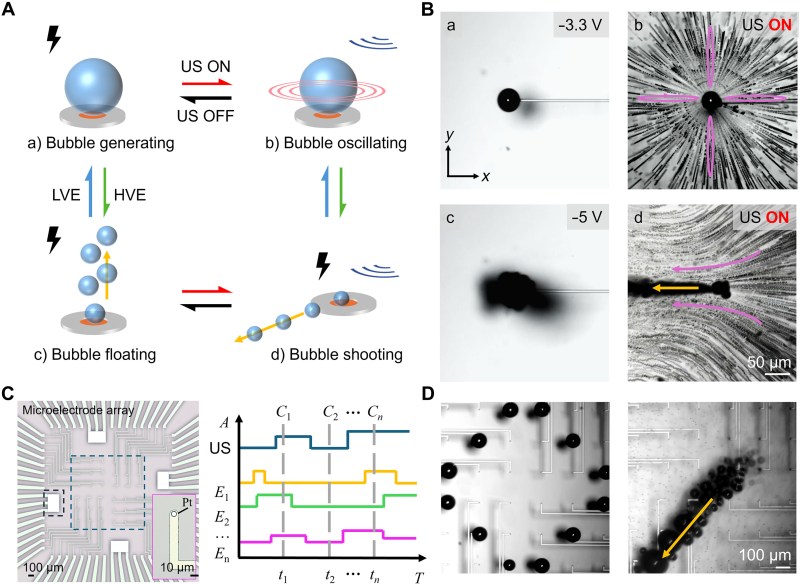
 Although we generally do not look at bubbles in fluids as more than a curiosity – if not an outright annoyance – in certain contexts they can be very useful. If you can namely control their formation and position, you can use them in small systems to control actuators and dynamically affect acoustic systems. The main issues here are that controlling their formation, lifetime and controllability remain hard to solve. This is what [Zhiyuan Zhang] et al. sought to address, with a recent study published in Science Advances covering their approach using ultrasound-driven, electronically programmable microbubbles.
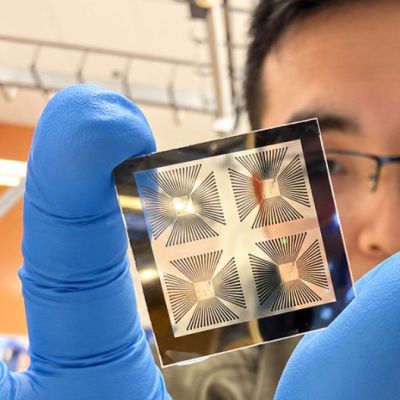
There’s also a Cornell press release article about their findings, which uses a new device that produces hydrogen bubbles along a grid of electrodes, before using ultrasound to steer them around. Using this chip-like device they claim to be able to control the 10-100 micron sized bubbles, with the ultrasound matching the resonant frequency of the target bubble. With each bubble size having its own resonant frequency, this allows for individual control by varying the induced oscillations.
Although in the demonstrated 2D setup this microbubble approach works well, it still requires a fairly bulky bench top setup around it which would need to be scaled down to be more practical. There is also the issue that the chamber geometry affects the movement of a bubble, which becomes especially important to further research when using complex (3D) chambers with this technology.












When air bubbles in water collapse they emit x-rays, could this be used for making sub-nm chips for GPUs and CPUs? It would finally enable the golden era of gaming.
X rays? Seriously? Can you provide a credible reference for that?
Sonoluminescence is a thing, but those photon energies poop out at just a few eV — nowhere near even the 1 keV of soft X rays.
What mechanism is there to produce higher energy photons, and has anyone actually measured them?
I wonder if they’re thinking of https://doi.org/10.1134/S1027451009020207
Yeah I did a quick look-around and there is nothing even close to x-ray emission. Temperatures are off by a orders of magnitude
sub-nm ? If you want that you first need to stop using silicon. Also the feauture size is still huge, but 3D so we get the “equivalent” of like 5nm if it was 2D.
Ditch the awful silicon semiconductor and instead use stuff like GaAs or InP and you can get easily 400GHz CPUs. But first soemone has to actually start with a new Porcess and that is super expesnive so nobody bothers.
With 400 GHz CPU imagine playing Super Mario Bros in emulator at 9999999 FPS. Pure eye message.
Is this the same thing that kills the boat props?
Yes, it’s the same effect. It’s also used for some biochemical processes and as a way of increasing drug absorption to a specific site (ie tumors).
Super-cavitation used for rocket torpedoes…. supposedly….as per ” Warp Drive Underwater”
Micropeening maybe?