
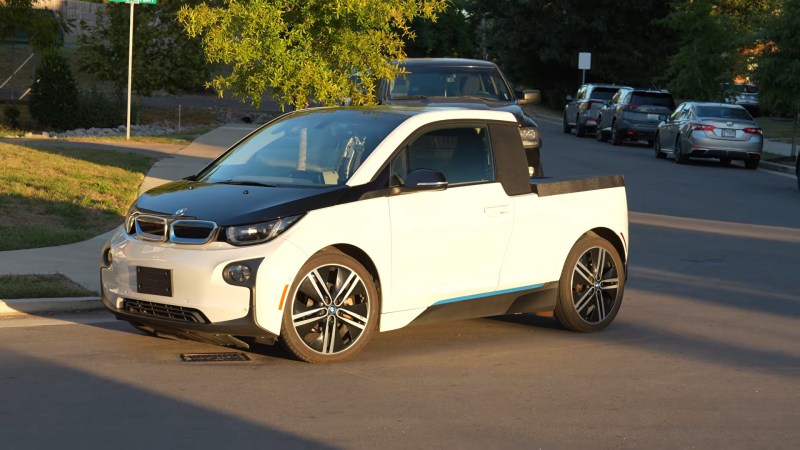
Trucks are handy, especially if you’ve got messy or dirty loads, but there aren’t a lot of options if you want a small electric pickup yet. [Michael Pick] decided to convert a BMW i3 into a utility vehicle.
After getting a new 12 V battery and cleaning the car up, [Pick] proceeded to disassemble the interior and remove the hatch from the car. Once he could look at the bones, he planned out the best places for the cut lines and removed the back half of the cabin.
The bed is built from plywood coated in penetrating epoxy and bedliner for weatherproofing, and special care was taken to seal the interface between the cabin and bed as the main electronics for the vehicle are housed in a compartment directly below. The taillight electronics were rehoused as the OEM lenses were too large to fit next to the tailgate opening.
The i3 has graced these pages before with a battery upgrade, and we’d be remiss not to remind you of the most famous EV to truck conversion, Truckla.











what’s the point? just use the car as it is
You’re on the wrong site for using ____ as it is.
yeah the thing that’s a bummer about this is i don’t think it will be used as it was changed either. it’s just too small a bed to be very useful…very few scenarios where that bed will be more useful than putting your load directly on the factory rear seats. like, anything long will cause huge balance problems even if you can get it loaded somehow. anything heavy like bags of mulch or concrete readymix will simply not fit a very large number of them, and a small number would fit on the seats..
getting things into a rear seat of a two door car is much more difficult than simply placing them in a microtruck bed. This small bed is very useful, Its about the size bed you find in the MANY MANY kei trucks on the japanese market. This sort of microcamino conversion isnt anything new. Chevettes in the 80s and metros in the 90s were often customized similarly.
actually, actually, its not a two door car, its four door. these cars have the little hidden door that swing hinged out opposite to the main doors, so they are ACTUALLY quite easy to get stuff in and out of the back.
‘about the size’ doesn’t mean to me what i think it must mean to you?
most kei trucks have 6ft beds, which is barely long enough that you can set an 8ft piece of lumber in it and its center of mass is barely in front of the rear wheel. those “barely”s are everything: it is long enough. it is balanced.
this thing’s bed looks like it is 5ft long. it is not long enough for an 8ft piece to be balanced. If you put an 8ft piece in it, you’ll have to pile stuff on top of the front of it or you’ll lift the weight off the front wheels.
kei truck beds are as low as possible, which is key to their convenience in loading and unloading. this thing’s bed is almost a foot higher, both the bottom of it and the walls. that ‘convenience’ question is what would distinguish it from simply loading it through the hatchback.
kei truck beds are typically steel and you can confidently throw a heavy bag of material in them but if you habitually toss an 80lb bag of quikrete in there, you will soon hear the sound of debonding that wooden bed.
all the things that make a kei truck convenient aren’t actually present in this design, which is why i say, you’re better off loading it through the stock hatchback. it would be more convenient than the hatchback if it was, but it isn’t. the details all matter.
I don’t think its quite as bad as you paint it – yes its not the most useful small truck dimensions in the back, but it is still large enough to hold your potted trees, wardrobes etc etc that just won’t fit in a small vehicle at all otherwise.
If you are trying to compare it to a regular whitevan or larger pickup it doesn’t do well at all in volume transported. So if your needs are mostly transporting full/half sheets of ply or something again not that well suited. But compact car sized cheap to run and utilitarian enough transport vehicle it certainly could be, just down to what you actually need on the daily hauling stuff around.
Also bags of concrete/mulch/garden waste etc are far better kept outside of the passenger compartment – they tend to be rather messy and annoying to clean up afterwards.
wrong corner of the internet for that kind of thinking.
Get that toxic nonsense out of here. Either you’re missing the entire point, or you’re trolling. Either way, there is no place for a comment like this here.
No place for it? There is, in fact, a place for that comment. Did you not see it? The place for it is just above your comment.
As much as I hate to agree, I fail to see the point, the usability is reduced, the material choice is questionable (despite best efforts to protect against the environment). If the purpose was to have an electric vehicle to move cargo, then just take the back seats out, at least it would last.
That being said, The idea of keeping a vehicle like this running and the “Because why not” mentality is the point, and it deserves to be on here.
Wow, I wouldn’t have thought that was possible on a carbon fiber unibody.
it isn’t. that thing will snap like a twig on impact.
The front will fall off
I was cringing the whole time he was cutting on it. At least he was wearing a respirator?
I suspect it is heavily compromised now as the shell was designed as a whole piece, especially since he didn’t weld into the aluminum frame. If it’s only light loads, might be OK?
Technically it’s a carbon fiber body on an aluminum frame/sled – more tightly integrated than a normal body-on-frame, but still not really a unibody.
.. which is good, because if it wasn’t, he’d need to do major reinforcement of the back.
I’m still a little bit concerned about how much his crash safety is compromised, but heck, it’s still probably safer than any small truck from the 1990s or earlier…
Also, on the bright side, It looks like BMW designed the carbon fiber body in broadly the same way as they’d build it in steel, with thin panels spanning thicker beams and pillars in the usual places. So in a very broad sense the consequences of chopping it up should be similar. Since he’s cutting behind the B pillars, the cab stays mostly intact, and it should still retain a fair amount of rollover protection. Personally I’d feel a lot better with a roll bar or other cab reinforcement rather than just a plywood back, though.
Should paint it a really goofy color, may as well go all-in
US, too, could uses its own version of Holden Ute, ice or ev, with the proportionally smaller price.
Back in the days US compact trucks were sold everywhere for nada, because older inner cities streets anything but wide. Not sure what went wrong in the 1990s that compact trucks went into tailspin and by 2000 none were sold anywhere, except used ones.
Slate seems to be changing that trend, but I don’t know how small it it. For now, I’m keeping my 1996 Mazda/Ford truck
The Chicken Tax mostly eliminated foreign competition for small pickups so the market doesn’t have good competition and American companies can sell high profit margin massive trucks as fast as they can make them. Side plot involving Americans who actively want to buy a truck larger than a WWII battle tank fomenting a size race.
No longer the case now BUT it did a lot to influence it: There was a law to promote better efficiency based on the size of a truck.
Of course the manufacturers didn’t want to get efficiency so they simply grew the trucks to match the curve in the law.
Again, this was repelled in …2024, 25 something like that so no longer applies but of course you’re not seeing smaller models yet because the design takes a while.
Land of the free eh? In EU this thing wouldn’t pass mandatory yearly vehicle inspection for at least two major reasons:
1 – mechanical – body structure compromised, simple as that.
2 – legal – gross mismatch between what’s in the vehicle registration certificate (5-seater passenger car) and what’s actually there (2-seater light truck).
In theory you could make it road-legal again after such major modifications. In practice it would involve so much red tape, it would cost at least as much as buying an entire fleet of top spec brand new Ford F150s or Renault Masters (depending on what your cargo needs are).
Actually, getting this on the road in the EU isn’t a multi-million euro red tape nightmare, it just requires a formal Individual Vehicle Approval (IVA). The Netherlands (RDW) or the UK offer highly pragmatic pathways to make amateur builds like this completely road-legal.
Here is what it actually takes to pass:
• The Roll Bar: Cutting the pillars kills the rollover protection. You need a certified seamless hydraulic steel roll bar. Since you can’t weld steel to the i3’s aluminum frame without galvanic corrosion, it has to be structurally bolted with insulation sleeves or bonded to the carbon fiber to prove it can handle the GVWR in a rollover.
• Dressed Edges: Raw, chopped carbon fiber splinters into razor shards. To pass EU exterior projection laws, all exposed edges must be sealed in resin, smoothed to a minimum 2.5mm radius, and finished with rubber or polyurethane trim.
• The Inspections: You can’t just roll into a standard yearly inspection. It requires a dedicated engineering review to reclassify it from a passenger car (M1) to a light truck (N1). They will test the high-voltage battery enclosure seals under the bed, check the permanent removal of the rear seatbelts, and run track tests (like the “elk test”) to ensure the factory ABS and stability control still play nice with the new weight distribution.
• The Fees: Nowhere near a “fleet of F-150s.” The actual IVA testing fees run between €500 and €2,000. Budget around €3,000 to €6,000 total to cover certified welding, material data sheets, and engineering sign-offs.
It’s a lot of paperwork and math, but with a properly engineered cage and clean bodywork, this thing could absolutely carry a valid EU license plate
This is just unverified AI slop.
Not at all, the UK and EU have pretty similar rules and in the UK you can do much wilder things than this. As the core chassis and remaining passenger compartment crash structure hasn’t had major modifications, the pillars are all intact etc this might even get certified as just a body kit. Complete self build vehicles can even be on the road legally with some rather crazy designs – this might need a little more refinement to pass but the concept is certainly possible.
A friend who relocated overseas just did an IVA on a RHD converted 70s restomod musclecar being shipped from to scotland. He said the IVA inspection took an hour and a half and cost him a couple hundred pounds. Not as out of the box as this but it was deemed a “Radically Altered Vehicle” and he has to submit it to yearly MOT testing where a bone stock car would have been exempt. Point being, There are definitely ways and means to get and keep strange builds on the roads over there.
From the US to Scotland
i understand the impulse to fully weatherproof the bed, so that the underside of it can be treated like an interior space (because that’s what bmw engineered it as). and for all i know it’s possible these days to achieve that kind of seal with a coating on plywood. there are some great polymer coatings these days!
but
don’t build a plywood aquarium. if you are going to have a wooden deck, use slats like 1x4s or 2x6s or whatever. it’s like a deck. the goal is not to keep water from getting through the deck, but rather to let it drain to minimize ponding.
that’s my two cents on the least significant of this projects’ engineering mistakes :)
I think I saw Red Green do this once but with a K-car and duct tape.
Given the above comments and opinions, Red’s build might be better… :)
This is a cool build and without a doubt it’s a “hack.” If it’s useful for the guy who built it, great.
But I used a Ford/Mercury Capri convertible as my only car for 10 years. Two-door convertible. I moved furniture, renovated an apartment, even slept in it a couple of times. The posters above are correct – the back seat is just as convenient as a small pickup truck for carrying stuff. At various times I put stacks of tiles in there, bags of cement, a washing machine… with the roof folded down there was plenty of room, and just as easy to load as a pickup, just throw your stuff in the back. If it’s about to rain on your bags of cement, you can put the roof up to protect things after loading. On the rare occasion that you really HAVE TO move something big, my local hardware store lets me borrow a trailer for free to haul my purchase home. That little convertible tows it just fine, though I concede it would suck to do an interstate trip like that.
I love cute trucks, like this thing, kei trucks, the Suzuki Mighty Boy, I even have a soft spot for the Subaru Baja! But there’s a tradeoff, and in my lived experience, a back seat is more useful than a small pickup bed. The sweet spot for me was a small back seat with unlimited overhead clearance :-)
Hot garbage.
The fact we need a do this bullshit.. just let us buy hiluxs already ..
Airplanes next
https://techxplore.com/news/2026-10-generation-solar-aircraft-batteries.html