
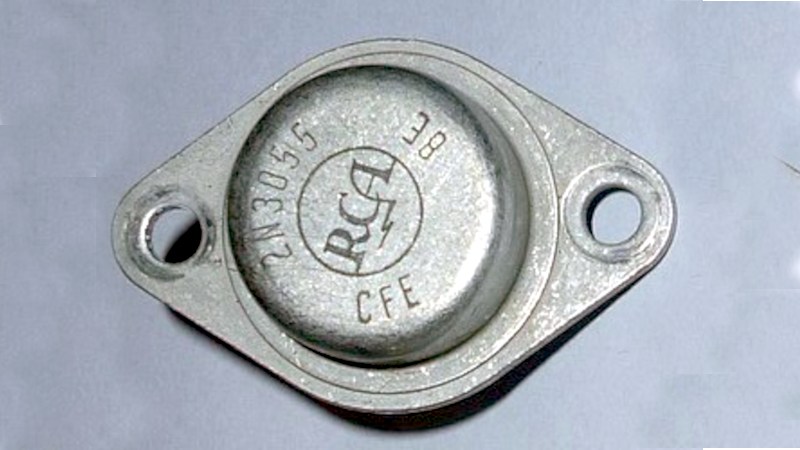
There are some devices which achieve electronic immortality, it’s likely that you have used a few of them yourself. The 555 timer of course, or the 741 op-amp. [ElectronicsNotes] is here with another candidate that might not have been on your mind as you read the previous sentences, and it’s a transistor. The 2N3055 is an NPN power transistor, no, THE NPN power transistor, that has found its way into an astounding array of devices over the last six decades or more.
For such a ubiquitous device one might imagine that there’s not much new to know, but the video delivers on that front. Here as well as probably for you the 3055 has always been an epitaxial device whose quirks you likely know well, but originally it was something different. It used the hometaxial construction process on its launch in the early 1960s, but in the mid 1970s it was replaced by a version with the same capabilities but using the epitaxial process. The consequent higher Ft required modifications to circuits using the device to stop unwanted oscillation.
Where this is being written there are several 2N3055s, in the by now rather old office audio amplifier, in a bench power supply, and probably elsewhere too. It’s been superseded in many ways and its TO3 case now feels antiquated, but it will probably never entirely go away. Meanwhile if you’d like to read about another iconic 1960s device that never went away, we have you covered.
Header: a really early example. Eule4404, CC BY-SA 4.0












Forrest Mims had a pretty standard beginner’s circuit involving one of these NPNs, a carbon microphone, a loudspeaker, and a lantern battery. That transistor ran really hot, but it sure worked as a make-shift megaphone.
Saw the top off of a 2n3055 and you can use it as a radiation detector.
Glue the nib from a smoke detector to it, add some amplification, and detect individual alpha particles striking the B-E junction.
(It also will see CBR muons, but it’s aperture is really small, so… they’re rare.)
Remove the text and gold plate it and you have a high end audiophile transistor :-)
Does ist sound “warm”? :D
Works also as a solar cell so you may need to screen it from light to not alter other readings.
Don’t forget the 2N2222 and the 2N3414.
Just sayin’…
Apropos of my post above, if the 2N2222 is a “tophat” metal can version, you can clamp it by it’s “forehead” in a drill, hold a file against it while rotating, and the tophat will come off, revealing the transistor guts.
This, too, can be used as an alpha particle detector, although the aperture here is really small.
Or as a light detector
And the 2N3904/2N3906 complementary devices.
This !!!
When a 555 won’t do, use 2N2222s and 2N2907s.
If I correctly remember a Bob Pease article, the hometaxial process was expensive because it was slow, requiring 24 hours to form all the layers at their required thickness. That thickness helped provide a large Safe Operating Area, an advantage that was lost when a more modern process was introduced.
These make great little heaters. I use them in a 4 cu ft climate controller greenhouse. With 12V from an old PC supply and a 0.1 ohm resistor in the emitter you have a current controlled heater. They have a beta of about 100 so 10 ma into the base means the 3055 drops 12V at 1 amp or 12 watts. Measure the drop on the 0.1 ohm resistor with an ESP32 and 0.1V = 12 Watts. With a 10 amp supply you precise control to over 100 watts. PWM on a GPIO drives a small transistor for the 0-100ma control current and a BME280 to measure temperature. Put he 3055 on a heatsink with a fan improves the heat distribution.
Anyone who’s ever owned a Tempest arcade cabinet (any of the colored vector games) knows exactly how warm some of these TO3 packages get 😆
Unfortunately, this ^
I made ny first 12DC to 230VAC invertor using 2N3055 transistors ( circa 1980)
Nice ! Would love to have seen that.
One funny thing about these i realized years ago that the 3055 part sort of spells “boss” and that’s kind of funny as this is the boss of old power transistors.
RIP RCA. Another company that went the way of the Dodo. But the BJT still works, (apart from Chinese nockoff fakes).
This company went quite a while ago. Try to guess the year before you peek:
https://en.wikipedia.org/wiki/RCA_Corporation
I got an old parts box loaded with TO-3 parts. A lot of them are the 2N3055 and MJ2955.
Don’t forget the TO-66
BC109,108,107. OC71 etc … Legendary devices I used while growing up in the uk
When the many component power supply mfrs in southern California shut down in the 1990s, I made several dumpster diving trips around OC and San Diego counties. Scored about a dozen tubes of (TO-3) 3055s; down to my last two tubes. Still have about (50) MJ410, ~ (100) BU508, and ~(100) MJE13005, and other bipolars.
Times are tough for the finding the well-made old stuff. One of my former students offered me his first-born for some of my stash, but his wife and my wife intervened.
Wait… you actually considered accepting that trade? :)
Spare hands and feet are kind of expensive these days… might even be worth a 3055 or two. Not a whole tube full, certainly.
I have no idea why or where, but I have a box of about 100 3055s that I acquired in the early ’70s. I used one once as an “audio amplifier” on a KIM board output circa 1977.
One of the first electronic circuits I ever tried to build was a 2N3055 power inverter from a magazine article. I didn’t really know what I was doing at the time and most of my parts had to scrounged and salvaged as the nearest electronics parts store was over an hour away and I didn’t have either a car or a license. I blew numerous fuses, smoked far too many resistors, and definitely overheated the transformer windings in my experimentation. Even with heat sinks, the 3055’s got hot enough to sear meat, a fact I found out the hard way when my wrist happened to brush against one of the transistors. (Still have the scar.) I got the circuit to work, marginally, and despite all the abuse the 3055’s took, they just kept working. I wouldn’t be surprised if they’re somewhere in the bottom of my junk box, still perfectly functional. Good times.
KD502 , KD503 ?!?
I’ve had a 3055 in my keychain since the late 90’s. Checked it a year or two ago and it still works. Reliable connections are hard to make though since I snipped the legs off when it became a nerdy accessory all those years ago.
I still have some of them in my drawers, of course legit ones not Ali* or Ama* relabeled crap. My diy lab linear power supply I built in …uh.. some 40 years ago still employs the original pair of them in parallel and none of the many shorts it had to sustain over the decades managed to kill them. Capacitors are almost gone and will need a replacement, but the transistors don’t miss a beat. They were workhorses.
The TO3 package has been around a very long time, but is it obsolete? Is there a better, more modern package that can handle the heat?
TO-3P, TO-247 & TO-264 are more modern packages with better thermal performance than TO-3. They are also much easier to mount to a heatsink.
As a kid growing up in the sticks with only occasional mail-order access to parts, this was one of my stalwart parts. High power? 2N3055 High gain? BC108 High power AND high gain? BC108 / 2N3055 as Darlington pair!
I had one glow red when I’d mis-wired something, but it worked just fine after it cooled down (even though the printing had burned off!)
I’ve never seen a transistor glowing, but I saw one get hot enough to melt its solder, and fall out of the board. It was part of a darlington pair similar to your BC108/2N3055 pair, and was a linear pass regulator in a TV back in the ’80s. The big transistor failed and the little one carried the load until it physically fell out (the board was mounted “upside down”). It still worked when I put it back in with another power transistor, but since a customer was paying for the work, I replaced it as well after my experiment.