
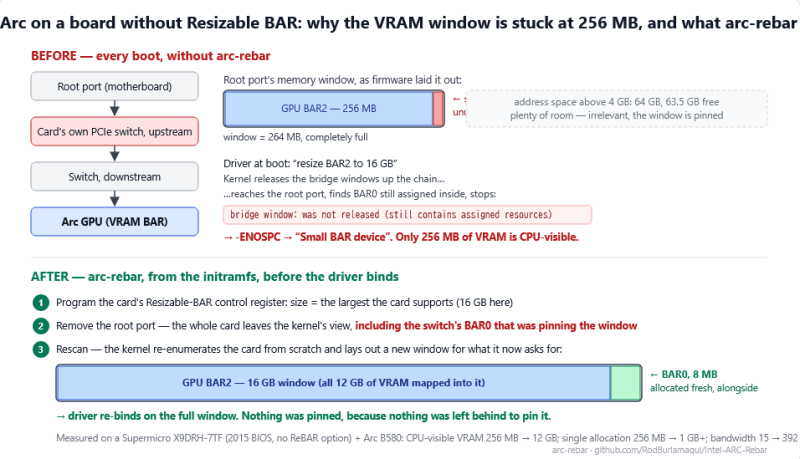
Recently [Rod Burlamaqui] released the arc-rebar project on GitHub, enabling Intel GPUs to work significantly more efficiently if the system’s mainboard does not support resizable BAR. It does require a Debian or Ubuntu installation and of course a supported Intel GPU.
Although the resizable base address register (ReBAR) feature has been part of the PCIe specification for a while, its use was quite limited until Intel released its Arc series of graphic cards. These use this feature to map much more of the GPU’s video RAM (VRAM) into the PC’s address space than the standard 256 MB, assuming that the system is capable of decoding addresses above 4 GB, i.e. allow for 64-bit BARs.
For GPU manufacturers like AMD and Nvidia this wasn’t so much of an issue as their GPU designs developed in a world where ReBAR didn’t exist, while Intel’s new GPU generations were designed with ReBAR as a core feature, which naturally cripples performance if the mainboard does not have it enabled during PCIe bus enumeration.
This initramfs-based fix runs before the GPU driver loads and performs the requisite BAR configuration. In testing with an Intel Arc B580 GPU on a 2015-era Intel Xeon mainboard the difference between the default and the fixed bandwidth was a bump from a pitiful 15 GB/s to a respectable 392 GB/s, showing how this one fix can breathe new life into older systems.












BAR in this case would be a very useful word to have defined. As a computer professional with 30 years if experience, I will have to look that term up.
Indeed. It’s clearly not the one related to FOO.
(Re)sizeable (B)ase (A)ddress (R)egister.
Wait, this isn’t clearly defined in the second paragraph? I see the ReBAR clearly defined as resizable BAR, but it says “base address register” instead of BAR. As a hobbyist in the field with around 32 years of experience this actually seems obvious to me, I’ve seen the BAR (base address register) in the original PCI spec years ago. PCIE is just an extension of the original PCI, and as I recall, surprisingly similar outside the obvious changes/updates. Kinda like the way SATA relates to PATA (aka IDE) for drives. Did I miss something here, or does someone need to read a little more carefully?
No disrespect intended, just sayin
It’s in the article, although out of context.
“Although the resizable base address register (ReBAR) feature”
BAR is base address register. For memory mapped devices, it’s where the system “puts” the device in the global memory address space. On Linux, do lspci -v and the “Memory at X” part is the BAR. Devices can have more than 1 BAR, corresponding to multiple memory-mapped windows.
It’s called a base address register because the system actually programs in the base address of the device into a register on the device, as opposed to older devices (pre-PCI, although there might have been a few busses beforehand that had a similar method) where you hard-coded the I/O address using jumpers.
Kek ok “Computer Professional”
1st rule of writing anything with acronyms – define the acronym on or before the first use.
yes, good idea to ask this on their AI when write slop like that..
^^ Would actually clutter HaD to the point of uselessness.
Linking acronyms to Wikipedia articles or similar on the other hand…
Due to my work on PCI drivers, I know what the BAR is in this case. And I still fully agree with you here, this article fails to properly introduce anything and just throws you in the deep end.
The article title here isn’t quite right.
The problem as described in the actual (LLM-assisted/authored :/) ReadMe is that these specific Arc GPUs have an internal PCIe bridge whose BAR size is fixed to 8MB and which are automatically tied to the pcieport Linux kernel driver. When the xe kernel driver tries to set the GPU’s BAR size, it can’t do it because the PCIe bridge happens to be in an overlapping address range.
This script addresses the problem by removing the pcieport kernel driver from that bridge, setting the GPU BAR size manually, and then having the kernel re-probe for devices, at which point it now sees the larger-BAR GPU.
It’s a very slick hack, but it’s very Arc-specific and does not at all substitute for the prior art in this field which generically enables ReBAR by injecting DXE modules into the UEFI (i.e. what we usually call the BIOS).
Thanks for alluding to the fact that other projects also exist. Do you have any names?
Nevermind, I found it:
https://github.com/xCuri0/ReBarUEFI
A notable difference here is that ReBarUEFI typically requires you to modify your firmware, where as the project in the article, “Intel-ARC-ReBar”, does not seem to have that requirement.
However, I find Rod’s licensing weirdness off-putting. He clearly states this is not an open source project. He also has a misunderstanding of how licensing works in general:
“Intel Arc B580 Limited Edition. Photo © Intel Corporation, from Intel’s newsroom press kit for the Arc B-Series launch (Dec 2024), reproduced with credit. The photo is Intel’s and is not covered by this project’s licence.”
Stating who owns the copyright of something does not give you permission to use that copyrighted material. If the newroom press kit’s license covers your use, then you’re using with permission, not with credit. Then there’s the use of “Intel ARC” in the name of his project. I’m pretty sure this is not a licensed Intel software package. ARC is probably also trademarked.
There are a lot of issues here, which makes me question how deep they may go.
It would also be easy to do a clean-room POSIX shell implementation of his Bash scripts. You can’t license a principle or discovery.
Why would you try clean room anything on a code generated by a vacuum cleaner? LLMs cant hold copyrights
Enabling ReBAR in the BIOS also helps performance for Nvidia and AMD GPUs.
This was also done earlier by this guy: https://github.com/ben-efros/grimtickle-overlay/blob/develop/sys-kernel/rebar-sources/files/0001-pci-resizable-bar-release-bridge-owned-bars.patch
Former Nvidia validation engineer here.
“For GPU manufacturers like AMD and Nvidia this wasn’t so much of an issue as their GPU designs developed in a world where ReBAR didn’t exist”
I don’t understand where this is coming from. Even for the Blackwell generation we were using ASRock Rack motherboards with bespoke BIOS images for VRAM validation because there were so few motherboards available with BIOS support for ReBAR over ~64GB of VRAM.
My home lab, I have a stack of B100 GPUs with 192GB of VRAM each that sit on a shelf because I haven’t been able to get a motherboard that can support them
The overwhelming impression from Arc vs Radeon etc. benchmarks with and without ReBAR enabled is that the former’s performance absolutely tanks without that feature. Hence the statement that both ATi/AMD and Nvidia developed ways to get solid performance even without said feature.
Thanks to Maya and Hackaday for the write-up, and to everyone for the feedback, including the kind words about the “slick hack”. You’re right that it’s Arc-specific: it isn’t meant to replace firmware-level tools like ReBarUEFI or earlier kernel patches, which came first and deserve the credit. It’s for
people who can’t or don’t want to modify their firmware or kernel. Based on your comments, the README now has a “What is ReBAR?” section explaining what BAR and ReBAR
mean, in detail and in plain language, with sources, and the product photo has been replaced with my own illustration. it’s free for personal use, and it’s an independent community project, not affiliated with or endorsed by Intel; “Intel Arc” in the name only says which cards it supports. Since the article, users have reported it working on A380, A750, A310 and B580 cards, and
1.0.8 adds Arch and RPM packages alongside the .deb. Bug reports and hardware results are welcome on GitHub: https://github.com/RodBurlamaqui/Intel-ARC-Rebar