
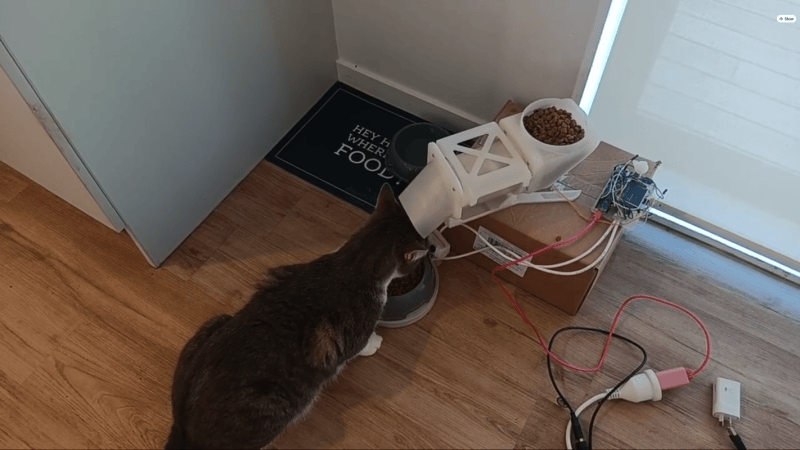
Automatic cat feeders are a dime a dozen, largely because this is an easy problem to solve. Dry cat food is easy for machines to manipulate, and the electronics needed to accomplish the task to a bare minimum are plentiful and inexpensive. But just doling out food is only easy part of the problem. [Jason] wanted to make sure that his cats actually ate once the food was dispensed so he added a few extra features to this cat feeder.
The main addition to this feeder compared to off-the-shelf models is a weight sensor under the bowl. The feeder metes out a certain amount of food, and then a Raspberry Pi Pico W keeps an eye on the weight of the dish. If it goes down, presumably the cat has eaten all of the food. But just to be sure, an ultrasonic sensor was added beside the bowl to ensure something cat-shaped was there at the same time. There was some issue with this sensor blasting out noise in a cat’s audible range at first, but it seems like that problem has since been solved as well.
The build has a few other perks as well. The hardware has wireless communication ability, so it’s easy to keep an eye on when out and about. It can log data and is much more programmable than others. Like most cat feeders, though, it’ll only work for dry food. For automatically feeding wet food something like this robotic feeder that opens cans and dispenses them at set intervals would be needed.









You have trouble getting your cat to eat? Ours runs like his life is in danger when he hears the clinking of food into the bowl and eats like a starving man when he gets there.
i got two kittens who are eating like pigs. you would think they would be fat but they are burning it as fast as its coming in. little hooligans.
Not sure if your trying to do scheduled feedings yet but kittens should be able to free feed on dry kibble if possible. I have yet to run into a fat kitten in my over 10 years of volunteering with a animal rescue (and fostering over 100 kittens). Wet food once or twice a day is what most fosters do but isn’t necessary, However it is a great way to do positive association with house guests and nail trimming.
I often ask guests if they want to see the kittens and if they do I have them bring in some wet food. The kittens gorge themselves and take a food coma nap/cuddle after but get very playful about 20-30 minutes later. 98% of the time this works to make very social and trusting cats if you combine it with making sure to mess with their paws, check their teeth, and holding them upside down like a baby at least once a day. This is best done in the 2-6 month range when they are most formable.
I’ve got two tubby orange cats, an elderly Siamese, and a new kitten. They all really need to eat different food and different amounts instead of the free feeding they enjoy (too much) now. I would love to come up with a way to feed them individually. They aren’t chipped, so no RFID sensors possible, but I suppose a camera could recognize which cat was which and open a door. When I see a pet feeder on here I get hopeful.
A RFID tag on a collar might do the trick – might have to be careful about the range and need to separate the feeders
I commented below, but I started with this approach and ended up settling on reading the color temperature of reflected light from each cat. Yes, the range was the problem with RFID.
Why don’t you get your cats chipped? It’s a prudent measure anyway in case they ever manage to wander and get lost.
Because I live in the middle of nowhere. If they escape and disappear, they’ve probably been eaten by coyotes.
I’ve played around with “Cat Scanners” (ugh at the name) and as you’d expect just because two things use radio waves does not mean they’re even remotely compatible. Or catpatible. Cat scanners and chips run super low frequency and have VERY short range (like an inch or two) you’d never get a COTS 13.56 MHz NFC scanner to scan a cat chip. It would be about as difficult as making a FM radio receive AM radio, or making an AM radio receive commercial high def TV. A “cat scanner” would make an interesting hackaday project. You could do the whole thing with a fancy enough SDR I think. No cat chips are not mi-fare compatible etc. It is not rocket surgery to hook up a loop of wire to an attenuator and input of a spectrum analyzer and once you figure out they run around 150 KHz the protocol (protocat?) can’t be that complicate as they’re rather simple chips.
my indication is when the bowl is empty and the cats are meowing at me.
Perhaps a audio meow sensor at certain times in the day could be a useful feature for this project
The feline definition of “empty” and mine differ. Theirs involves the existence of any one spot where they can see the bottom of the bowl, no matter how piled high the rest is.
Also built such a system. But I bought a standard feeder, removed the controller and put in my own. Added a vibrator unit in case the spout remained blocked. A reverse option for the impeller in case it gets stuck when a food piece get caught. And wifi so I can control or adjust it remotely. Built 3 of them, we have about 25 cats.
We have a cat feeder,
it runs on bird seed.
I like this, but like so many of these projects, it seems overly complicated. Unlike most, it weighs the food, which is very good.
I use an automated feeder that has 5 cups. I put 10g of food in 4 of them, and set the timer to feed the cat every 6 hours (on the 4s and 10s). I have found that if I put out 40g of food all at once, she eats almost all, and often pukes. But even if she doesn’t puke, later in the day she gets hungry and starts chewing on wires.
Keeping feeding amounts small, and feeding multiple times per day and night controls her hunger, her wire chewing, her propensity to puke, and her weight. One of her feedings is at 4am which keeps her from waking me up because she’s hungry.
I think that for this project, a simple timer paired with a dispenser that drops a preprogrammed weight of food would be perfect. You could weigh the food inside the machine, then drop it into the cat’s bowl.
I built a “cat un-feeder” at one point. We had two cats, the young, starving, orange cat and the brown cat who could never get to the food before it was gone. The un-feeder worked by putting the food at the end of a tunnel with a servo operated door and some motion detected white LEDs. When a cat would enter the tunnel the lights came on. I would read the color temperature of the reflected light of an approching cat and close the door unless the brown cat had already eaten.
Our little furry scoundrel would have all kinds of fun playing with the feeder itself. Knocking it off that box, pulling at the wires, batting the pieces around, etc.
How is the open hopper shown in the photo not a 24/7 cat diner? Our experience with cat feeders is that cats are masters of the brute force method and will happily dismantle anything that will take it, if only for their own amusement though snacks are always a bonus.