
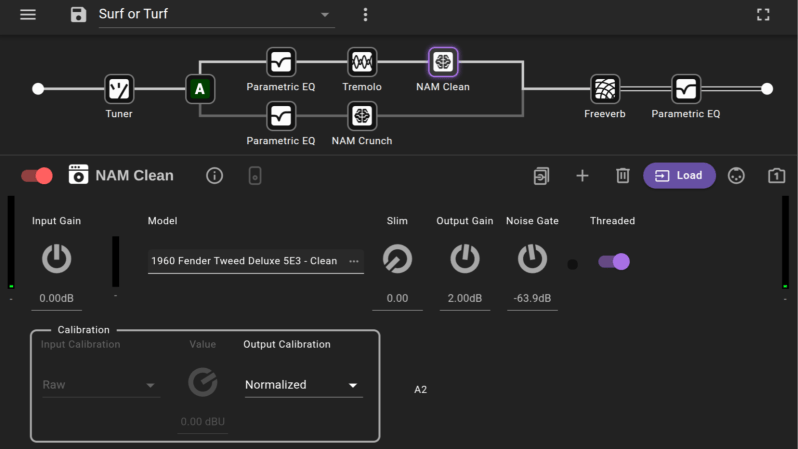
Back in the day, if one wanted a particular guitar effect one would purchase an effects pedal or “stomp box”, and even a modest collection of them could be an eye-watering investment. A guitar amp chosen for a specific sound could be another huge purchase (and who stops at one?) But if you’ve got a Raspberry Pi kicking around and a bit of free time, PiPedal provides configurable effects, guitar amp emulation, and more.
Things have come a long way in terms of audio processing, and PiPedal is no straightforward application of simple digital filters. We indirectly learned about it from a fellow who used it to experiment with a range of equipment he could in no reality actually afford. He shared his experience in a blog post that left him thinking he might as well sell all his pedals and build the stomp box of his dreams around PiPedal.
PiPedal’s impressive audio engine runs on a Raspberry Pi (or comparable single-board Linux computer) with control and configuration accessed from a mobile device or web browser. It’s expressly designed to seamlessly work whether one is at home, on stage, or in a studio.
The GitHub repository has code and documentation, so check it out. And if you use it as the basis of a project of your own, don’t keep it to yourself! Drop us a note on the tips line because we absolutely want to know all about it.











Linux audio is a particular weak point.. kudos to this creator for wrangling it, I know from experience it ain’t exactly easy.
This is a great tool, you can do a lot with virtual instruments on a desktop, but sometimes a desktop is a very inconveniently-shaped tool for doing what you want to do.. and what you really need is a little box you can stomp on
Not my experience at all, Pipewire + relatively unpopular Lexicon Omega interface work perfectly out of the box and on a distro not specially optimized for audio related work.
Were you using ALSA or Pipewire?
Awesome, awesome, awesome!!! Thank You Mr Robin Davies :)
Nice project, though it’ll be a tough sell to anyone not already owning a pi 4/5, you can get perfectly capable virtual amps for less than $100 nowadays.
However my biggest concern is how you should handle this pi to survive the average guitar player. You could put it in a strong enough box to survive the physical abuse but the SD card will still not like the common practice of unplugging everything after the gig, which makes it hard to rely on a device like this.
on my SD-based systems, i mount the SD read-only. so it can’t kill the SD with logging etc, and it can’t corrupt it on power out. i don’t see why pipedal would need read-write SD. if it wants to save state, it can save it in its own partition so at most it only corrupts its own settings.
Because this one goes to eleven.
don’t toch it, don’t even look at it!
I have a pi stomp pedal. It does what it’s designed to do but I find that the sound is inferior to some of the more expensive pedals I own. Compared to my boss gt1000 core, the pi stomp is noisy and is not nearly as polished sounding. I’m hoping that this project overcomes those problems. I’ll be waiting to see if this one works a little better. 🤞
It’s because you’re missing the warm sound of valves.
one of the nice things of discrete pedals is not having to wait to boot the damn things.
Promise you’ll perform the hell out of this.
What’s the latency though? Back when I had a PC that ran at uhhhh 300 mhz (slow even then, in 2005), the latency made it unplayable if I added too many effects when using jesusonic.
Iirc it was a Reaper plugin or something. Someone made a dedicated PC for it .
https://www.reddit.com/r/Reaper/comments/1ly27rx/rare_picture_of_justin_with_the_crusfx_his_own/
https://web.archive.org/web/20200226063630/http://cockos.com/jesusonic/
Shoulda just gotten all the Radium cracked Steinberg stuff back then pal.
I’ve been disappointed with NAM modelling, it’s definitely not as good as fractal modelling or even my Headrush gigboard. There’s no dynamics – if you roll off the volume it is still overdriven.