
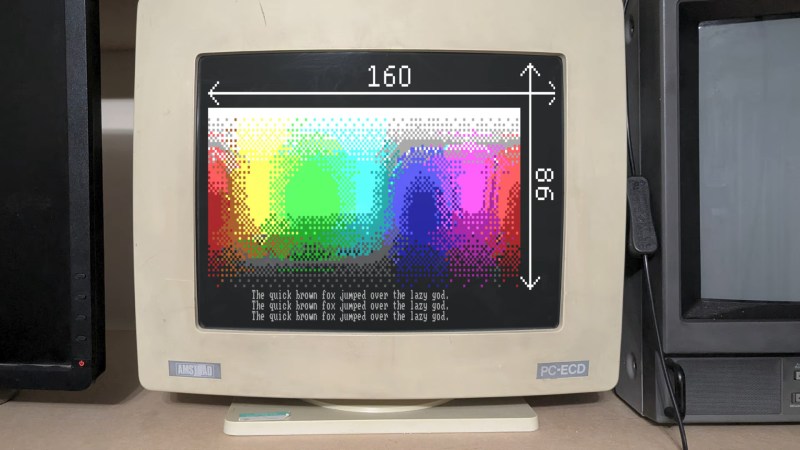
Flash is obsolete and the IBM 5150 is obsolete. Therefore, by the transitive property of algebra, you should be able to run flash games on IBM’s original PC, right? Okay, obviously not — there’s obsolete, and then there’s obsolete — but that didn’t stop [TheRasteri] from trying to bring his favorite scatological humor game to glorious CGA in a slightly not-safe-for-work video.
CGA is really not meant to display the fine details of a 2000s flash game, but [TheRasteri] has some experience with the Amstrad CPC and its demoscene, where they’ve learned to hack the heck out of the same MC6845 CRT controller chip that lives on a CGA card. With a few lines of carefully-crafted assembler, he’s able to swap character height on the fly to create the equivalent of a 160 x 86 pixel window in CGA text mode. That’s probably the most impressive part of this build, but the adventure of vintage-DOS C development on display here is worth watching. He’s using Open Watcom V2 and coding the entire thing as a huge state machine, and tests it on a wide range of DOS machines to catch all the bugs.
While Adobe Flash once enabled a golden age of browser games, we could be on the verge of another thanks to WebAssembly. If you want to hear about programming in C on DOS, we’ve seen a good case made for it.









With the other posters on hackaday enjoying retro computing so much, it feels blasphemous to say but I kinda don’t care much for retro computers. They’re alright to me as a curiosity, quite fun to learn about their weird and wacky design (usually to get around some interesting technical problem of the time), but I wouldn’t use them at all, if I could help it.
My main PC until 2015 was a Pentium 4 with 1GB RAM. It was slow and I had to block all JavaScript just to be able to browse the internet, using a Firefox fork called Palemoon which was known for its decent performance on older hardware. I used Lubuntu (the old LXDE one, not the new heavy LXQT one), and everything was still painfully slow. It taught me to be resourceful, but it wasn’t until I moved on to a modern (comparatively modern, 4th gen i3 with 4GB RAM) system that I realised what I had been missing out on.
yeah i’m old eough to have used a 5150 and i was so glad to leave those constraints behind. i don’t miss the old hardware…instead, i miss my own youth :)
Hi, the 5150 was so cruel – you have to explore the wonderful world of “Turbo XTs” then! 😃
Though a hot-rod 5150 can be fun, too.
If it has EGA/VGA or 8514/A (say ATI Mach8), XTIDE, mouse,
AdLib or Sound Blaster or Game Blaster or Tandy 3-Voice card,
Covox SpeechThing, an EMS board and some UMB card, maybe an NE2000 NIC..
A NEC V20 or CPU accelerator is helpful, too. The PC-Sprint is from the mid 80s, even!
https://github.com/reeshub/pc-sprint
MS-DOS 5+ is recommended, it was still common in Turbo XT era.
Die-hards might be into DOS 3.3x, DOS Plus, DR-DOS also..
Or PC-MOS, Wendin DOS, Minix, Xenix.. Or that brand new OS8088 that does.. things.
But yeah, who ever had the “pleasure” to operate an IBM PC in original condition learns to really love an IBM PC/AT! 🙂❤️
An unexpanded IBM 5150 is nice playing ancient PC booters and
pre-1985 games written for IBM CGA card over composite video output.
An Amiga or C64 video monitor (NTSC) is ideal for playing those classics.
Composite CGA is visually like Apple II graphics. It has that, um, organic feel to it.
It’s not everyone’s cup of tea, but I’m glad the retro scene is still strong. Of course it’s all just youth sentiment for a craft that doesn’t exist anymore.
Hm. Personally, I wouldn’t say that. I’m optimistic. 🙂
In the early 2000s, many 2D retro games were in still fasion/again in fashion (I’ve found Cave Story at caiman.us for example).
Point&click games and the Sonic games made in Klik&Play IDE and later versions (Multimedia Fusion) also come to mind.
Or RPG maker gamers. They were exchanged at the school yards on CDs..
Deponia, that commercial title from the 2010s comes to mind, too.
And nowadays, many indie games in pixel art style are currently on itch.io site
and some do run on vintage hardware, even (have seen many GB ROMs).
So I tend to think the 2D pixel art stuff never had died out.
It rather always remained there, just less in public.
Some “retro games” were invisible to “PC master race” and “consoleros” because they were played by “casual gamers”, rather.
Those gamers who played the fun stuff on cover CDs in computer magazines, rather.
They had been stuffed with the whole Windows “essentials” (Winamp, Irfanview, VB and .NET runtimes, WMP) and many freeware stuff.
Such as old DOS games, Win32 desktop games, Flash games, MIDI files etc.
So personally, I think young people are just naturally being interested in vintage technology, too.
For various reasons. Curiosity being a strong one, but also the family.
Many parents and older siblings introduce them to the pop culture and technology of their own youth.
The NES and original GameBoy, for example, are being universally known by almost all gamers who deserve that title.
Because they’re the origin platforms of so many franchises still being current.
In addition, virtual consoles (such as former Wii version) and compilations do introduce the youth on a regular base to the classics.
I can’t even count how many times the Sonic games for the Sega Genesis/MD and Sega GameGear had been available on GBA, DS, XBox/XBox360/XBox One, Wii/Wii U, PS2/3/4..
And one day, these kids will get interested in seeing the original hardware or owning a replica, a clone console. 😃
Things like FC Twin or the many “mini” consoles (emulator boxes).
Classic Famiclones are still being made, now with HDMI converters built-in.
So I’m not worried about “our legacy” being forgotten anytime soon.
There are so many interesting games on each vintage platform..
Especially C64 and DOS platform have a huge library.
The Amiga, MSX and PC-98, too, of course.
Fan translations also help to introduce them to a wider audience.
Heck, [Rasteri] is a big retrocomputing nerd and even he ends this video with a hearty “never doing that again!”
Different strokes for different folks and all that.
I don’t think anyone daily drives a retro-computer. I personally find that diving into and working with that old tech is a great opportunity for learning core fundamentals of computing on platforms that are far simpler to wrap my head around. And it is always great fun to see just how far you can push a platform that was clearly not made to do some of the things people are making them do. Sort of like this project.
Likely not, but interestingly it’s more feasible than ever. 🙂
There are new web browsers such as MicroWeb 2 that run on 16-Bit PCs.
Though purists might prefer Links, Lynx or Minuet for browsing/doing e-mail in text-mode.
PC GEOS also became open source and has two web browsers, Skipper and WebMagick.
GEOS is comparable to Windows 3.0 or GEM in terms of appearance.
In the 2000s, GEM also had gotten a web browser, GEMWeb (unfinished).
Windows 3.0 (and 3.1 beta) still supported Real-Mode and there was a third-party TCP/IP network suite called “N.E.W.T.”.
Running out of memory might be an issue, though. Expanded Memory can help here.
In worst case, without extra hardware (Lo-Tech 2MB EMS card etc),
a LIMulator software can be used that uses a swap file on Fixed-Disk as a RAM substitute (Turbo EMS, Above DISC etc).
There are also projects such as DreamPi that simulate an ISP,
so old game consoles and set-top boxes can access the internet via dial-up again.
Proxy servers for vintage PCs also exist.
There are helpful sites such as frogfind.com, frogfind.de, wiby.me or theoldnet.com.
Gaming wise, win16.page lists Win 3.0 games that run in Real-Mode on 8088 PCs.
Though Hercules or EGA/VGA hardware really is recommended.
Or something else with at least ~350 lines. Say, Olivetti M24 graphics.
Olivetti/AT&T graphics uses 640×400 mono and was also known in Japan as “DCGA” because of the Toshiba J-3100 laptop.
DOSBox-X uses DCGA for Japanese support.
https://dosbox-x.com/wiki/Guide%3AVideo-card-support-in-DOSBox%E2%80%90X#_dcga