
Finger Joint Cutter Uses A Jigsaw Blade, But Not As We Know It

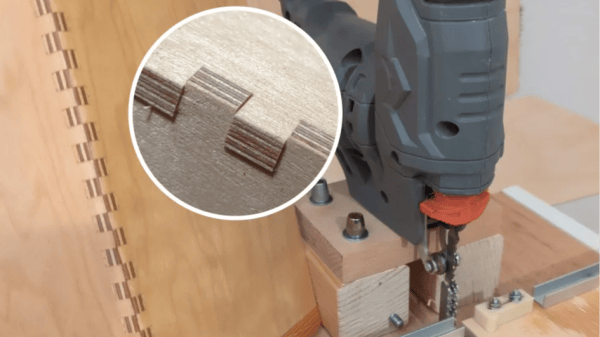
Around these parts, finger joints (or box joints) are usually the product of laser cutting. [bluesyann] shows us a method of using a stationary jigsaw, a custom blade, and 3D-printed jig to create a DIY box joint cutter whose results look impressive. What’s appealing is not just the end result, but the fact that the whole system is made from little more than an inexpensive tool, scrap wood, and common hardware.
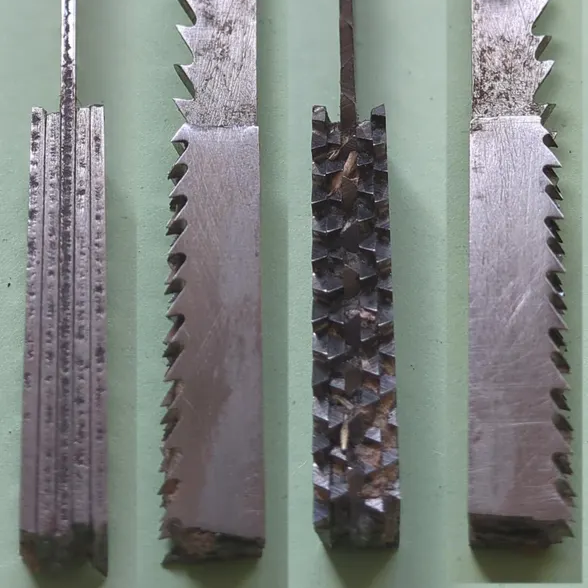
A DIY wide blade cuts each notch in a single go.

In [bluesyann]’s system, the jigsaw is fixed in place to make a stationary cutter. The saw itself is nothing special; it’s the wide blade that makes the difference. It cuts a notch in a single go, and it’s made by epoxying together multiple blades to make a single extra-wide one. Jigsaw blades are not expensive, and they’re easy to snap into pieces. By using a total of three blades (snapping two of them into pieces) one can create the wide version shown here.

With a stationary jigsaw sporting an extra-wide blade that cuts the same notch every time, all that remains is a way to get the spacing right. The solution there is a 3D-printed jig that each freshly-cut notch fits onto as the next one is cut.

There are a few other details, but those are the important bits. One does have to do a bit of trial and error to get things dialed in, but once they are, it’s off to the races.

If one prefers a less hands-on method of cutting box joints, check out this robotic table saw which automates the process.

Porting A “Crappy” Flash Game To The IBM 5150 And Beyond

Flash is obsolete and the IBM 5150 is obsolete. Therefore, by the transitive property of algebra, you should be able to run flash games on IBM’s original PC, right? Okay, obviously not — there’s obsolete, and then there’s obsolete — but that didn’t stop [TheRasteri] from trying to bring his favorite scatological humor game to glorious CGA in a slightly not-safe-for-work video.

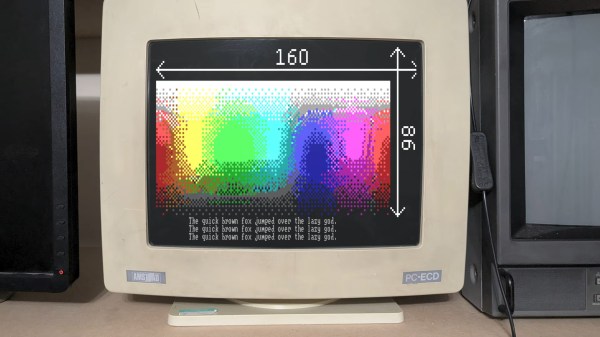
CGA is really not meant to display the fine details of a 2000s flash game, but [TheRasteri] has some experience with the Amstrad CPC and its demoscene, where they’ve learned to hack the heck out of the same MC6845 CRT controller chip that lives on a CGA card. With a few lines of carefully-crafted assembler, he’s able to swap character height on the fly to create the equivalent of a 160 x 86 pixel window in CGA text mode. That’s probably the most impressive part of this build, but the adventure of vintage-DOS C development on display here is worth watching. He’s using Open Watcom V2 and coding the entire thing as a huge state machine, and tests it on a wide range of DOS machines to catch all the bugs.

While Adobe Flash once enabled a golden age of browser games, we could be on the verge of another thanks to WebAssembly. If you want to hear about programming in C on DOS, we’ve seen a good case made for it.

Continue reading “Porting A “Crappy” Flash Game To The IBM 5150 And Beyond” →








