
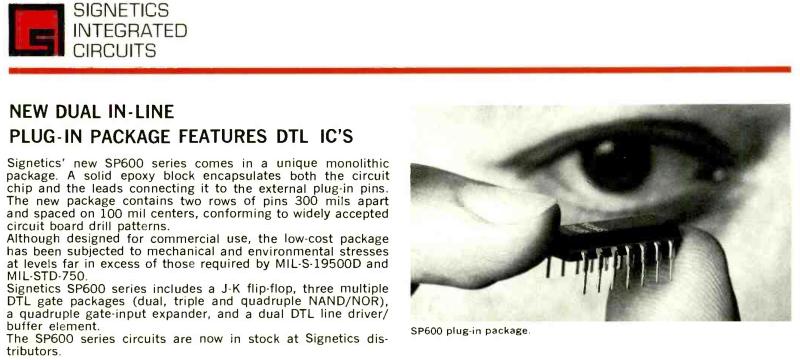
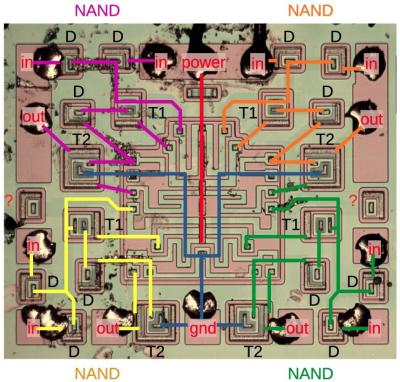
Before transistor-transistor logic (TTL) took over, diode-transistor logic (DTL) was a common sight especially in pre-IC circuits where it was a major improvement over resistor-transistor logic (RTL). That said, it’s rare to see DTL used in ICs considering how e.g. TI’s 5400 and 7400 series set the trend in the 1960s. This makes the Signetics ST680a quad-NAND gate DTL DIP IC that [Ken Shirriff] ogled recently a bit of a treat.
This was also one of the earliest ICs to use the then brand new plastic dual in-line package (PDIP) for modular convenience, even if [Ken] was none too happy about as unlike ceramic DIP, PDIP requires more extreme methods to decap to access the die for reverse-engineering.
Overall, TTL is faster and less power-hungry than DTL, but it took a while to work out its issues, including noise immunity and fan-in/out issues. Until then alternatives like DTL still made sense as a well-understood and mature technology. In the article an example is provided of how a DTL NAND gate as used in this IC works, which is really quite simple in how it uses multiple diodes to sum the inputs, which subsequently drives the transistors.
We’d like to thank [CuriousMarc] for finding this IC in his strategic reserve of unknown ICs and for doing the initial decapping using hot air, as well as [Ken] for doing the analysis and documenting of this fascinating glimpse into early semiconductor logic history.












Please be kind and respectful to help make the comments section excellent. (Comment Policy)