
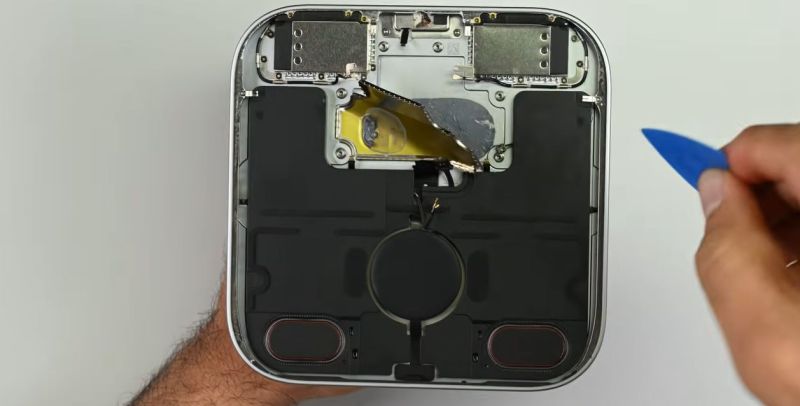
Over the past years there have been hopeful noises about Apple devices becoming easier to service and repair, but as [iFixit] found with their teardown of the new HomeView devices, such optimism may be premature. In this teardown they found that extremely strong adhesive is used for the display, as well as to keep the speakers in place.
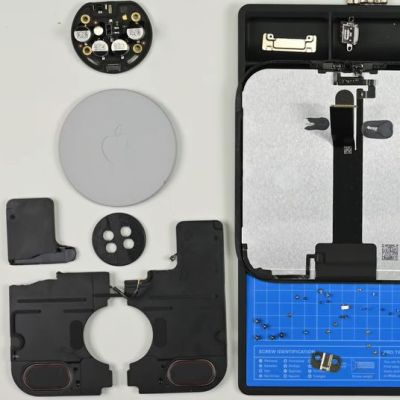
Even worse is that the mainboard’s back metal can is effectively glued in place with thermal compound, and the speaker connectors on the mainboard pretty much disintegrate if you try to unplug them, even after trying to scrape off the glue on them.
All of this leads to a pretty miserable teardown experience, with the display removal probably being the easiest part. Even plentiful IPA application and careful prying cannot save one of the big speaker modules, with both their connectors mauled as well.
The rear metal can of the mainboard is left in place, probably requiring liberal dousing in IPA or stronger solvents to loosen up first, as well as borderline inaccessible screws, and the subwoofer in the base is basically impossible to plug back into place after disassembly. Looking at the wall-mounted version of the HomeView, things do not get much better, but it omits the subwoofer and screw issues of the base version.
Overall this seems like the kind of device that’s somewhat repairable if you go in armed with all this knowledge that [iFixit] sacrificed a HomeView for, but it’s disappointing to see such a repair nightmare in 2026. Interestingly, this device is not available in the EU, purportedly due to the privacy nightmare that is the Siri AI feature, but it may run afoul of some right-to-repair regulations too, or at the very least get assigned a very low score.












You cannot have slick/compact/high end design which is also repairable..
Framework strikes a nice balance, in my opinion.
Are you serious? We had that design sinds we started making things. Braun in the 70’s had dieter rams, the inspiration for many years of Apple design and that was very repairable. And that is just one example.
Slick/compact/high end design can also be repairable. It just requires actual thinking and not just glue everything together. For your comment on of all places, hackaday you should be banned to an outer planet.
Screws and such can either be hidden, replaced by smartly placed clips and whatnot or just made part of the design. You can make them of many materials, give them many shapes and can add so many different thing to beautify them.
The materials technologies and low levels of integration in the 70’s hardware meant that those designs were repairable by default. When everything was made out of stamped steel and discrete components, covered in a big painted plywood box, someone could bang out spare parts to a cassette deck at home with a hammer and a file.
https://sgustokdesign.com/dieter-rams-braun-rt-20
You had me until the words cassette deck. Who was making all those tiny little gears and springs with a hammer and a file?
Not a hammer perhaps, but definitely a file. Springs? Easy, just twist some soft spring wire around a mandrel, make the necessary twists and bends with needle nose pliers, heat and quench.
There are much finer things made entirely by hand without even 1970’s level of tools and technology, such as mechanical watches. The point is, if you really needed a spare part for a 1970’s radio or a cassette player, there were no parts that you couldn’t manufacture yourself if you wanted to. That’s because those parts were hand-made in factories by people in the first place. With the help of machinery of course, but all in all something you could replicate in a garage or a small workshop. That’s how people still keep fixing those things.
Lol, no you can. And if you *have* to sacrifice 1 mm for it, so what?
yes you can
You watched that video where Apple makes this claim, didn’t you? Repeating advertisements as fact does not make you correct.
not with that attitude you can’t
“You cannot have slick/compact/high end design which is also repairable..”
Probably true. But only because people let salespeople from the same companies that benefit from the buy, e-waste, buy again cycle tell them what is slick and what is high end.
Compact? It would be hard to make the paper-thin crap that is all the rage today repairable but one can make things plenty compact enough to be practical with screws, modular design and high repairability.
What does the “actively” in this page’s title mean? Does it mean “very“? I keep hearing the word and it seems to serve as a filler word or a crutch word.
The opposite would be “passively”. Think of a locked door, versus the bouncer outside a bar. The door just sits there, passively keeping people out. The bouncer can move to get between people and the door, actively keeping them out, despite their best attempts.
Inanimate objects aren’t active in this regard.
True – but the folks who designed and made the inanimate objects in question certainly ARE “active in this regard”. And they very, very actively ‘encourage’ replacement over repair.
They can be, if there’s a trap in the design that springs to break stuff when you try to repair things.
I interpreted it as Apple resists repairs by choice, as opposed to just unintentionally making a device that is difficult to repair. It’s the difference between “repairs are difficult because of the device itself” vs “repairs are difficult because of Apple’s chose to add difficulty.” Actively puts the focus on the responsible party rather than on the device itself.
The word seems fitting to me. Apple isn’t a newbie in this game, and they shouldn’t be given the benefit of the doubt.
When I read “actively” I pictured explosives or other booby traps in the device… Which there effectively are.
And yet there is no evidence provided that correlates except an awkward design of a device that isn’t likely to be ever repaired or upgraded
It translates to “by intent”.
actively = overtly intentionally
at least in this context
I did wonder if there were something about it that was actively anti-tamper. For example I would consider a switch that wipes the eeproms when the case is removed to be an active system. Animate vs inanimate is not a part of whether a system is active or passive. In this context and after having read the entirety of the article I’d say that either it is being used figuratively to imply that it feels like Apple is trying to prevent repairs on purpose, or as an exaggeration to illustrate just how difficult it is to repair one of these devices.
Who buys Apple devices and expects them to be repairable? It’s the exact opposite of their walled garden community turnkey solutions target group approach.
They do at least sell some parts and provide proper tools for repairing some of their devices now, whether anyone likes it or not. they are doing more than other manufacturers in that regard. so the precedent has been set…
You’re talking as if Apple was the trailblazer here instead of dragging their feet behind everyone else.
The interesting bit is that other manufacturers like Samsung get mixed repairability scores. Samsung for example gets 60-70 points out of 100 for the A series, but 40-50 for the most expensive flagship models, which is on par with Apple. The top end of the market is aimed at people who have more money than sense, and making unfixable phones is part of that strategy.
I basically agree with you, and it’s why I haven’t bought an Apple product since the iPhone 3GS. They’re overpriced timebombs that explode into trash. You’re just renting the device for a whole lot of money, then you throw it away when the support window is up. Then since you’ve got everything saved on their system, and you have software that only runs on their system, you have to buy another one so you don’t lose access to your data or your investment.
I saw that trap early on. I’ve had various maker’s phones since then and I still have and have always used all my Android apps. They run on every device I buy or build. Which makes me wonder if I could convince Apple hardware to run Android the same way you can install Linux on Apple pc hardware (obviously with a whole lot of trouble). That would be interesting. Then you could also ignore the parts that refuse to work when they’re replaced like the home button on older iPads.
The EU and even the US moved to enforcing it somewhat.
But of course with current AI Siri not being EU compliant those Homeview devices are a truly bit of a waste of money for EU users, so Apple can ignore the EU market for them.