
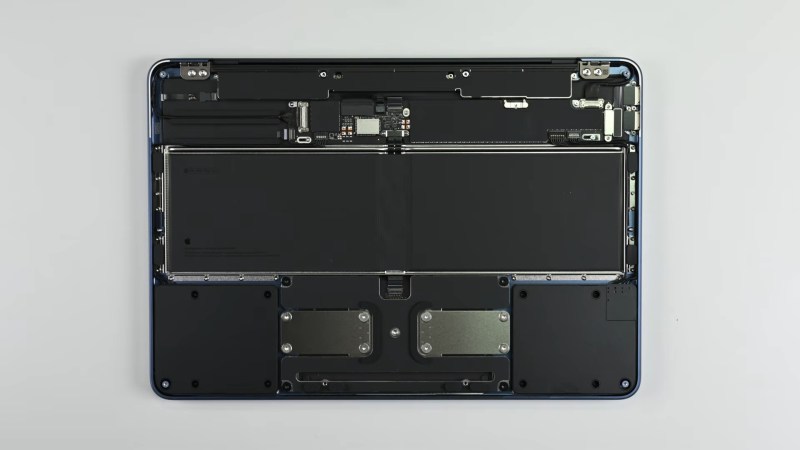
The common narrative around device design is that you can have repairability or a low price, but that they are inversely proportional to each other. Apple’s new budget MacBook Neo seems to attempt a bit of both.
Brittle snap-fit enclosures or glue can make a device pop together quickly during manufacture, but are a headache when it comes time to repair or hack it. Our friends at iFixit tore down the Neo and found it to be the most repairable MacBook since the 2012 unibody model. A screwed in battery, and modules for many of the individual components including the USB ports and headphone jack make it fairly simple to replace individual components. Most of those components are even accessible as soon as you pop the bottom cover instead of requiring major surgery.
As someone who has done a keyboard replacement on a 2010 MacBook, the 41 screws holding the keyboard in brought back (bad) memories. While this is a great improvement over Apple’s notoriously painful repair processes, we’re still only looking at an overall 6/10 score from iFixit versus a 10/10 from Framework or Lenovo.
The real story here is that these improvements from Apple were spurred by Right-to-Repair developments, particularly in the EU, that were the result of pressure from hackers like you.
If you want to push a Neo even further, how about water cooling it? If you’d rather have user-upgradeable RAM and storage too in a Mac, you’ve got to go a bit older.












That’s the first mac I’d consider buying tbh… definitely not for me but if someone really wants to get into that ecosystem…
Or it was necessary because the motherboard is from a Cellphone 🤷🏼♂️
Also here to point out that Apple has a tablet with a laptop/desktop processor, and now a laptop with a Cellphone processor.
And Valve is still going to beat them to x86 gaming on an ARM, what a wacky time to live. The M1 or M2 (or M3 or M4) would have been a great time to make their products play PC games, as it is arguably a contender for graphics processing power (and has Vulkan?). But hey, maybe with the M5. Also crazy considering they literally needed a translation layer when they switched from Intel to their own silicon, so they aren’t completely oblivious to the concept. But I guess the money is spent on . . . VR development?
They don’t want x86 games on their platform, nor do they want Vulkan. They want ARM native games using Metal.
Haha, Lenovo is well known for repairability sonce before Framework, so this is more of a return to form for them.
Why HP and Dell still refuse to make their commercial grade laptops repairable is beyond me. It’s not just the design, Dell is notorious for confusing naming schemes and completely different and incompatible wiring and connectors among different specifications of the same laptop.
Lenovo however will give you part numbers for free online, not even a sign-in required and is famously cross compatible.
I sometimes get myself into confusing situations where I have swapped a Gen6 laptop for a Gen8 lid, and one is a faster 4 core with slower DDR4 while the other is a one-year 6 core with lower latency DDR3. But unlike Dell I usually always wind up with a functional laptop.
I like passively cooled performant laptops and this is as far as I know the best one available today. I just wish it ran Linux not Mac OS so docker could run without VM overhead. I hope this gets Asahi Linux one day.
I am holding out for an M7 Mac under the jackboot of European repairability mandates