
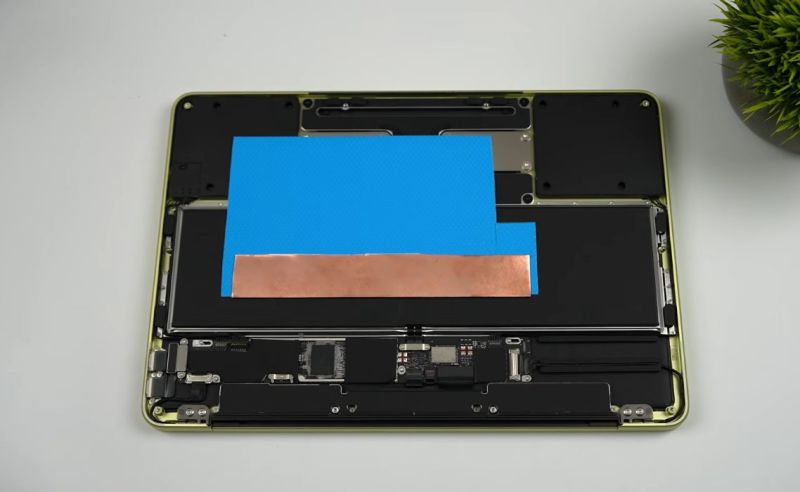
Recently [ETA Prime] felt a bit underwhelmed by the raw performance of his MacBook Neo when it came to running for extended periods under full load, such as when gaming. Thus the obvious solution is to mildly over-engineer a cooling solution that takes care of issues like thermal throttling.
The Apple MacBook Neo with its repurposed iPhone 16 SoC seems to have leaned hard into answering the question whether a smartphone can be a good general purpose personal computer. Ignoring the lack of I/O, it’s overall not a bad SoC for a laptop, but like when you try to push the CPU and GPU on a smartphone, they do get pretty toasty. Due to the minimalistic cooling solution in the MacBook Neo it’ll easily hit the 105°C thermal throttle limit.
Technically the ‘heatsink’ for this laptop is the aluminium case, as the SoC is coupled via a thermal pad to the case. This doesn’t leave a lot of space and the case will heat soak pretty fast, while also making retrofitting a cooling solution a challenge.
 Amusingly, replacing the existing thermal pad with a thin copper plate already massively reduced the thermal throttling of the A18 Pro SoC by about 20 degrees. In Geekbench 6 this bumped multi-core scores up by 9.7% and single-core by 15.2%. Definitely a promising glimpse at how much performance could still be extracted from this SoC.
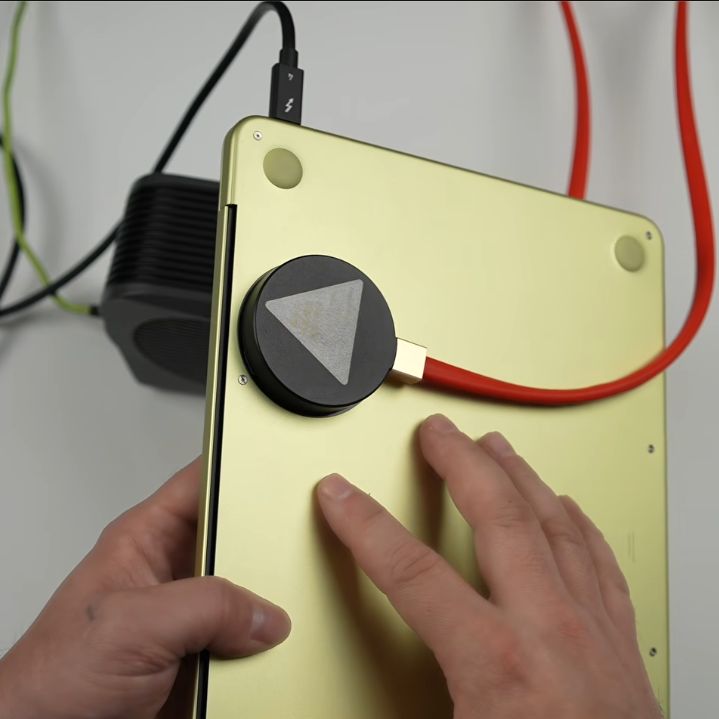
For the next step a thermo-electric cooler (TEC) with built-in water cooling loop was used, which happened to be one of those overkill smartphone cooling systems that you’d stick to the back of the phone. Here the cooler was attached similarly, directly to the bottom aluminium of the case.
With this solution in place Geekbench 6 results mostly showed a solid bump for single-core results, while multi-core results showed diminishing returns. For Cinebench results this gave a 19% increase over stock cooling in multi-core and 23.5% for single-core.
Perhaps most interesting of all was that playing a video game for a while without thermal throttling meant framerates of over 80 FPS instead of hitting that thermal wall with 30 FPS. This shows just how much performance is left on the table due to the cooling choices for the system, even with this still rather inefficient cooling solution.
That said, this probably isn’t some kind of nefarious scheme by Apple, but rather the result of designing the thermal solution to not heat the case up to temperatures that are deemed to be unsafe or uncomfortable for the user. After all, if the case is the heatsink, then you don’t want to feel like you’re literally handling one. This is sadly the compromise when venting out hot air is deemed to be an unacceptable solution.












“Technically the ‘heatsink’ for this laptop is the aluminium case, as the SoC is coupled via a thermal pad to the case.”
I believe this is incorrect and the bulk of the reason for the throttling. Apple has a heat spreader on top of the A18 but this does not couple to the case in stock form. Many youtubers have been adding a 1mm thermal pad to couple to the bottom of the case and that helps massively. Why Apple did not do this from the factory is a mystery to me, perhaps a manufacturing tolerance thing? Or to avoid the bottom plate bowing a little?
To sell the next iteration with improved performance.
Real reason is almost certainly decide skin temperature.
No, you numpty. If the case is directly contacting the motherboard, what do you think will happen when someone bonks the bottom of the laptop on their knee or something on their desk?
Answer: the motherboard gets damaged. And then people like you screech about how fragile “overpriced” Macs are.
iirc apple tries to prevent the chassis of a MacBook from getting hot, there are sensors specifically for this on some macbooks, like in the palm rest and bottom case
Yup, believe there are laws about this, and there’s certainly been lawsuits against some laptop manufacturers.
And I believe the lack of forced ventilation (fans) is a deliberate choice to avoid moving parts which are always the first thing to break. And few people think slow laptop = broken fan.
It might have posed a worse outcome for drop tests. Physically coupling chips directly to cases seems like it could have draw backs.
That said adding water cooling seems a little wild to me. I am not shunning the project nerd on. 20% performance increases go brrr. I bet an aluminum laptop stand would probably be real close to enough. Or a stand with some fans.
He’s only using a water cooled solution as that’s the easiest way to cool the chip in it’s current manufactured form. If the laptop actually has some cooler, a basic copper heatsink would do everything.
No it’s not the easiest way. It doesn’t even sit flush.
The easiest way is rubbish the neo on top of a llano V12 ultra. That fan will dump cold air in the aluminium case for hard gaming. So do the thermalpad to base of case mod and run it on that for “gaming”
And you can still be portable for other day to day activities otherwise get a M4 mini
I think the real reason Apple doesn’t couple the CPU to the bottom is a 105°C aluminum plate on my lap doesn’t sound like a good time.. Why it can’t be 2-5mm thicker and have a fan inside is crazy. Even more so when there is that solid state tech from Frore Systems.
Although this is sold as an entry level product, so not too surprising.
Fan = moving parts, which is a significant early failure point. These been the first thing to fail on every laptop I’ve owned – even before I had dog hair filling the house.
Interesting. I’ve never had a laptop fan fail.
Device surface temperature.
Passive cooled laptops get hot enough already on their surfaces. There are limits to how high you can go before you get burnt.
The margin is amazingly small. Like 45c will feel instantly painful, but 42c can also burn over the span of hours.
If a device also has to operate in 30c summer there is a limit on what you can do.
People smacking some pads on for giggles is great, but its not testing surface temps, ambient temperature variations, etc..
The Neo is built to a price. You cannot have it both ways. But you can improve its’ performance by these type of mods.
fans are not expensive. there was a deliberate aesthetic choice to make the device fanless.
would have been interesting to see what you could get with eg. one of those ultra-slim netbook fans+heatsinks.
Fan are also noisy, eat battery, allow for dust and water ingress etc.
Fanless is something many folks would want, and in this case I’d suggest the right move, the only question is if the base plate being coupled with a thermal pad is capable of raising the device skin temperature at that contact point too high for us pesky humans, as that is a corner Apple might have cut that would vastly improve sustained performance. But I’d suggest doing that will let the laptop get too hot in some situations – I think you’d also need to add some ‘fins’ to the bottom so even when its sat on something there is some room for some air currents or something similar.
A thermal pad isn’t much costs. It’s purposely left like that to safeguard apple from lawsuits as people have a suing culture in some parts of the world and because why would you want to up the performance to complete with your other devices? You want to limit it on purpose and you want to then make small improvements in neo2
How much power does that subzero peltier water cooler use?
I bet it’s more than the laptop by a fair bit :D
But now I need to build one of those, I totally have reasons to superchill my phone for gaming…
Or… Do what mryeester did and just put thermal paste between the case and the cpu.