
We’ve all seen these sensors and modules kicking around, as part of beginner kits, strapped into prototypes and potentially even in products deployed in the field. Yet as [John Teel] rightfully points out in a recent video, most of these have no business ever being used in a real product, and might not even be suitable for prototyping.
First up is a combination of the related DHT11 and DHT22 temperature-humidity sensors. As common as these are, they’re also pretty sketchy with their proprietary one-wire protocol and at most questionable accuracy, worsened by not having a good supply chain. The replacements are plentiful: the SHT40 and SHT41, the Bosch Sensortec BME280 or BMP180, as well as TI’s HDC3020. These get you standard I2C communication and a supply chain plus a datasheet you can trust.
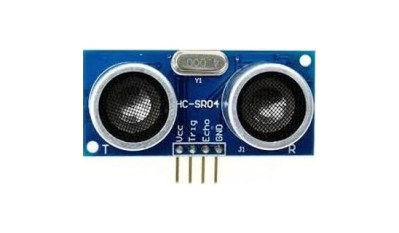
Second is the HC-SR04 ultrasonic distance sensor. Although fine for prototyping, it’s a 5 V module, lacks temperature compensation and other features that’d be needed outside a temperature-controlled room. Here ST’s VL53 Time-of-Flight sensors are a good alternative, containing a range of sensors of which we covered the fancier VL53L5CX previously for 3D scanning a room. Of course, you can also use reflective IR as a good cheap alternative.
Third is the HC-SR501 passive infrared (PIR) motion module. This one is also fine for PIR and motion sensing prototyping, but is too inconsistent and power-hungry for production. Instead you can get much better and much smaller PIR modules, like the Panasonic EKMC and EKMB, or the ST STHS34 IR motion and presence sensor.
Fourth takes a swing at all the MQ-series of gas sensors. These generally feature a heater that consumes a lot of power, require a long burn-in period and need calibration using a reference gas to be useful. In a safety-first environment you’d thus use a sensor from a reputable manufacturer with a datasheet and some level of calibration.
Fifth is the MPU-6050 IMU, which probably comes as a surprise to many, as it generally seems to just work well. The main issue here is something that is common for a lot of common non-sensor chips as well, like the still very common UDA1334A I2S codec that hasn’t been manufactured by NXP for ages, but is still found everywhere. If you want to design a product that can be easily manufactured, you have to pick an IMU here that is actively being manufactured by a reputable manufacturer.
You also have to actively avoid anything that’s marked as ‘Not Recommended for New Designs’ (NRND) unless you love supply surprises during production. For IMUs you end up with something like the Bosch BMI270 or TDK’s ICM-42688, albeit for more money, but with better specifications.
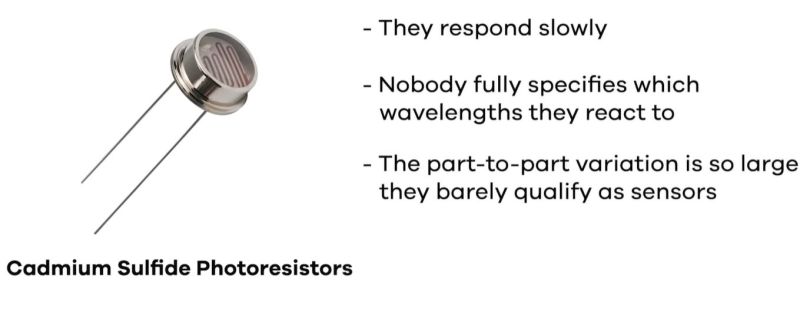
Sixth sensor are cadmium sulfide photoresistors (LDRs). Although this is a very simple light-dependent resistor part, they fall afoul of the EU’s RoHS regulations due to the presence of said cadmium. Fortunately they’re not that great anyway, so an ambient light sensor IC is a good alternative. Here the Vishay VEML7700, TI OPT3001 and Lite-On LTR-303 are recommended and provide far more features at a reasonable BOM cost.
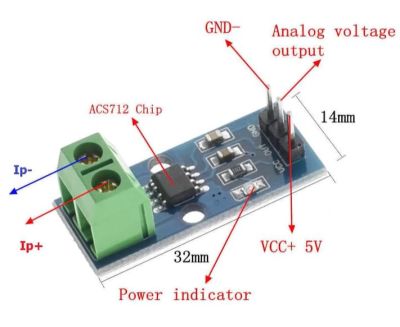
Seventh sensor and #1 on the list is the ACS712 current sensor. Specifically the mains-targeting breakout boards that are being sold everywhere. Here it’s not the IC that’s the problem, it’s that here – as also seen with various common relay boards – there has been no consideration given to basic mains power safety, such as creepage distance and general separation. The lesson here is that if you integrate mains power in your device, you do not skimp on safety with a sketchy module.









Anything involving mains power requires proper separation and is not recommended for hobbyist tinkerers, even the experienced one make many mistakes here.
Can we have a list, so I don’t have to watch the video? Kthxbye.
Actually there is a list. Clearly I didn’t even look. Thanks.
Bought an SCD40 on Aliexpress and its temperature sensor is so bad that I have to trim it every few degrees to get accurate humidity readings. This is made even worse by its command set, which requires measurements to be turned off to set the temperature correction value, because when you switch measurements back on, it takes several minutes for them to settle.
rtc: ds1307 vs. ds3231
More of these articles please, useful summary no need to watch an algorithm satisfyig video… Hackaday at its best ;-)
Yes! Ideally, could we have a common parts library including things to avoid? I feel the hurdle to find what I need for tinkering projects a bit high and to dive into each datasheet before even understanding the main needs as well, while in the other side not wanting to solely rely on breakout bords
It’s a shame about CdS cells, but I had a hard time finding them even 15 years ago. I often ended up doing hacker type stuff with them by replacing the potentiometer in a mains dimmer with them then and shining an Arduino LED at them for isolated mains light dimming. But cadmium is bad stuff. Too bad the coat most fasteners in jets with it 🫤