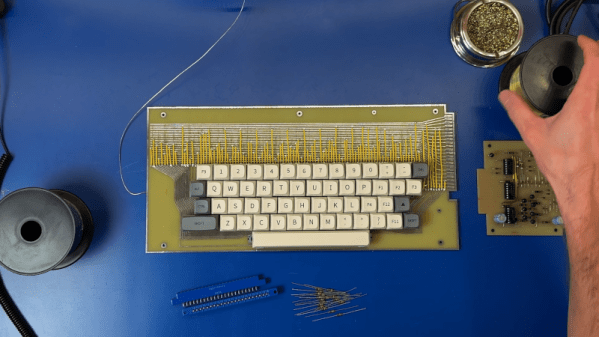
It is hard to imagine that there was a time when having a keyboard and screen readily available was a real problem for people who wanted to experiment with computers. In the 1970s, if you wanted a terminal, you might well have built a [Don Lancaster] “TV Typewriter” and the companion “low cost keyboard.” [Artem Kalinchuk] wanted to recreate this historic keyboard and, you know what? He did! Take a look at the video below.
The first task was to create a PCB from the old artwork from Radio Electronics magazine. [Artem] did the hard work but discovered that the original board expected a very specific kind of key. So, he created a variant that takes modern MX keyboard switches, which is nice. He does sell the PCBs, but you can also find the design files on GitHub.
[Kevin] doesn’t stock zener diodes anymore. Why? Because for everything he used to use zeners, he now uses TL431 bandgap voltage references. These look like zener diodes but have an extra terminal. That extra terminal allows you to set the threshold to any value you want (within specifications, of course). Have a look at the video below for an introduction to these devices and a practical circuit on a breadboard.
Inside, there’s a voltage reference, an op-amp, and a transistor, so these are tiny 3-terminal ICs. The chip powers itself from the load, so there are no separate power supply pins.
Last time we checked in on [Inkbox], he had made a 16-bit CPU in Excel. Impressive, but not really practical. Presumably, his latest project isn’t any more practical, but we suspect an 8-bit RISC CPU was easier to implement in Excel and probably runs faster, too. The new machine uses a stack architecture with a simplified instruction set of ten instructions. You can follow along with his Excel adventure in the video below.
If you think about it, you may decide that doing something like this in Excel is easy because you could just script it and use Excel as the user interface. That’s true, but that’s not how [Inkbox] does it. He won’t use scripts or IF statements in a cell. That makes things much harder.
[My Ham Radio Journey] wanted to see if a “common person” (in his words) could build an effective vertical ham radio antenna. If you look at the video below, the answer is apparently yes.
He started with a 24-foot fishing rod and a roll of 22 gauge wire. The height of the antenna wire is just over 20 feet long and he has several ground radials, as you might expect for a vertical antenna.
[Japhy Riddle] was tired of creating pixel art. He went to subpixel art. The idea is that since each color pixel is composed of three subpixels, your display is actually three times as dense as you think it is. As long as you don’t care about the colors, of course.
Is it practical? No, although it is related to the Bayer filter algorithm and font antialiasing. You can also use subpixel manipulation to hide messages in plain sight.
How do you collect a lot of data about the ionosphere? Well, you could use sounding rockets or specialized gear. Or maybe you can just conscript a huge number of cell phones. That was the approach taken by Google researchers in a recent paper in Nature.
The idea is that GPS and similar navigation satellites measure transit time of the satellite signal, but the ionosphere alters the propagation of those signals. In fact, this effect is one of the major sources of error in GPS navigation. Most receivers have an 8-parameter model of the ionosphere that reduces that error by about 50%.
However, by measuring the difference in time between signals of different frequencies, the phone can estimate the total electron current (TEC) of the ionosphere between the receiver and the satellite. This requires a dual-frequency receiver, of course.
According to the Sapir–Whorf hypothesis, our language influences how we think and experience the world. That’s easy to imagine. Certainly our symbolism of mathematics influences how we calculate. Can you imagine doing moderately complex math with Roman numerals or without zero or negative numbers? But recently I was reminded that technological media also influences our perception of reality, and I have a Hackaday post to thank for it.
The post in question was about color TV. When I was a kid, most people had black and white TVs, although there were color sets. Even if you had a color set, many shows and movies were in black and white. Back then, many people still shot black and white film in their cameras, too, for many reasons. To make matters worse, I grew up in a small town, reading books from the local library that were ten or twenty years behind the times.
At some point, I read a statistic that said that most people dream in black and white. You may find this surprising, as I’ll bet you dream in color. It turns out, how people dream may have changed over the years and still and motion photography may be the reason.
The Post
In the post, I posed a question I’ve thought about many times: Did people dream in black and white before the advent of photography? It was kind of an off-hand remark to open the post, but many people reacted to it in the comments. They seemed surprised that I would ask that because, of course, everyone dreams in color.
I asked a few people I knew who also seemed very surprised that I would assume anyone ever dreams in color. But I was sure I had been told that sometime in the past. Time to hit the Internet and find out if that was incorrect or a false memory or something else. Turns out, it was indeed something else.
A scientific paper from 2008 held the answer. It turns out that science started asking questions like this in the early 1900s. Up through the 1940s, people overwhelmingly reported dreaming in black and white, at least most of the time. Color dreams were in the minority, although not unheard of.
Then something changed. Studies that occurred in the 1960s and later, show exactly the opposite. People almost always dream in color and rarely in black and white. Of course, that correlates well with the rise of color photos, movies, and television. What’s more is, while there is no scientific evidence gathering about earlier times, there is a suspicious lack of, for example, a Shakespeare quote about “The gray world of slumber…” or anything else that would hint that the writer was dreaming in black and white.
Interpretation
Judging from the paper, it seems clear that most people agree that color media played a role in this surprising finding. What they can’t agree on is why. It does seem unlikely that your dreams really change based on your media consumption. But it is possible that your recollection changes. This is particularly true since the way researchers acquired data changed over that time period, too. But even if the data doesn’t show that you dreamed in black and white, it did show that you remembered dreaming in black and white.
For that matter, it isn’t clear that anyone understands how you experience dreams visually, anyway. It isn’t like the back of your eyelids are little movie screens. You don’t actually see anything in a dream, you only remember seeing it.
The Question
If something as simple as black-and-white movies and TV can change how we perceive dreams, you have to wonder how much tech is changing our reality experience in other ways. Do we live differently because we have cell phones? Or the Internet? Will virtual reality alter our dream lives? It would be interesting to fast-forward a century and see what historians say about our time and how strangely we perceive reality today.