Linux On Obsolete Displays

linux on obsolete displays

[bryan chafy] has been hacking away to get older non VGA displays running on VGA hardware without using a scan converter. You can pick these old grayscales up for cheap or even free. The tricky part is modifying the BIOS to reprogram the VGA card to output a sync and scanrate that is NTSC compliant. He’s managed to do this with a WYSE Winterm thin-client. Another clever trick is the poor man’s triple head display which stores a different image in each portion of the RGB signal.

Continue reading “Linux On Obsolete Displays”

X10 PIC Based RF Remote

x10 remote

[ned] received a free X10 RF remote. He popped it open to discover that the device is actually based on a PIC. By replacing the PIC with his own he’s able to issue any X10 command using the remote to any device in the system. He did spend a lot of time with a logic analyzer to try and figure out the protocol, but later found some good reference links. He hopes this will make it easier to connect his PIC projects to the X10 system since this remote doesn’t have to be plugged into the wall like the X10 serial interfaces.

Continue reading “X10 PIC Based RF Remote”

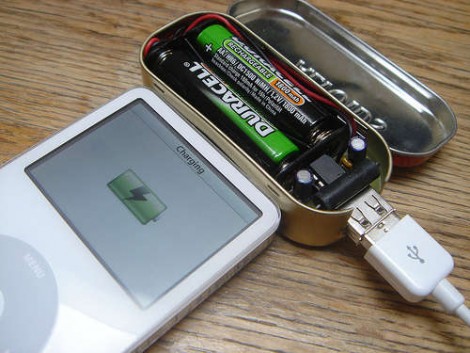
Minty Boost, AA Based USB Charger

Limor a.k.a. Ladyada has been a long standing staple in the Hack-A-Day community and we were more than happy to hear about her latest project. The Minty Boost is an improvement on the idea of building a battery powered USB charger. Most designs (including ours) use a 7805 linear regulator with a 9V battery. Even in the best case the regulator is only about 60% efficient which means you’re losing at least 1/3 of the power to heat. Limor’s design is a much more efficient boost converter design and uses far more common (and rechargeable) AA batteries. She’s got a thorough write up on how to build the converter in an Altoids gum tin. The end result is 82% efficient and can effectively double the play time of a video iPod.

The guide doesn’t end there. Limor actually wrote this as a demonstration on what goes into a making a kittable project. She covers the entire process from component selection, to mass PCB production, to what her final cost break down is. The guide is full of pictures thanks to some good planning as well. Of course the most interesting thing we learned from the guide is this: despite using the tins all the time, Limor finds the taste of Altoids gum disgusting.

[The guide is on her site, but we’re linking to the version on Instructables since we’ve managed to DDOS her site in the past… by announcing that her site was back online.]

Continue reading “Minty Boost, AA Based USB Charger”

Portable Media Center Extender

media extender

Hack247 has posted their first project: a portable media center extender. It has a wireless video sender that’s connected to an Xbox running XBMC. The receiver is housed in a box with the popular Sony PSone LCD. The box can transmit remote commands back to the Xbox for full control. It’s a nice bit of kit, but he still needs to build the battery pack.

Continue reading “Portable Media Center Extender”

ROV Capable Of Diving To 400 Feet

rov

My buddy Willy Volk at Divester has always been good about passing along stories about cool remote operated vehicles and this is no exception. A team of 8 engineering students at RIT have built an ROV capable of diving to 400 feet. Most schools design there ROVs for competition in pools, but the RIT seniors had a real-world goal: exploring shipwrecks in Lake Ontario. They built a lightweight aluminum frame and mounted batteries onboard. The ROV moves via four commercial thrusters controlled by an ATMega128. There are 3 video cameras plus HID lights. All control comes from a laptop using an RS-232 tether. More details are provided in their conference paper PDF.

Continue reading “ROV Capable Of Diving To 400 Feet”

DDR Whack-a-mole

ddr whack a mole

Drew and Calvin built this DDR whack-a-mole game for their EECS 373 class. It’s powered by a Freescale MPC823. The processor controls eight servos with pictures of their friend Malav. The game runs for 20 seconds and then reports how many Malavs you’ve stepped on. They say that the hardest part of this project was figuring out how to properly read the Playstation DDR pad.

[thanks Ano nym ous]

Continue reading “DDR Whack-a-mole”